Add the case that makes Russian sentences move: the accusative. Direct objects, the animate masculine, and the где? / куда? contrast that turns the prepositions в and на from "where" into "where to".
⏱ About 60 minutes24 phrases34 exercises
What you will learn
Recognise the accusative as the case of the direct object, and ask for it with «Кого? Что?»
Form the accusative singular of masculine, feminine and neuter nouns, including the animate masculine
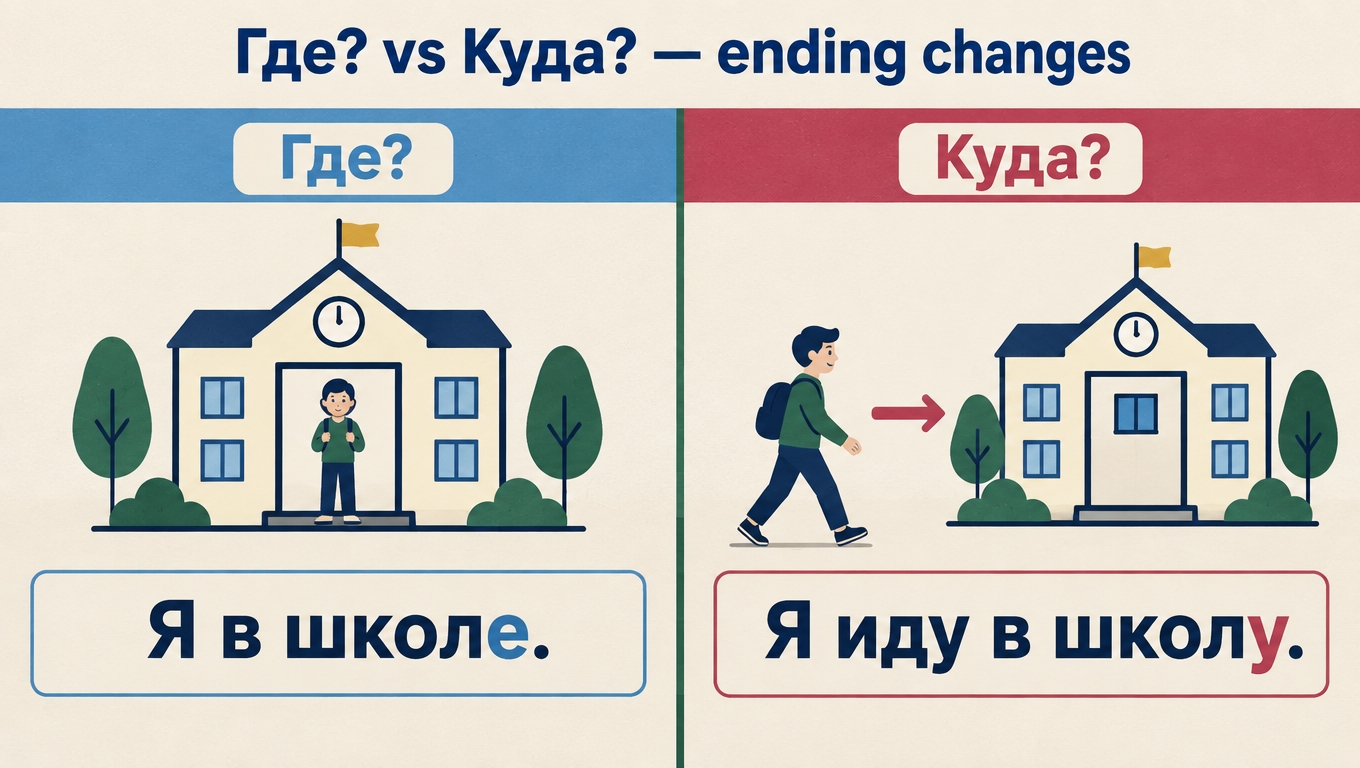
Keep «Где?» and «Куда?» apart: the same в / на pair, two different endings
Use the в-places and на-places of Lesson 5 in the direction sense: вшколу, напочту, вмагазин
Conjugate eight new transitive verbs and state the case each one governs
Say what you see, buy, eat, drink, wait for, watch — and where you are going
Quick review
Say these aloud before you start. They come from earlier lessons.
У меня́ есть кни́га.I have a book. (literally: at me there is a book)Listen in Russian:Slow in Russian:У меня́ есть кни́га.
Мне интере́сно.I am interested.Listen in Russian:Slow in Russian:Мне интере́сно.
Я живу́ в Москве́.I live in Moscow.Listen in Russian:Slow in Russian:Я живу́ в Москве́.
Где ты ра́ботаешь?Where do you work?Listen in Russian:Slow in Russian:Где ты ра́ботаешь?
Он говори́т по-ру́сски.He speaks Russian.Listen in Russian:Slow in Russian:Он говори́т по-ру́сски.
Мой брат врач.My brother is a doctor.Listen in Russian:Slow in Russian:Мой брат врач.
Theory
The direct object: the thing the verb lands on
Some verbs are not complete on their own. Reading reads something, buying buys something, seeing sees something. The something is called the direct object, and in Russian it goes into a case you have not used as an ending yet: the accusative, винительныйпадеж. You ask for it with «Кого? Что?» — "whom? what?".
English marks its objects almost entirely by position: "the dog bit the man" and "the man bit the dog" use the same words in a different order. Russian marks them by ending, which is why it can afford to move words around much more freely later on. Because Russian has no articles either, the ending is often the only signal in the sentence that a noun is an object and not a subject — so it is worth getting right early, and that is what this hour does.
Here is the encouraging part. For most nouns the accusative looks like a form you already know. Only two things change: a feminine noun in -а or -я swaps that ending for -у or -ю, and an animate masculine noun borrows the genitive ending -а or -я. Every other noun keeps its dictionary shape exactly. Learn two endings and you have the whole case.
Я чита́ю кни́гу.I am reading a book. (feminine -а becomes -у)Listen in Russian:Slow in Russian:Я чита́ю кни́гу.
Я ви́жу стол.I can see the table. (masculine inanimate — no change)Listen in Russian:Slow in Russian:Я ви́жу стол.
Она́ лю́бит му́зыку.She loves music.Listen in Russian:Slow in Russian:Она́ лю́бит му́зыку.
Мы покупа́ем хлеб.We are buying bread.Listen in Russian:Slow in Russian:Мы покупа́ем хлеб.
Four accusative shapes, and only two of them move
Masculine inanimate nouns do not change: стол → стол, телефо́н → телефо́н, фильм → фильм. Neuter nouns do not change either: окно́ → окно́, письмо́ → письмо́, я́блоко → я́блоко. If a noun denotes a thing and is masculine or neuter, its accusative is simply the dictionary form. That covers most of the objects and food in this lesson.
Feminine nouns in -а change to -у, and those in -я change to -ю: кни́га → кни́гу, су́мка → су́мку, вода́ → во́ду, Росси́я → Росси́ю. This is the one ending that does real work every single day, and it is completely regular — there are no exceptions to learn. Notice that it applies to animate and inanimate nouns alike: ма́ма becomes ма́му just as су́мка becomes су́мку.
The one genuinely new idea is animacy. A masculine noun that denotes a living being takes the genitive ending in the accusative: студе́нт → студе́нта, брат → бра́та, врач → врача́. So «Явижустол» and «Явижубрата» differ by exactly one letter, and that letter is the whole rule. This is the minimal version of the animacy rule, and it is deliberately minimal: animate plurals, feminine nouns like дочь, and the handful of exceptions are systematised in Lesson 12. Today you need one thing — an animate masculine object ends in -а.
In the plural the same logic holds: an inanimate plural accusative is identical to the plural nominative (столы́, о́кна, ру́чки), and an animate plural accusative is identical to the plural genitive (студе́нтов, враче́й). Recognition only for now.
Я ви́жу стол.I can see the table. (masculine, inanimate — unchanged)Listen in Russian:Slow in Russian:Я ви́жу стол.
Я беру́ ру́чку.I am taking the pen. (feminine -а becomes -у)Listen in Russian:Slow in Russian:Я беру́ ру́чку.
Я ви́жу окно́.I can see the window. (neuter — unchanged)Listen in Russian:Slow in Russian:Я ви́жу окно́.
Я ви́жу бра́та.I can see my brother. (animate masculine — the genitive ending)Listen in Russian:Slow in Russian:Я ви́жу бра́та.
Где? or Куда? — one preposition, two cases
This is the heart of the lesson, and it is the idea that makes Russian feel like a system rather than a list. Lesson 5 taught you that «где?» — where something is — takes в or на plus the prepositional: Яживу́вМоскве́, Она́вмагази́не, Мынапочте́. This lesson adds the missing half: «куда?» — where something is going — takes the very same в or на, but with the accusative: Яеду́вМоскву́, Она́идётвмагази́н, Мыидёмнапо́чту.
The preposition does not change. The place does not change. Only the last vowel of the noun changes, and that vowel is chosen by the question you are answering. English collapses both into one word, "where", which is exactly why this pair needs drilling rather than translating: «Гдеты?» and «Куда́тыидёшь?» are not two ways of asking the same thing, and a Russian hears the difference instantly.
Which of в and на a place takes is a property of the place, and you settled it in Lesson 5: напочте́, навокза́ле, нарабо́те, but вшко́ле, впа́рке, вМоскве́. That choice carries straight across to the direction sense — напо́чту, навокза́л, вшко́лу, впарк. Two rules, applied in order: first pick the preposition the place wants, then pick the ending the question wants.
Two escape hatches are worth knowing now. An indeclinable noun never changes, so «вкино́» means both "at the cinema" and "to the cinema" and only the verb tells you which. And the adverb домо́й ("homewards") takes no preposition at all — Яиду́домой — just as its partner до́ма ("at home") takes none.
Где ты? — В шко́ле.Where are you? — At school.Listen in Russian:Slow in Russian:Где ты? — В шко́ле.
Куда́ ты идёшь? — В шко́лу.Where are you going? — To school.Listen in Russian:Slow in Russian:Куда́ ты идёшь? — В шко́лу.
Где А́нна? — На почте́.Where is Anna? — At the post office.Listen in Russian:Slow in Russian:Где А́нна? — На почте́.
Куда́ вы е́дете? — На по́чту.Where are you going? — To the post office.Listen in Russian:Slow in Russian:Куда́ вы е́дете? — На по́чту.
Eight verbs that need an object, and what they demand
The verbs of this lesson are видеть, ждать, покупать, давать, брать, есть, пить and готовить. All eight are transitive: they take a direct object, and that object is in the accusative. "Government" is the word this course uses for the case a verb demands, and every verb record in this lesson states it. Learning a verb with its government from day one is what stops you guessing later.
Five of the eight are conjugation I, but none of them is plain. ждать drops the -а- of its stem: жду, ждёшь, ждёт. давать keeps its -ва-: даю, даёшь, даёт. брать loses a vowel and picks up a soft sign: беру, берёшь, берёт. пить rebuilds its stem entirely: пью, пьёшь, пьёт. покупать is the only straightforward one: покупаю, покупаешь, покупает. видеть and готовить are conjugation II, and видеть is one of the -еть verbs that behave like -ить — ви́жу, ви́дишь, ви́дит, with the д turning into ж before -ю.
есть "to eat" belongs to neither conjugation: ем, ешь, ест, еди́м, еди́те, едя́т. It is spelled exactly like есть "there is" from Lesson 4 and exactly like the third person singular of быть, so the three are told apart by context and by nothing else. That is normal Russian, not a defect of the course.
Three honest warnings. First, видеть has no imperative anyone actually uses — when you want to say "look", say смотри́ or смотри́те. Second, ждать with an animate masculine object takes the genitive shape: ждатьбра́та, not ждатьбрат. Third, the person you give something to is in the dative case, and the dative is Lesson 9 — until then, давать gives you the thing given, and that is enough for a great many sentences.
Я жду ма́му.I am waiting for Mum.Listen in Russian:Slow in Russian:Я жду ма́му.
Он ест мя́со.He is eating meat.Listen in Russian:Slow in Russian:Он ест мя́со.
Она́ гото́вит ры́бу.She is cooking fish.Listen in Russian:Slow in Russian:Она́ гото́вит ры́бу.
Мы покупа́ем я́блоки и сок.We are buying apples and juice.Listen in Russian:Slow in Russian:Мы покупа́ем я́блоки и сок.
Sound focus
Sound focus: the preposition в, and an ending that is never full
The preposition в is voiced, and voiced consonants obey their neighbours. Before a voiceless consonant it becomes [ф]: вкино́ [f kʲɪˈno], вшко́лу [f ˈʂkolʊ], впарк [f park], всу́мку [f ˈsumkʊ]. Before a voiced one it stays [в]: вмагази́н [v mɐɡɐˈzʲin], вМоскву́ [v mɐˈskvu]. Before a word that starts with certain consonant clusters it gains an о and becomes во: вовто́рник (Lesson 17). None of this is written down; you simply say it.
The accusative ending is never stressed, so it is never full. A feminine -у after a soft consonant is a short, dull [ʊ], not an English "oo": кни́гу is [ˈknʲiɡʊ], ма́му is [ˈmamʊ], во́ду is [vɐˈdu]. Say the ending too clearly and you will sound as though you are spelling the word. Let it collapse.
Two clusters in this lesson are worth saying slowly until they are automatic. Москву́ is [mɐˈskvu] — the whole word is only two syllables, and the second one packs three consonants around a single [u]. And the initial о of a word is very often reduced to a bare [ɐ] or [ə]: окно́ [ɐˈkno], она́ [ɐˈna].
Finally, melody. «Куда́тыидёшь?» is a wh-question, so it takes ИК-2: a sharp, emphatic fall on the stressed syllable of the question word itself, and a flat, uninteresting tail. «Тыберёшьсу́мку?» is a yes/no question, so it takes ИК-3: a steep rise on «су́мку» that never comes back down. Mixing the two up will not make you unintelligible, but it will make you sound unsure.
в кино́[f kʲɪˈno] — в devoices to [ф] before the voiceless кListen in Russian:Slow in Russian:в кино́
в магази́н[v mɐɡɐˈzʲin] — в stays [в] before the voiced мListen in Russian:Slow in Russian:в магази́н
кни́гу[ˈknʲiɡʊ] — the accusative -у is a short reduced [ʊ], never English "oo"Listen in Russian:Slow in Russian:кни́гу
в Москву́[v mɐˈskvu] — two syllables in total, with three consonants around the final [u]Listen in Russian:Slow in Russian:в Москву́
The accusative: four shapes, decided by gender, number and animacy
Form
Masculine, inanimate
Masculine, animate
Feminine
Neuter
Кто? Что? — Nominative (the dictionary form)
стол
студе́нт
ру́чка
окно́
Кого? Что? — Accusative singular
стол
студе́нта
ру́чку
окно́
Accusative plural
столы́
студе́нтов
ру́чки
о́кна
What actually changed
nothing
-а, the genitive ending
-а becomes -у
nothing
Only two endings to learn today: the feminine -у (and -ю after a soft stem), and the -а that an animate masculine borrows from the genitive. Everything else is a copy of a form you already know. The plural rule shown here is the short version — animate plurals and their exceptions are systematised in Lesson 12.
Где? / Куда? — the same в and на, a different ending
Form
шко́ла (f, в-class)
магази́н (m, в-class)
по́чта (f, на-class)
кино́ (indeclinable)
Где? — Prepositional (Lesson 5)
вшко́ле
вмагази́не
напочте́
вкино́
Куда? — Accusative (this lesson)
вшко́лу
вмагази́н
напо́чту
вкино́
The ending that moves
-е becomes -у
no ending: accusative = nominative
-е becomes -у
nothing — it never changes
Same preposition, same place, one different vowel. The question word decides which ending you need: где? asks where something already is, куда? asks where it is going. Whether a place takes в or на was settled in Lesson 5 and does not change here. One adverb escapes the whole pattern: домо́й takes no preposition at all.
Transitive verbs and their objects
Form
Infinitive
Form for я
In a sentence (object in the accusative)
see
ви́деть
ви́жу
Яви́жубра́та.
wait for
ждать
жду
Яждума́му.
buy
покупа́ть
покупа́ю
Япокупа́юхлеб.
give
дава́ть
даю́
Ядаю́кни́гу.
take
брать
беру́
Яберу́су́мку.
eat
есть
ем
Яеммя́со.
drink
пить
пью
Япьючай.
cook
гото́вить
гото́влю
Ягото́влюры́бу.
Every verb in this table takes a direct object, and the direct object is always in the accusative. Notice how often the case is invisible: хлеб, чай and мясо look exactly as they do in the dictionary. Only the feminine -а nouns and the animate masculines wear the case on the surface, which is why those two endings are the whole of today’s grammar.
Vocabulary
Learn each word with its stress mark and its pronunciation. Nouns are given with their gender, animacy and their full six-case declension; verbs are given with their aspect and, where one exists, their partner verb.
Russian
English
Gender / aspect
Pronunciation
Audio
столmasculine · inanimate
table
masculine · inanimate
/stol/STOHL
Listen in Russian:Slow in Russian:стол
стулmasculine · inanimate
chair
masculine · inanimate
/stul/STOOL
Listen in Russian:Slow in Russian:стул
окно́neuter · inanimate
window
neuter · inanimate
/ɐˈkno/uk-NOH
Listen in Russian:Slow in Russian:окно
телефо́нmasculine · inanimate
telephone, phone
masculine · inanimate
/tʲɪlʲɪˈfon/tih-lih-FOHN
Listen in Russian:Slow in Russian:телефон
компью́терmasculine · inanimate
computer
masculine · inanimate
/kəmˈpʲjutʲɪr/kum-PYOO-tihr
Listen in Russian:Slow in Russian:компьютер
телеви́зорmasculine · inanimate
television, TV set
masculine · inanimate
/tʲɪlʲɪˈvʲizər/tih-lih-VEE-zuhr
Listen in Russian:Slow in Russian:телевизор
су́мкаfeminine · inanimate
bag
feminine · inanimate
/ˈsumkə/SOOM-kuh
Listen in Russian:Slow in Russian:сумка
ру́чкаfeminine · inanimate
pen, biro
feminine · inanimate
/ˈrutɕkə/ROO-chkuh
Listen in Russian:Slow in Russian:ручка
каранда́шmasculine · inanimate
pencil
masculine · inanimate
/kərɐnˈdaʂ/kuh-run-DAHSH
Listen in Russian:Slow in Russian:карандаш
письмо́neuter · inanimate
letter (written message)
neuter · inanimate
/pʲɪˈsʲmo/pih-SMOH
Listen in Russian:Slow in Russian:письмо
фильмmasculine · inanimate
film
masculine · inanimate
/fʲilʲm/FEELM
Listen in Russian:Slow in Russian:фильм
му́зыкаfeminine · inanimate
music
feminine · inanimate
/ˈmuzɨkə/MOO-zih-kuh
Listen in Russian:Slow in Russian:музыка
хлебmasculine · inanimate
bread
masculine · inanimate
/xlʲep/KHLYEP
Listen in Russian:Slow in Russian:хлеб
мя́соneuter · inanimate
meat
neuter · inanimate
/ˈmʲasə/MYAH-suh
Listen in Russian:Slow in Russian:мясо
ры́баfeminine · inanimate
fish
feminine · inanimate
/ˈrɨbə/RIH-buh
Listen in Russian:Slow in Russian:рыба
сырmasculine · inanimate
cheese
masculine · inanimate
/sɨr/SIHR
Listen in Russian:Slow in Russian:сыр
я́блокоneuter · inanimate
apple
neuter · inanimate
/ˈjabləkə/YAH-bluh-kuh
Listen in Russian:Slow in Russian:яблоко
чайmasculine · inanimate
tea
masculine · inanimate
/tɕaj/CHAY
Listen in Russian:Slow in Russian:чай
сокmasculine · inanimate
juice
masculine · inanimate
/sok/SOHK
Listen in Russian:Slow in Russian:сок
вино́neuter · inanimate
wine
neuter · inanimate
/vʲɪˈno/vih-NOH
Listen in Russian:Slow in Russian:вино
ви́детьimperfective
to see
imperfective
/ˈvʲidʲɪtʲ/VEE-dit
Listen in Russian:Slow in Russian:видеть
ждатьimperfective
to wait for, to expect
imperfective
/ʐdatʲ/ZHDYAT
Listen in Russian:Slow in Russian:ждать
покупа́тьimperfective
to buy
imperfective
/pəkʊˈpatʲ/puh-koo-PYAT
Listen in Russian:Slow in Russian:покупать
дава́тьimperfective
to give
imperfective
/dɐˈvatʲ/duh-VYAT
Listen in Russian:Slow in Russian:давать
братьimperfective
to take
imperfective
/bratʲ/BRYAT
Listen in Russian:Slow in Russian:брать
естьimperfective
to eat
imperfective
/jesʲtʲ/YEST
Listen in Russian:Slow in Russian:есть
питьimperfective
to drink
imperfective
/pʲitʲ/PEET
Listen in Russian:Slow in Russian:пить
гото́витьimperfective
to cook; to prepare
imperfective
/ɡɐˈtovʲɪtʲ/guh-TOH-vit
Listen in Russian:Slow in Russian:готовить
домо́йAdverb
home, homewards (where to)
Adverb
/dɐˈmoj/duh-MOY
Listen in Russian:Slow in Russian:домой
кни́гаfeminine · inanimate
book
feminine · inanimate
/ˈknʲiɡə/kuh-NEE-guh
Listen in Russian:Slow in Russian:книга
чита́тьimperfective
to read
imperfective
/tɕɪˈtatʲ/chih-TYAT
Listen in Russian:Slow in Russian:читать
люби́тьimperfective
to love, to like
imperfective
/lʲʊˈbʲitʲ/lyoo-BEET
Listen in Russian:Slow in Russian:любить
смотре́тьimperfective
to look at, to watch
imperfective
/smɐˈtrʲetʲ/smuh-TRYET
Listen in Russian:Slow in Russian:смотреть
магази́нmasculine · inanimate
shop, store
masculine · inanimate
/məɡɐˈzʲin/muh-guh-ZEEN
Listen in Russian:Slow in Russian:магазин
Full six-case declension of the 22 nouns in this lesson
Each case is listed with the question word that selects it. Find the question you are answering and the ending follows.
Singular
Form
стол (m)
стул (m)
окно́ (n)
телефо́н (m)
компью́тер (m)
телеви́зор (m)
су́мка (f)
ру́чка (f)
каранда́ш (m)
письмо́ (n)
фильм (m)
му́зыка (f)
хлеб (m)
мя́со (n)
ры́ба (f)
сыр (m)
я́блоко (n)
чай (m)
сок (m)
вино́ (n)
кни́га (f)
магази́н (m)
Nominative · Кто? Что?
стол
стул
окно́
телефо́н
компью́тер
телеви́зор
су́мка
ру́чка
каранда́ш
письмо́
фильм
му́зыка
хлеб
мя́со
ры́ба
сыр
я́блоко
чай
сок
вино́
книга
магазин
Genitive · Кого? Чего?
стола́
сту́ла
окна́
телефо́на
компью́тера
телеви́зора
су́мки
ру́чки
карандаша́
письма́
фи́льма
му́зыки
хле́ба
мя́са
ры́бы
сы́ра
я́блока
ча́я
со́ка
вина́
книги
магазина
Dative · Кому? Чему?
столу́
сту́лу
окну́
телефо́ну
компью́теру
телеви́зору
су́мке
ру́чке
карандашу́
письму́
фи́льму
му́зыке
хле́бу
мя́су
ры́бе
сы́ру
я́блоку
ча́ю
со́ку
вину́
книге
магазину
Accusative · Кого? Что?
стол
стул
окно́
телефо́н
компью́тер
телеви́зор
су́мку
ру́чку
каранда́ш
письмо́
фильм
му́зыку
хлеб
мя́со
ры́бу
сыр
я́блоко
чай
сок
вино́
книгу
магазин
Instrumental · Кем? Чем?
столо́м
сту́лом
окно́м
телефо́ном
компью́тером
телеви́зором
су́мкой
ру́чкой
карандашо́м
письмо́м
фи́льмом
му́зыкой
хле́бом
мя́сом
ры́бой
сы́ром
я́блоком
ча́ем
со́ком
вино́м
книгой
магазином
Prepositional · Оком? Очём?
столе́
сту́ле
окне́
телефо́не
компью́тере
телеви́зоре
су́мке
ру́чке
карандаше́
письме́
фи́льме
му́зыке
хле́бе
мя́се
ры́бе
сы́ре
я́блоке
ча́е
со́ке
вине́
книге
магазине
Plural
Form
стол (m)
стул (m)
окно́ (n)
телефо́н (m)
компью́тер (m)
телеви́зор (m)
су́мка (f)
ру́чка (f)
каранда́ш (m)
письмо́ (n)
фильм (m)
му́зыка (f)
хлеб (m)
мя́со (n)
ры́ба (f)
сыр (m)
я́блоко (n)
чай (m)
сок (m)
вино́ (n)
кни́га (f)
магази́н (m)
Nominative · Кто? Что?
столы́
сту́лья
о́кна
телефо́ны
компью́теры
телеви́зоры
су́мки
ру́чки
карандаши́
пи́сьма
фи́льмы
—
—
—
ры́бы
—
я́блоки
—
—
—
книги
магазины
Genitive · Кого? Чего?
столо́в
сту́льев
о́кон
телефо́нов
компью́теров
телеви́зоров
су́мок
ру́чек
карандаше́й
пи́сем
фи́льмов
—
—
—
рыб
—
я́блок
—
—
—
книг
магазинов
Dative · Кому? Чему?
стола́м
сту́льям
о́кнам
телефо́нам
компью́терам
телеви́зорам
су́мкам
ру́чкам
карандаша́м
пи́сьмам
фи́льмам
—
—
—
ры́бам
—
я́блокам
—
—
—
книгам
магазинам
Accusative · Кого? Что?
столы́
сту́лья
о́кна
телефо́ны
компью́теры
телеви́зоры
су́мки
ру́чки
карандаши́
пи́сьма
фи́льмы
—
—
—
ры́бы
—
я́блоки
—
—
—
книги
магазины
Instrumental · Кем? Чем?
стола́ми
сту́льями
о́кнами
телефо́нами
компью́терами
телеви́зорами
су́мками
ру́чками
карандаша́ми
пи́сьмами
фи́льмами
—
—
—
ры́бами
—
я́блоками
—
—
—
книгами
магазинами
Prepositional · Оком? Очём?
стола́х
сту́льях
о́кнах
телефо́нах
компью́терах
телеви́зорах
су́мках
ру́чках
карандаша́х
пи́сьмах
фи́льмах
—
—
—
ры́бах
—
я́блоках
—
—
—
книгах
магазинах
Ready-to-use phrases
Я чита́ю кни́гу.
I am reading a book.
IPA/ja tɕɪˈtaju ˈknʲiɡʊ/
Say itYAH chih-TAH-yoo kuh-NEE-goo.
The model sentence for the whole lesson. книга is feminine, so its accusative swaps -а for -у: кни́гу. The stress does not move.
neutralaccusativestudyobjects
Listen in Russian:Slow in Russian:Я читаю книгу.
Я ви́жу стол.
I can see the table.
IPA/ja ˈvʲiʐu stol/
Say itYAH VEE-zhoo STOHL.
стол is masculine and inanimate, so the accusative is invisible — the noun looks exactly as it does in the dictionary.
neutralaccusativeobjects
Listen in Russian:Slow in Russian:Я вижу стол.
Она́ ви́дит бра́та.
She can see her brother.
IPA/ɐˈna ˈvʲidʲɪt ˈbratə/
Say ituh-NAH VEE-dit BRAH-tuh.
The one place the accusative surprises an English speaker: an animate masculine noun takes the genitive ending -а. Compare «Она́ви́дитстол».
neutralaccusativeanimacyfamily
Listen in Russian:Slow in Russian:Она видит брата.
Мы покупа́ем хлеб и сыр.
We are buying bread and cheese.
IPA/mɨ pəkʊˈpajɪm xlʲep i sɨr/
Say itMIH puh-koo-PAH-yim KHLYEP EE SIHR.
Two inanimate masculines in a row, and neither shows the case. Russian has no articles, so "bread and cheese" needs nothing added.
neutralaccusativeshoppingfood
Listen in Russian:Slow in Russian:Мы покупаем хлеб и сыр.
Я люблю́ му́зыку.
I love music.
IPA/ja lʲʊˈblʲu ˈmuzɨkʊ/
Say itYAH lyoo-BLYOO MOO-zih-koo.
любить is conjugation II (Lesson 3): люблю́, лю́бишь, лю́бит. Its object is accusative — contrast «Мненра́витсяму́зыка», where music is the subject and stays in the nominative.
neutralaccusativehobbies
Listen in Russian:Slow in Russian:Я люблю музыку.
Я жду ма́му.
I am waiting for Mum.
IPA/ja ʐdu ˈmamʊ/
Say itYAH ZHDOO MAH-moo.
ждать takes the accusative without any preposition — English "wait for" does not map word for word. For a feminine noun the animate rule makes no difference: -а becomes -у either way.
neutralaccusativefamily
Listen in Russian:Slow in Russian:Я жду маму.
Что ты пьёшь?
What are you drinking?
IPA/ʂto tɨ pʲjoʂ/
Say itSHTOH TIH PYOHSH?
Every word here is a monosyllable or contains ё, so the sentence carries no stress marks at all. The question word takes ИК-2: a sharp fall on «что».
informalquestionsfood
Listen in Russian:Slow in Russian:Что ты пьёшь?
Я пью чай.
I am drinking tea.
IPA/ja pʲju tɕaj/
Say itYAH PYOO CHAY.
Three monosyllables, so no stress marks. The soft sign in пью is part of the spelling; dropping it would give a different word.
neutralpresentfood
Listen in Russian:Slow in Russian:Я пью чай.
Он ест мя́со.
He is eating meat.
IPA/on jesʲtʲ ˈmʲasə/
Say itOHN YEST MYAH-suh.
есть "to eat" is irregular: ем, ешь, ест, еди́м, еди́те, едя́т. Do not confuse it with есть "there is" (Lesson 4) — the context is the only thing that separates them.
neutralpresentfood
Listen in Russian:Slow in Russian:Он ест мясо.
Ты берёшь су́мку?
Are you taking the bag?
IPA/tɨ bʲɪˈrʲoʂ ˈsumkʊ/
Say itTIH bih-RYOHSH SOOM-koo?
брать loses the vowel of its infinitive stem: беру́, берёшь, берёт. A yes/no question, so the ИК-3 rise lands on «су́мку».
informalquestionsobjects
Listen in Russian:Slow in Russian:Ты берёшь сумку?
Па́па гото́вит ры́бу.
Dad is cooking fish.
IPA/ˈpapə ɡɐˈtovʲɪt ˈrɨbʊ/
Say itPAH-puh guh-TOH-vit RIH-boo.
готовить is conjugation II: гото́влю, гото́вишь, гото́вят. ры́ба → ры́бу, the ordinary feminine change.
neutralpresentfoodfamily
Listen in Russian:Slow in Russian:Папа готовит рыбу.
Я смотрю́ фильм.
I am watching a film.
IPA/ja smɐˈtrʲu fʲilʲm/
Say itYAH smuh-TRYOO FEELM.
смотреть is one of the -еть verbs that conjugate like -ить (Lesson 3). фильм is inanimate, so the accusative is invisible.
neutralaccusativemediahobbies
Listen in Russian:Slow in Russian:Я смотрю фильм.
Она́ смо́трит телеви́зор.
She is watching television.
IPA/ɐˈna ˈsmotrʲɪt tʲɪlʲɪˈvʲizər/
Say ituh-NAH SMOH-trit tih-lih-VEE-zuhr.
A fixed phrase: смотретьтелевизор means "to watch television" in general. When you name what is on, you watch a фильм or a передача instead.
neutralpresentmedia
Listen in Russian:Slow in Russian:Она смотрит телевизор.
Куда́ ты идёшь?
Where are you going?
IPA/kʊˈda tɨ ɪˈdʲoʂ/
Say itkoo-DAH TIH ih-DYOHSH?
The question word of this lesson. куда? always expects a direction, and a direction always takes the accusative. идти is conjugated in full in Lesson 7; until then, use идёшь / иду / идём as ready-made chunks.
informalquestionsaccusativeplace
Listen in Russian:Slow in Russian:Куда ты идёшь?
Я иду́ в магази́н.
I am going to the shop.
IPA/ja ɪˈdu v mɐɡɐˈzʲin/
Say itYAH ih-DOO v muh-guh-ZEEN.
The same в as in «вмагази́не» from Lesson 5, with a different ending: -е answers где?, nothing at all answers куда?. The в stays voiced [в] before м.
neutralaccusativeplacecity
Listen in Russian:Slow in Russian:Я иду в магазин.
Она́ е́дет в Москву́.
She is going to Moscow.
IPA/ɐˈna ˈjedʲɪt v mɐˈskvu/
Say ituh-NAH YEH-dit v muh-SKVOO.
Москва́ → Москву́. Two things to hear: the whole word is only two syllables, [mɐˈskvu], with three consonants crowded around the final [u]; and the preposition stays voiced [в] because the next sound is м. едет is a chunk of ехать, which Lesson 7 conjugates in full.
neutralaccusativeplacecity
Listen in Russian:Slow in Russian:Она едет в Москву.
Мы идём в шко́лу.
We are going to school.
IPA/mɨ ɪˈdʲom f ˈʂkolʊ/
Say itMIH ih-DYOHM f SHKOH-loo.
вшко́ле (where) → вшко́лу (where to). The preposition is the same; only the last vowel changes. Before the voiceless ш the preposition в becomes [ф].
neutralaccusativeplacecity
Listen in Russian:Slow in Russian:Мы идём в школу.
Куда́ вы е́дете? — На по́чту.
Where are you going? — To the post office.
IPA/kʊˈda vɨ ˈjedʲɪtʲə nə ˈpotɕtʊ/
Say itkoo-DAH VIH YEH-dih-tyuh? — nuh POH-chtoo.
почта is a на-place, so it keeps на in both questions: напочте́ (where) and напо́чту (where to). Which preposition a place takes was settled in Lesson 5 and does not change here.
neutralquestionsplacecity
Listen in Russian:Slow in Russian:Куда вы едете? — На почту.
Где кни́га? — На столе́.
Where is the book? — On the table.
IPA/ɡdʲe ˈknʲiɡə nə stɐˈlʲe/
Say itguh-DYEH kuh-NEE-guh? — nuh stuh-LYEH.
The mirror image of the previous phrase: где? takes the prepositional, настоле́. Say the two together — настоле́, настол — and the whole lesson is in your mouth.
neutralprepositionalquestionsobjects
Listen in Russian:Slow in Russian:Где книга? — На столе.
Я иду́ домо́й.
I am going home.
IPA/ja ɪˈdu dɐˈmoj/
Say itYAH ih-DOO duh-MOY.
домой takes no preposition, ever. Its partner до́ма ("at home") also takes none, and the two differ only in their stress.
neutralaccusativeplace
Listen in Russian:Slow in Russian:Я иду домой.
Где твой телефо́н?
Where is your phone?
IPA/ɡdʲe tvoj tʲɪlʲɪˈfon/
Say itguh-DYEH TVOY tih-lih-FOHN?
твой is the informal "your" (Lesson 4); with вы it becomes ваш. Both are followed by the nominative here, because the phone is the subject of the question.
informalquestionsplaceobjects
Listen in Russian:Slow in Russian:Где твой телефон?
Я жду письмо́.
I am waiting for a letter.
IPA/ja ʐdu pʲɪsʲˈmo/
Say itYAH ZHDOO pih-SMOH.
With an inanimate object ждать takes the plain accusative: ждуписьмо́. With an animate masculine it takes the genitive shape instead: ждубра́та.
neutralpresentobjects
Listen in Russian:Slow in Russian:Я жду письмо.
Дай, пожа́луйста, ру́чку.
Please give me the pen.
IPA/daj pɐˈʐalujstə ˈrutɕkʊ/
Say itDAY, puh-ZHAH-luy-stuh, ROO-chkoo.
дай is the imperative of дать, learnt as a chunk in Lesson 4. The thing asked for is accusative: ру́чку. The person asked is dative, and that is Lesson 9.
politeimperativeobjectspoliteness
Listen in Russian:Slow in Russian:Дай, пожалуйста, ручку.
Я покупа́ю я́блоки.
I am buying apples.
IPA/ja pəkʊˈpaju ˈjabləkʲɪ/
Say itYAH puh-koo-PAH-yoo YAH-bluh-kih.
The plural accusative of an inanimate noun is the same as the plural nominative: я́блоки. Both unstressed о reduce to [ə].
neutralaccusativeshoppingfood
Listen in Russian:Slow in Russian:Я покупаю яблоки.
Dialogues
In a small food shop
Anna is buying food from Nina, the woman behind the counter. They do not know each other, so Nina uses вы.
Nina
Здравствуйте! Что вы хотите?
Hello! What would you like?
Listen in Russian:Slow in Russian:Здравствуйте! Что вы хотите?
Anna
Я покупаю хлеб, сыр и яблоки.
I am buying bread, cheese and apples.
Listen in Russian:Slow in Russian:Я покупаю хлеб, сыр и яблоки.
Nina
Вот хлеб и вот сыр.
Here is the bread and here is the cheese.
Listen in Russian:Slow in Russian:Вот хлеб и вот сыр.
Anna
А где яблоки?
And where are the apples?
Listen in Russian:Slow in Russian:А где яблоки?
Nina
Яблоки там. Вы любите яблоки?
The apples are over there. Do you like apples?
Listen in Russian:Slow in Russian:Яблоки там. Вы любите яблоки?
Anna
Да, я очень люблю яблоки. И чай, пожалуйста.
Yes, I love apples very much. And tea, please.
Listen in Russian:Slow in Russian:Да, я очень люблю яблоки. И чай, пожалуйста.
Nina
Хорошо. Вот чай.
Right. Here is the tea.
Listen in Russian:Slow in Russian:Хорошо. Вот чай.
Anna
Спасибо!
Thank you!
Listen in Russian:Slow in Russian:Спасибо!
Where is everyone going?
Tom and Ivan meet in the street, both on their way somewhere else. They are friends, so they use ты.
Tom
Привет, Иван! Куда ты идёшь?
Hi Ivan! Where are you going?
Listen in Russian:Slow in Russian:Привет, Иван! Куда ты идёшь?
Ivan
Я иду в университет. А ты куда?
I am going to the university. And where are you going?
Listen in Russian:Slow in Russian:Я иду в университет. А ты куда?
Tom
Я иду домой. Где Анна?
I am going home. Where is Anna?
Listen in Russian:Slow in Russian:Я иду домой. Где Анна?
Ivan
Анна в магазине.
Anna is in the shop.
Listen in Russian:Slow in Russian:Анна в магазине.
Tom
А где твой брат?
And where is your brother?
Listen in Russian:Slow in Russian:А где твой брат?
Ivan
Мой брат дома. Он ждёт маму.
My brother is at home. He is waiting for Mum.
Listen in Russian:Slow in Russian:Мой брат дома. Он ждёт маму.
Tom
До свидания, Иван!
Goodbye, Ivan!
Listen in Russian:Slow in Russian:До свидания, Иван!
Ivan
До свидания!
Goodbye!
Listen in Russian:Slow in Russian:До свидания!
An evening at Anna’s flat
Olga drops in on her friend Anna. Two friends of the same age, so both use ты.
Olga
Привет, Анна! Ты смотришь фильм?
Hi Anna! Are you watching a film?
Listen in Russian:Slow in Russian:Привет, Анна! Ты смотришь фильм?
Anna
Да, я смотрю фильм. Это очень хороший фильм.
Yes, I am watching a film. It is a very good film.
Listen in Russian:Slow in Russian:Да, я смотрю фильм. Это очень хороший фильм.
Olga
А что ты пьёшь?
And what are you drinking?
Listen in Russian:Slow in Russian:А что ты пьёшь?
Anna
Я пью чай. Ты хочешь чай?
I am drinking tea. Do you want tea?
Listen in Russian:Slow in Russian:Я пью чай. Ты хочешь чай?
Olga
Да, пожалуйста. А где твой телефон?
Yes, please. And where is your phone?
Listen in Russian:Slow in Russian:Да, пожалуйста. А где твой телефон?
Anna
Мой телефон на столе. А где твоя сумка?
My phone is on the table. And where is your bag?
Listen in Russian:Slow in Russian:Мой телефон на столе. А где твоя сумка?
Olga
Моя сумка там, на стуле.
My bag is over there, on the chair.
Listen in Russian:Slow in Russian:Моя сумка там, на стуле.
Anna
Вот твой чай.
Here is your tea.
Listen in Russian:Slow in Russian:Вот твой чай.
Exercises
Answer actively — try to recall the Russian before you look at any hint.
ConjugationExercise 1
Give the present tense form for «я».
видеть — я
ConjugationExercise 2
Give the present tense form for «они».
пить — они
ConjugationExercise 3
Give the present tense form for «вы».
есть (to eat) — вы
ConjugationExercise 4
Give the present tense form for «ты».
ждать — ты
Choose the endingExercise 5
Choose the ending that completes the accusative of книга.
Ячитаюкниг___.
Choose the endingExercise 6
Choose the ending that completes the accusative of брат.
Онждётбрат___.
Choose the endingExercise 7
Choose the ending that completes the accusative of окно.
Мывидимокн___.
Choose the endingExercise 8
Choose the ending that completes the accusative of сумка.
Онапокупаетсумк___.
Choose the caseExercise 9
Choose the correct form.
Complete: "I am going to school." — Яиду ___
Choose the caseExercise 10
Choose the correct form.
Complete: "Where is Anna?" — ГдеАнна? — ___
Choose the caseExercise 11
Choose the correct sentence.
Which sentence means "I am going to the post office"?
Choose the caseExercise 12
Choose the correct sentence.
Which sentence means "I can see my brother"?
Choose the caseExercise 13
Choose the correct sentence.
Which sentence means "I am waiting for Mum"?
Choose the caseExercise 14
Choose the correct form.
Complete: "Where are you going?" — Кудавыедете? — ___
Choose the caseExercise 15
Choose the correct sentence.
Which sentence means "She is watching a film"?
Translate into RussianExercise 16
Translate into Russian.
I am buying bread and cheese.
Translate into RussianExercise 17
Translate into Russian.
She is drinking tea.
Translate into RussianExercise 18
Translate into Russian.
Where are you going? — To the shop.
Translate into RussianExercise 19
Translate into Russian.
We are waiting for Mum and Dad.
Translate into EnglishExercise 20
Translate into English.
Она́берётсу́мкуиидётдомо́й.
Translate into EnglishExercise 21
Translate into English.
Гдекни́га? — Настоле́.
Multiple choiceExercise 22
Choose the correct sentence.
Which sentence means "I am eating meat"?
Fill the gapExercise 23
Fill the gap with the accusative of книга.
Ячитаю ___ (книга).
Fill the gapExercise 24
Fill the gap with the right preposition.
Кудатыидёшь? — Яиду ___ магазин.
True or falseExercise 25
Answer true or false.
«Где?» and «Куда?» take the same preposition but a different case ending.
Word orderExercise 26
Put the words in order.
Build the sentence: "I am buying bread and cheese."
Match the pairsExercise 27
Pair the forms with their meanings.
Match each form with the job it does.
Transform the sentenceExercise 28
Rewrite it so that it answers «Куда?».
Change the prepositional phrase «вшколе» into the accusative.
Transform the sentenceExercise 29
Rewrite it in the past tense.
Put this sentence into the past, with a female speaker: «Япьючай.»
Choose the stressExercise 30
Choose the correctly stressed form.
Where does the stress fall in «домой»?
Choose the stressExercise 31
Choose the correctly stressed form.
Where does the stress fall in the plural «окна»?
Listen and typeExercise 32
Play the audio and type what you hear.
Listen and type the sentence.
Listen and chooseExercise 33
Play the audio and pick the match.
Listen and choose the sentence you hear.
FlashcardExercise 34
Recall the English meaning, then rate how well you knew it.
домо́й
Speak now
Say each sentence aloud three times, then swap one noun for another of your own and say the new version. When you swap a noun, say the accusative out loud before you put it into the sentence — that one second of hesitation is exactly what this lesson is removing.
Я покупа́ю хлеб и сыр.I am buying bread and cheese.Listen in Russian:Slow in Russian:Я покупа́ю хлеб и сыр.
Я пью чай, а ты?I am drinking tea — and you?Listen in Russian:Slow in Russian:Я пью чай, а ты?
Куда́ ты идёшь? — Я иду́ в магази́н.Where are you going? — I am going to the shop.Listen in Russian:Slow in Russian:Куда́ ты идёшь? — Я иду́ в магази́н.
Я иду́ домо́й.I am going home.Listen in Russian:Slow in Russian:Я иду́ домо́й.
Я ви́жу бра́та и жду ма́му.I can see my brother and I am waiting for Mum.Listen in Russian:Slow in Russian:Я ви́жу бра́та и жду ма́му.
Где кни́га? — На столе́.Where is the book? — On the table.Listen in Russian:Slow in Russian:Где кни́га? — На столе́.
Lesson checkpoint
Before you move on, make sure you can do all of this without looking:
Give the accusative singular of these six nouns without looking: стол, ручка, окно, книга, брат, мама
Say aloud why «Явижустол» and «Явижубрата» look different, and what the rule is
Answer «Кудатыидёшь?» six times with six different places, picking в or на correctly each time
Ask «Где?» and «Куда?» about the same place and hear the ending change: вшколе, вшколу
Conjugate видеть and пить in the present tense, all six forms, out loud
Say four true sentences about today: what you eat, what you drink, what you buy and what you watch
Remember this
The accusative is the case of the direct object. It answers «Кого? Что?» and it is what a transitive verb acts on.
Only two endings move in the singular: feminine -а/-я becomes -у/-ю (книга → книгу), and an animate masculine takes the genitive -а/-я (брат → брата).
Masculine inanimate and all neuter nouns are unchanged in the accusative: стол → стол, окно → окно. There is nothing to learn there.
The same prepositions в and на answer two different questions. «Где?» takes the prepositional (вшколе), «Куда?» takes the accusative (вшколу).
In the plural, an inanimate accusative equals the nominative plural (столы, окна) and an animate accusative equals the genitive plural (студентов, врачей). The full rule is Lesson 12.
The preposition в devoices to [ф] before a voiceless consonant — вкино, вшколу — and an accusative ending is always reduced, never a full English vowel.