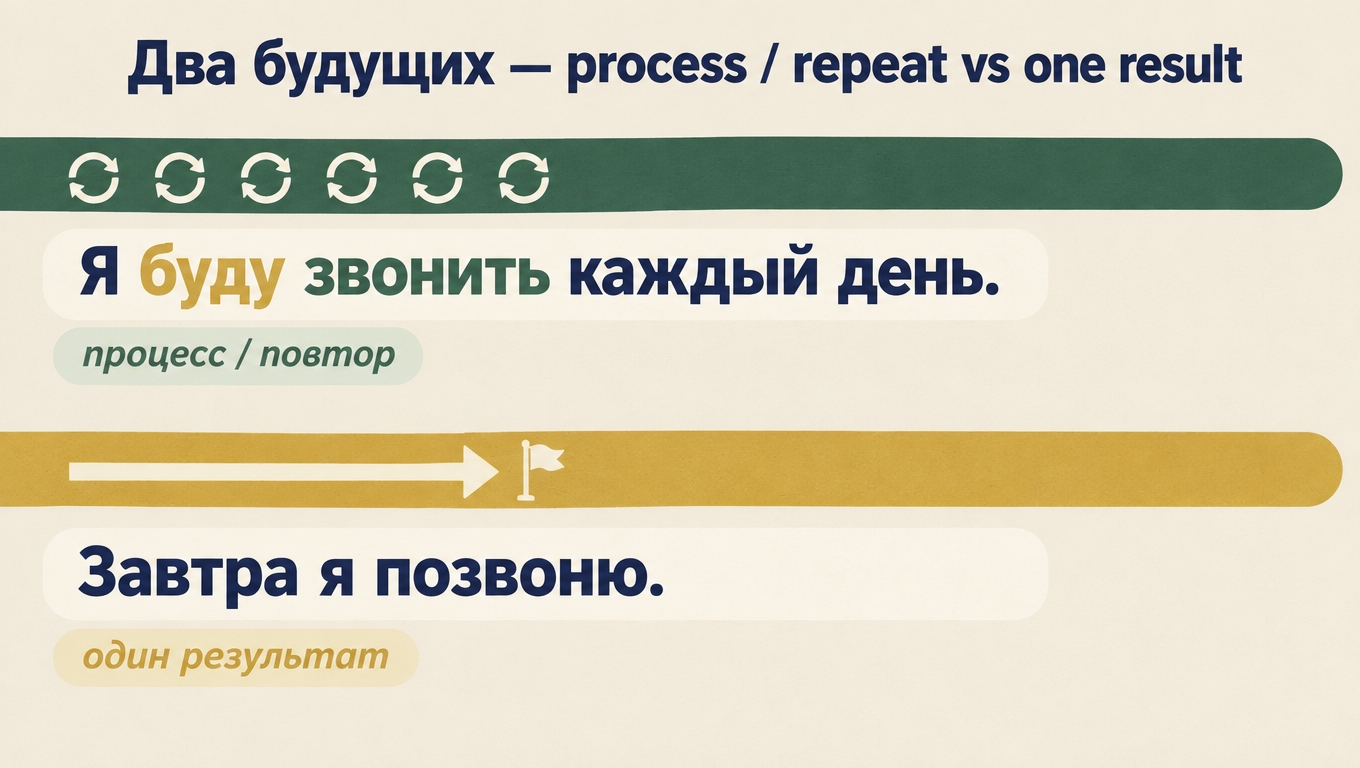
Russian has two futures, and one of them looks exactly like the present tense. This lesson puts them side by side — будуделать against сделаю — adds the time adverbs that choose the aspect for you, and fixes the когда-clause trap that catches almost every English speaker.
⏱ About 60 minutes24 phrases34 exercises
What you will learn
Build the perfective future by simply conjugating the perfective verb, and see that its shape is the shape of the present tense
Choose between будуделать and сделаю — process, duration and repetition against one completed result
Use уже, ещё, ещёне, толькочто, недавно, скоро, потом, сразу, долго, быстро, медленно and послезавтра, and know which aspect each one pulls towards
Say «Когдаяприду, янапишутебе» — a future meaning carried by a present-shaped verb in the time clause
Join two events in time with пока, дотогокак and послетогокак
Use the result verbs успеть, опоздать, решить and обещать with the aspect their meaning demands
Quick review
Say these aloud before you start. They come from earlier lessons.
За́втра я бу́ду чита́ть.Tomorrow I will read. / Tomorrow I will be reading.Listen in Russian:Slow in Russian:За́втра я бу́ду чита́ть.
Вчера́ я рабо́тал.Yesterday I worked.Listen in Russian:Slow in Russian:Вчера́ я рабо́тал.
У меня́ нет вре́мени.I have not got any time.Listen in Russian:Slow in Russian:У меня́ нет вре́мени.
Он пошёл на вокза́л.He set off for the station.Listen in Russian:Slow in Russian:Он пошёл на вокза́л.
Я хоте́л купи́ть кни́гу.I wanted to buy a book.Listen in Russian:Slow in Russian:Я хоте́л купи́ть кни́гу.
Мы бу́дем гуля́ть сего́дня.We will go for a walk today.Listen in Russian:Slow in Russian:Мы бу́дем гуля́ть сего́дня.
Theory
One shape, two meanings: the perfective future looks like the present
In Lesson 2 you built one future: буду, будешь, будет plus an infinitive that never moves. Russian has a second one, and it costs you nothing new, because you already know how to make it. Take a perfective verb and conjugate it the way you would conjugate a present — ясделаю, тысделаешь, онсделает, мысделаем, высделаете, онисделают. Those are not presents. A perfective verb has no present tense at all, so its present-shaped forms can only be future.
That is the whole mechanism, and it is worth stopping on for a moment. The column you learnt for «ячитаю, тычитаешь» and the column for «япрочитаю, тыпрочитаешь» have identical endings. The only thing that changes is which verb you put into it. Russian is cheaper than English here: English needs «will» for both futures, Russian needs «буду» for one of them and nothing whatever for the other.
The one thing to watch is the stress, which does not travel reliably from an imperfective to its partner. де́лать gives сде́лать and чита́ть gives прочита́ть, but пи́сать gives написа́ть — the stress jumps from the first syllable to the last. Learn each perfective with its own stress, exactly the way you learnt the imperfective — and learn its first person singular, because that is the form that tells you the conjugation.
Я сде́лаю э́то.I will do it. (perfective future — one completed act)Listen in Russian:Slow in Russian:Я сде́лаю э́то.
Я бу́ду де́лать э́то.I will be doing it. (imperfective future — the process)Listen in Russian:Slow in Russian:Я бу́ду де́лать э́то.
За́втра мы напи́шем письмо́.Tomorrow we will write the letter.Listen in Russian:Slow in Russian:За́втра мы напи́шем письмо́.
Он прочита́ет кни́гу.He will read the book — and finish it.Listen in Russian:Slow in Russian:Он прочита́ет кни́гу.
Which future, and why: process against result
The two futures are not free variants of one meaning, and this is where English speakers lose the most ground. Буду plus the infinitive is the future of process, of duration, of repetition and of intention: «Ябудудолгоработать» describes time being filled, and «Онбудетопаздывать» describes something that will keep happening. The simple perfective future is the future of one completed result: «Язакончуработу», «Япрочитаюкнигу», «Янапишутебевечером».
Three questions decide it, and they are worth learning in this order. Is there a result you can point to afterwards? Take the perfective. Is there a stretch of time the action fills, or does it happen again and again? Take буду plus the infinitive. Are you promising, deciding, or announcing a single act? Perfective again — «Обещаю, ясделаюэтосегодня».
Two traps follow. First, after a modal verb the aspect lives in the infinitive, not in the modal: «Яхочукупитьхлеб» is one purchase, «Яхочупокупатьхлебздесь» is a habit. Second, in a negative the imperfective is very often the right choice, because you are denying the activity rather than reporting a missing result: «Янебудусмотретьфильм».
One honest caveat. Not every verb has a clean partner. быть has no perfective future of its own, since «буду» already is the future, and a small group of verbs — обещать is the one you will actually meet — is biaspectual, with one form doing both jobs. When there is no partner, Russian uses the form it has and lets the context carry the rest. What you must not do is invent a partner.
Я бу́ду до́лго рабо́тать.I will be working for a long time.Listen in Russian:Slow in Russian:Я бу́ду до́лго рабо́тать.
Он бу́дет о́паздывать.He will keep being late. (repetition)Listen in Russian:Slow in Russian:Он бу́дет о́паздывать.
Я зако́нчу рабо́ту.I will finish the work. (one result)Listen in Russian:Slow in Russian:Я зако́нчу рабо́ту.
Обеща́ю, я сде́лаю э́то сего́дня.I promise I will do it today.Listen in Russian:Slow in Russian:Обеща́ю, я сде́лаю э́то сего́дня.
Result verbs: the words that only make sense finished
Some verbs describe a state of affairs you either reach or do not reach, and with those the perfective is the default rather than a choice. успеть («to make it in time»), опоздать («to be late»), решить («to solve, to decide»), and the ones you met in Lesson 13 — закончить, понять, написать. The result is built into the meaning, so «Яуспеюнапоезд», «Мырешилипроблему», «Онапонялавопрос» all report an outcome.
Their imperfective partners describe the activity around that outcome, and they are what you use for duration and repetition. «Ядолгорешалпроблему» says you spent a long time working on it and tells you nothing about the ending; «Ярешилпроблему» says you solved it. That contrast — a long process against a bare fact — is one English cannot make with tense alone, and it is the reason aspect is worth an hour of your time.
Notice the two adverbs that switch the aspect almost by themselves. сразу («at once») points at a single moment and pulls a perfective: «Ясразунапишутебе». долго («for a long time») measures a stretch and pulls an imperfective: «Ядолгописалписьмо». When you cannot decide which aspect to use, look for the adverb first — very often it has already decided for you.
Я успе́ю на по́езд.I will make the train.Listen in Russian:Slow in Russian:Я успе́ю на по́езд.
Он опозда́л на рабо́ту.He was late for work.Listen in Russian:Slow in Russian:Он опозда́л на рабо́ту.
Мы реши́ли пробле́му.We solved the problem.Listen in Russian:Slow in Russian:Мы реши́ли пробле́му.
Я до́лго реша́л пробле́му.I spent a long time working on the problem.Listen in Russian:Slow in Russian:Я до́лго реша́л пробле́му.
The time adverbs, and the aspect each one prefers
A dozen or so adverbs do most of the work of placing an event in time: уже, ещё, ещёне, толькочто, недавно, скоро, потом, сразу, долго, быстро, медленно, завтра, послезавтра. Each sits at a fixed point relative to the moment of speaking, and each has a favourite aspect. The matrix below is worth learning as a whole rather than word by word.
уже («already») and толькочто («just now») look backwards from now and are at home with a perfective past: «Яужесделалэто», «Онтолькочтопришёл». ещё («still») holds a state open and takes an imperfective: «Яещёработаю». ещёне is the standard «not yet», and here Russian switches back to the perfective — «Яещёнесделалэто» — because what is missing is precisely the result.
скоро, потом, завтра and послезавтра look forward and will take either future, so the choice still tells you something: «Яскорозакончуработу» is one finished job, while «Завтраябудудолгоработать» is a day of work with no ending in sight. And быстро with медленно are genuinely neutral, because they describe how something happens rather than whether it gets finished: «Ябыстронаписалответ» and «Ябыстропишу» are both ordinary Russian.
Я уже́ написа́л письмо́.I have already written the letter.Listen in Russian:Slow in Russian:Я уже́ написа́л письмо́.
Я ещё не сде́лал э́то.I have not done it yet.Listen in Russian:Slow in Russian:Я ещё не сде́лал э́то.
Он то́лько что пришёл.He has only just arrived.Listen in Russian:Slow in Russian:Он то́лько что пришёл.
Я до́лго чита́л и сра́зу написа́л отве́т.I read for a long time and then wrote the answer straight away.Listen in Russian:Slow in Russian:Я до́лго чита́л и сра́зу написа́л отве́т.
Когда plus the present: the future you must not put in a time clause
Here is the mistake almost every English speaker makes, and it deserves its own section. English says «When I arrive, I will phone», not «When I will arrive» — and Russian is stricter still. In a clause that says when the main action happens, the verb is present-shaped and normally perfective: «Когдаяприду, янапишутебе». There is no буду inside that clause, and putting one there marks the sentence out as translated rather than written.
The rule covers когда, пока, дотогокак and послетогокак alike. The main clause keeps its future; the time clause does not. «Когдатызакончишьработу, мыпосмотримфильм», «Дотогокактыпридёшь, язакончуработу», «Послетогокакянапишуписьмо, япойдудомой».
Two exceptions are worth knowing now, because the rule is usually stated too flatly. In a direct question the future is completely normal: «Когдатынапишешьписьмо?». And in an object clause — I know when he will come — Russian keeps the future too: «Язнаю, когдаонпридёт». The present-tense rule belongs to time clauses and to nothing else.
пока also does double duty, and the aspect is what tells the two apart. As «while» it takes an imperfective: «Покаячитал, онписал». As «until» it takes a perfective: «Ябудуждать, покатыпридёшь». A very common variant of the second is «покане» — «Ябудуждать, покатынепридёшь» — and that не is part of the conjunction, not a negation. Nothing is being denied.
Когда́ я приду́, я напишу́ тебе́.When I arrive, I will write to you.Listen in Russian:Slow in Russian:Когда́ я приду́, я напишу́ тебе́.
Когда́ ты зако́нчишь рабо́ту, мы посмо́трим фильм.When you finish work, we will watch a film.Listen in Russian:Slow in Russian:Когда́ ты зако́нчишь рабо́ту, мы посмо́трим фильм.
Пока́ я чита́л, он писа́л.While I was reading, he was writing.Listen in Russian:Slow in Russian:Пока́ я чита́л, он писа́л.
Я зна́ю, когда́ он придёт.I know when he will arrive. (an object clause, so the future stays)Listen in Russian:Slow in Russian:Я зна́ю, когда́ он придёт.
The two futures side by side: делать against сделать
Form
де́лать (imperfective)
сде́лать (perfective)
я
ябу́дуде́лать
ясде́лаю
ты
тыбу́дешьде́лать
тысде́лаешь
он / она / оно
онбу́детде́лать
онсде́лает
мы
мыбу́демде́лать
мысде́лаем
вы
выбу́детеде́лать
высде́лаете
они
они́бу́дутде́лать
они́сде́лают
Two columns, one set of persons. The left column is two words and the infinitive never changes; the right column is a single word, and its endings are exactly the endings of the present tense. That is not a coincidence and it is not a trick: a perfective verb has no present tense at all, so a present-shaped perfective form can only mean the future. Learn the right-hand column the way you learnt the present — it is the same shape, and it costs you nothing new.
Which future do I need? Four meanings, two forms
Form
Process or duration
Repetition
One completed result
Promise or decision
What you are saying
it goes on for a while
it happens again and again
it ends, and there is something to show for it
you commit to a single act
Aspect
imperfective
imperfective
perfective
perfective
Future form
бу́ду + infinitive
бу́ду + infinitive
conjugate the perfective
conjugate the perfective
Example
Ябу́дудо́лгорабо́тать.
Онбу́дето́паздывать.
Язако́нчурабо́ту.
Обеща́ю, ясде́лаюэ́то.
The English clue
will be doing
will keep doing
will do (and finish it)
will do (I promise)
Ask one question before you choose: is there a result you can point to afterwards? If yes, take the perfective. If you are describing a stretch of time, a habit, or an intention with no end in sight, take буду + the infinitive. The two columns are not stylistic variants of one meaning — they say different things.
The time adverbs, and the aspect each one pulls
Form
Meaning
Aspect it prefers
Example
уже́
already
perfective past
Яуже́сде́лалэ́то.
ещё
still; more
imperfective
Яещёрабо́таю.
ещёне
not yet
perfective past
Яещёнесде́лалэ́то.
то́лькочто
just now
perfective past
Онто́лькочтопришёл.
неда́вно
recently
either
Неда́вноянаписа́лписьмо́.
ско́ро
soon
perfective future
Яско́розако́нчурабо́ту.
пото́м
later, afterwards
perfective future
Пото́мянапишу́тебе́.
сра́зу
at once
perfective
Ясра́зускажу́ему́.
до́лго
for a long time
imperfective
Ядо́лгочита́л.
бы́стро / ме́дленно
quickly / slowly
neutral — how, not whether
Мыбу́демрабо́татьбы́стро.
The two rows marked in bold are the ones to memorise first, because they decide the aspect for you. сразу points at a single moment, so it takes a perfective; долго measures a stretch, so it takes an imperfective. «Ядолгопрочитал» is simply not Russian. «Ясразуписал» is not impossible, but it leaves a listener waiting for the rest of the sentence, because the adverb points at a moment and the verb at a stretch.
Time clauses: a future meaning with a present-shaped verb
Form
когда́ (when)
пока́ (while / until)
по́слетого́как (after)
Verb in the time clause
perfective, present-shaped
imperfective for «while», perfective for «until»
perfective, present-shaped
Verb in the main clause
future
future or present
future or present
Example
Когда́яприду́, янапишу́тебе́.
Пока́ячита́л, онписа́л.
По́слетого́какянапишу́письмо́, япойду́домо́й.
English
When I arrive, I will write to you.
While I was reading, he was writing.
After I write the letter, I will go home.
дотогокак behaves exactly like послетогокак, only backwards. The trap is the direct question and the object clause, where the future comes straight back: «Когдатынапишешьписьмо?» and «Язнаю, когдаонпридёт». The present-tense rule belongs to time clauses and to nothing else.
Vocabulary
Learn each word with its stress mark and its pronunciation. Nouns are given with their gender, animacy and their full six-case declension; verbs are given with their aspect and, where one exists, their partner verb.
уже + a perfective past is how Russian says the English present perfect. There is no perfect tense here; the aspect does the whole job. The с of сделал voices to [з] before the д.
neutralaspecttimepast
Listen in Russian:Slow in Russian:Я уже сделал это.
Я ещё не написа́л письмо́.
I have not written the letter yet.
IPA/ja ɪˈɕːo nʲe nəpʲɪˈsal pʲɪsʲˈmo/
Say itYAH yih-SHCHOH NYEH nuh-pih-SAHL pih-SMOH.
ещёне is the fixed order for «not yet», and the verb is perfective, because what is missing is the finished result. Compare «Яещёнеписалписьмо» — also possible, but it denies the activity, not the outcome.
neutralnegationaspecttime
Listen in Russian:Slow in Russian:Я ещё не написал письмо.
Он то́лько что пришёл.
He has only just arrived.
IPA/on ˈtolʲkə ʂto prʲɪˈʂol/
Say itOHN TOHL-kuh SHTOH prih-SHOHL.
толькочто forces a past tense and normally a perfective one. пришёл is from прийти (Lesson 7), whose past is built on a different stem: пришёл, пришла, пришли.
neutralaspecttimepast
Listen in Russian:Slow in Russian:Он только что пришёл.
Я ско́ро зако́нчу рабо́ту.
I will finish work soon.
IPA/ja ˈskorə zɐˈkontɕʊ rɐˈbotʊ/
Say itYAH SKOH-ruh zuh-KOHN-choo ruh-BOH-too.
скоро + a perfective future: one completed act, coming soon. закончу has no буду in front of it, and that is exactly the point — закончить is perfective, so its present-shaped form is already future.
neutralaspectfuturetimework
Listen in Russian:Slow in Russian:Я скоро закончу работу.
Пото́м я напишу́ тебе́.
Afterwards I will write to you.
IPA/pɐˈtom ja nəpʲɪˈʂu tʲɪˈbʲe/
Say itpuh-TOHM YAH nuh-pih-SHOO tih-BYEH.
потом usually opens the second half of a plan. тебе is the dative of ты: писатькому? — the person you write to is in the dative (Lesson 9).
neutralaspectfuturetime
Listen in Russian:Slow in Russian:Потом я напишу тебе.
Я сра́зу скажу́ ему́.
I will tell him straight away.
IPA/ja ˈsrazʊ skɐˈʐu jɪˈmu/
Say itYAH SRAH-zoo skuh-ZHOO yih-MOO.
сразу points at one moment, so the verb is perfective: скажу from сказать. «Ясразубудуговорить» would mean a long conversation starting immediately, not a quick answer. ему is the dative of он.
neutralaspectfuturetime
Listen in Russian:Slow in Russian:Я сразу скажу ему.
Я до́лго чита́л.
I read for a long time.
IPA/ja ˈdolɡə tɕɪˈtal/
Say itYAH DOHL-guh chih-TAHL.
долго needs a process, so the verb is imperfective: читал, not прочитал. «Ядолгопрочитал» is not Russian — a finished act has no duration to talk about.
neutralaspectpasttime
Listen in Russian:Slow in Russian:Я долго читал.
Мы бу́дем рабо́тать бы́стро.
We will work quickly.
IPA/mɨ ˈbudʲɪm rɐˈbotətʲ ˈbɨstrə/
Say itMIH BOO-dim ruh-BOH-tyut BIH-struh.
быстро describes how, not whether, so it is at home with either future. Here the imperfective one is the natural choice, because the sentence is about the activity rather than about a finished job.
neutralaspectfutureworktime
Listen in Russian:Slow in Russian:Мы будем работать быстро.
Когда́ я приду́, я напишу́ тебе́.
When I arrive, I will write to you.
IPA/kɐɡˈda ja prʲɪˈdu ja nəpʲɪˈʂu tʲɪˈbʲe/
Say itkug-DAH YAH prih-DOO, YAH nuh-pih-SHOO tih-BYEH.
The sentence of the lesson. The когда-clause means the future but takes a present-shaped verb — приду — and the main clause keeps the real future: напишу. English does the same thing with «when I arrive», but Russian does it with a perfective.
neutralaspectfutureconnectorstime
Listen in Russian:Slow in Russian:Когда я приду, я напишу тебе.
Когда́ ты зако́нчишь рабо́ту, мы посмо́трим фильм.
Say itkug-DAH TIH zuh-KOHN-chish ruh-BOH-too, MIH puh-SMOH-trim FEELM.
Both verbs are present-shaped and both mean the future. The stress of посмотреть follows смотреть: посмотрю́, but посмо́трим and посмо́трят.
informalaspectfutureconnectorshobbies
Listen in Russian:Slow in Russian:Когда ты закончишь работу, мы посмотрим фильм.
Когда́ ты напи́шешь письмо́?
When will you write the letter?
IPA/kɐɡˈda tɨ nɐˈpʲiʂɨʂ pʲɪsʲˈmo/
Say itkug-DAH TIH nuh-PEE-shish pih-SMOH?
A direct question is not a time clause, so the future stays exactly where it is: напишешь. Compare «Когдаянапишуписьмо, яскажутебе» — same verb form, different job, because there the clause says when.
neutralaspectfuturequestionstime
Listen in Russian:Slow in Russian:Когда ты напишешь письмо?
Я зна́ю, когда́ он придёт.
I know when he will arrive.
IPA/ja ˈznaju kɐɡˈda on prʲɪˈdʲot/
Say itYAH ZNAH-yoo, kug-DAH OHN prih-DYOHT.
An object clause, not a time clause — so Russian keeps the future form here too. The present-tense rule after когда belongs to time clauses only, and it is worth knowing the two neighbours it does not cover.
neutralaspectfutureconnectors
Listen in Russian:Slow in Russian:Я знаю, когда он придёт.
Пока́ я чита́л, он писа́л.
While I was reading, he was writing.
IPA/pɐˈka ja tɕɪˈtal on pʲɪˈsal/
Say itpuh-KAH YAH chih-TAHL, OHN pih-SAHL.
пока in its «while» sense takes an imperfective, in whatever tense the story needs. Two processes run in parallel and neither is completed, which is precisely what the imperfective is for.
neutralaspectpastconnectors
Listen in Russian:Slow in Russian:Пока я читал, он писал.
Я бу́ду ждать, пока́ ты придёшь.
I will wait until you arrive.
IPA/ja ˈbudʊ ʐdatʲ pɐˈka tɨ prʲɪˈdʲoʂ/
Say itYAH BOO-doo ZHDYAT, puh-KAH TIH prih-DYOHSH.
The same пока now means «until» and takes a perfective, because the waiting stops at a single point. Russian very often adds не — «покатынепридёшь» — and that не is part of the conjunction; it negates nothing.
neutralaspectfutureconnectorstime
Listen in Russian:Slow in Russian:Я буду ждать, пока ты придёшь.
До того́ как ты придёшь, я зако́нчу рабо́ту.
Before you arrive, I will finish work.
IPA/də tɐˈvo kak tɨ prʲɪˈdʲoʂ ja zɐˈkontɕʊ rɐˈbotʊ/
Say itduh tuh-VOH KAHK TIH prih-DYOHSH, YAH zuh-KOHN-choo ruh-BOH-too.
Three words, one conjunction, and the г of того is [в]. The verb inside it is present-shaped even though the meaning is future, exactly as after когда. Because the conjunction opens the sentence, the comma goes at the end of the clause.
neutralaspectfutureconnectorswork
Listen in Russian:Slow in Russian:До того как ты придёшь, я закончу работу.
По́сле того́ как я напишу́ письмо́, я пойду́ домо́й.
After I write the letter, I will go home.
IPA/ˈposlʲɪ tɐˈvo kak ja nəpʲɪˈʂu pʲɪsʲˈmo ja pɐjˈdu dɐˈmoj/
Say itPOH-slyuh tuh-VOH KAHK YAH nuh-pih-SHOO pih-SMOH, YAH puy-DOO duh-MOY.
The mirror of дотогокак, with the same present-shaped verb inside it. Mid-sentence Russian usually splits the conjunction: «япойдудомойпослетого, какнапишуписьмо».
neutralaspectfutureconnectorsplace
Listen in Russian:Slow in Russian:После того как я напишу письмо, я пойду домой.
Я успе́ю на по́езд.
I will make the train.
IPA/ja ʊˈspʲeju na ˈpojɪst/
Say itYAH oo-SPYEH-yoo nuh POH-yist.
успеть takes на + accusative for the event you are in time for. успею is one word: успеть is perfective, so there is no буду anywhere in the sentence.
neutralaspectfuturetransporttime
Listen in Russian:Slow in Russian:Я успею на поезд.
Он опозда́л на рабо́ту.
He was late for work.
IPA/on ɐpɐˈzdal na rɐˈbotʊ/
Say itOHN uh-puh-ZDAHL nuh ruh-BOH-too.
The same на + accusative as успеть — the two verbs are mirror images and take the same government. опоздал is a perfective past: it states the result, not the process of running late.
neutralaspectpastworktime
Listen in Russian:Slow in Russian:Он опоздал на работу.
Я не успева́ю.
I am not going to make it. / I cannot keep up.
IPA/ja nʲe ʊspʲɪˈvaju/
Say itYAH NYEH oo-spih-VAH-yoo.
The imperfective, because this is about an ongoing inability to keep up rather than one missed deadline. For a single event Russian switches to the perfective: «Янеуспеюнапоезд».
informalaspectnegationtime
Listen in Russian:Slow in Russian:Я не успеваю.
Мы реши́ли пробле́му.
We solved the problem.
IPA/mɨ rʲɪˈʂɨlʲɪ prɐˈblʲemʊ/
Say itMIH rih-SHIH-lih pruh-BLYEH-moo.
решили is the perfective past, and the problem is now solved. «Мырешалипроблему» would say we were working on it, and would leave the ending open. The и after ш is pronounced [ɨ].
neutralaspectpastwork
Listen in Russian:Slow in Russian:Мы решили проблему.
Я реши́л написа́ть тебе́.
I decided to write to you.
IPA/ja rʲɪˈʂɨl nəpʲɪˈsatʲ tʲɪˈbʲe/
Say itYAH rih-SHIHL nuh-pih-SYAT tih-BYEH.
решить + infinitive is «to decide to». The aspect of the second verb is a separate choice and a separate meaning: написать is one letter, писать would be writing regularly.
neutralaspectpastcommunication
Listen in Russian:Slow in Russian:Я решил написать тебе.
Обеща́ю, я сде́лаю э́то сего́дня.
I promise I will do it today.
IPA/ɐbʲɪˈɕːu ja ˈzʲdʲeləjʊ ˈɛtə sʲɪˈvodʲnʲə/
Say ituh-bih-SHCHAH-yoo, YAH ZDYEH-luh-yoo EH-tuh sih-VOHD-nyuh.
A promise is a commitment to one completed act, so it takes the perfective future: сделаю. обещать itself is biaspectual — the same form covers both aspects — and here it is simply a present.
neutralaspectfuturecommunication
Listen in Russian:Slow in Russian:Обещаю, я сделаю это сегодня.
Послеза́втра я прочита́ю кни́гу.
The day after tomorrow I will read the book.
IPA/pəslʲɪˈzavtrə ja prɐtɕɪˈtaju ˈknʲiɡʊ/
Say itpuh-slih-ZAHF-truh YAH pruh-chih-TAH-yoo kuh-NEE-goo.
послезавтра is после + завтра and keeps завтра’s stress. It sets a future time, and the verb is a perfective future: прочитаю — I will read it and finish it. «Ябудучитатькнигупослезавтра» would be true too, and would mean something different.
neutralaspectfuturetimestudy
Listen in Russian:Slow in Russian:Послезавтра я прочитаю книгу.
Я ещё не зна́ю.
I do not know yet.
IPA/ja ɪˈɕːo nʲe ˈznaju/
Say itYAH yih-SHCHOH NYEH ZNAH-yoo.
ещёне + an imperfective is the normal «not yet» for a state. знать has no perfective partner in this sense — узнать means «to find out», which is a different meaning — so there is no aspect choice to make here.
neutralnegationtimeaspect
Listen in Russian:Slow in Russian:Я ещё не знаю.
Dialogues
Plans for tomorrow
Anna and Tom are friends, so they use ты. It is evening and they are comparing what tomorrow will look like.
Tom
Анна, что ты будешь делать завтра?
Anna, what will you do tomorrow?
Listen in Russian:Slow in Russian:Анна, что ты будешь делать завтра?
Anna
Завтра я буду читать и отдыхать. А ты?
Tomorrow I will read and rest. And you?
Listen in Russian:Slow in Russian:Завтра я буду читать и отдыхать. А ты?
Tom
Я буду работать. У меня много работы.
I will be working. I have a lot of work.
Listen in Russian:Slow in Russian:Я буду работать. У меня много работы.
Anna
Ты уже знаешь, когда ты закончишь?
Do you already know when you will finish?
Listen in Russian:Slow in Russian:Ты уже знаешь, когда ты закончишь?
Tom
Думаю, что закончу вечером.
I think I will finish in the evening.
Listen in Russian:Slow in Russian:Думаю, что закончу вечером.
Anna
Хорошо. Когда ты закончишь, мы посмотрим фильм?
Good. When you finish, will we watch a film?
Listen in Russian:Slow in Russian:Хорошо. Когда ты закончишь, мы посмотрим фильм?
Tom
Да! Когда я закончу работу, я сразу напишу тебе.
Yes! When I finish work, I will write to you straight away.
Listen in Russian:Slow in Russian:Да! Когда я закончу работу, я сразу напишу тебе.
Anna
Очень хорошо. Я буду ждать.
Very good. I will be waiting.
Listen in Russian:Slow in Russian:Очень хорошо. Я буду ждать.
Running late
Tom is still at the office and Anna is already at the station. They are friends, so the conversation is in ты.
Anna
Том, ты уже на вокзале?
Tom, are you at the station already?
Listen in Russian:Slow in Russian:Том, ты уже на вокзале?
Tom
Нет, я ещё на работе. У меня много работы.
No, I am still at work. I have a lot of work.
Listen in Russian:Slow in Russian:Нет, я ещё на работе. У меня много работы.
Anna
Поезд скоро. Ты успеешь?
The train is soon. Will you make it?
Listen in Russian:Slow in Russian:Поезд скоро. Ты успеешь?
Tom
Думаю, да. Я быстро закончу работу и сразу пойду на вокзал.
I think so. I will finish work quickly and go straight to the station.
Listen in Russian:Slow in Russian:Думаю, да. Я быстро закончу работу и сразу пойду на вокзал.
Anna
Хорошо. Я буду ждать тебя.
Good. I will be waiting for you.
Listen in Russian:Slow in Russian:Хорошо. Я буду ждать тебя.
Tom
А когда я приду, мы купим чай.
And when I arrive, we will buy some tea.
Listen in Russian:Slow in Russian:А когда я приду, мы купим чай.
Anna
Очень хорошо!
Very good!
Listen in Russian:Slow in Russian:Очень хорошо!
Tom
Обещаю, я не опоздаю.
I promise I will not be late.
Listen in Russian:Slow in Russian:Обещаю, я не опоздаю.
At the office
Ivan is Anna’s manager. They are colleagues who use the polite вы with each other, and the register stays neutral throughout.
Ivan
Анна, вы уже прочитали моё письмо?
Anna, have you read my letter already?
Listen in Russian:Slow in Russian:Анна, вы уже прочитали моё письмо?
Anna
Да, я уже прочитала его.
Yes, I have already read it.
Listen in Russian:Slow in Russian:Да, я уже прочитала его.
Ivan
Хорошо. Когда вы ответите?
Good. When will you reply?
Listen in Russian:Slow in Russian:Хорошо. Когда вы ответите?
Anna
Я отвечу сегодня. Обещаю.
I will reply today. I promise.
Listen in Russian:Slow in Russian:Я отвечу сегодня. Обещаю.
Ivan
А до того как вы ответите, вы закончите работу?
And before you reply, will you finish the work?
Listen in Russian:Slow in Russian:А до того как вы ответите, вы закончите работу?
Anna
Да, я закончу работу сразу.
Yes, I will finish the work straight away.
Listen in Russian:Slow in Russian:Да, я закончу работу сразу.
Ivan
Спасибо. Я буду ждать ваш ответ.
Thank you. I will be waiting for your reply.
Listen in Russian:Slow in Russian:Спасибо. Я буду ждать ваш ответ.
Anna
Хорошо, я напишу вам сегодня вечером.
Good, I will write to you this evening.
Listen in Russian:Slow in Russian:Хорошо, я напишу вам сегодня вечером.
Exercises
Answer actively — try to recall the Russian before you look at any hint.
Aspect ChoiceExercise 1
Choose the verb form that fits the meaning.
Завтрая ___ книгуинапишутебе. (I will get through the book and then write to you.)
Aspect ChoiceExercise 2
Choose the verb form that fits the meaning.
Я ___ письмо. (I will be writing the letter for a long time.)
Aspect ChoiceExercise 3
Choose the verb form that fits the meaning.
Когдая ___, ясразунапишутебе. (When I arrive, I will write to you straight away.)
Aspect ChoiceExercise 4
Choose the verb form that fits the meaning.
Мойдруг ___ наработу. (My friend is always late for work — it happens again and again.)
Aspect ChoiceExercise 5
Choose the verb form that fits the meaning.
Обещаю, я ___ этосегодня. (I promise I will do it today.)
ConjugationExercise 6
Give the future tense form for «я».
сделать — future, я
ConjugationExercise 7
Give the future tense form for «мы».
успеть — future, мы
ConjugationExercise 8
Give the future tense form for «они».
решить — future, они
Fill GapExercise 9
Fill the gap with one word.
Я ___ сделалэто. (I have already done it.)
Fill GapExercise 10
Fill the gap with one word.
Я ___ ненаписалписьмо. (I have not written the letter yet.)
Fill GapExercise 11
Fill the gap with the conjunction.
___ яприду, янапишутебе. (When I arrive, I will write to you.)
Fill GapExercise 12
Fill the gap with one word.
Я ___ напишутебе. (I will write to you straight away.)
Translate To RussianExercise 13
Translate into Russian.
Tomorrow I will read the book — and finish it.
Translate To RussianExercise 14
Translate into Russian.
Tomorrow I will be working at home.
Translate To RussianExercise 15
Translate into Russian.
When I arrive, I will write to you.
Translate To RussianExercise 16
Translate into Russian.
He was late for the train.
Translate To EnglishExercise 17
Translate into English.
Яуже́сде́лалэ́то.
Translate To EnglishExercise 18
Translate into English.
Когда́тызако́нчишьрабо́ту, мыпосмо́тримфильм.
Multiple ChoiceExercise 19
Choose the correct sentence.
How does Russian say «I will write the letter», as one completed act?
Multiple ChoiceExercise 20
Choose the correct sentence.
Which sentence means «I do not know yet»?
True FalseExercise 21
Answer true or false.
In the perfective future, the verb endings are the same as the endings of the present tense.
True FalseExercise 22
Answer true or false.
In a когда-clause about the future, Russian uses буду plus the infinitive.
Match PairsExercise 23
Pair the words.
Match each time adverb with its meaning.
Word OrderExercise 24
Put the words in order.
Build the sentence: «When I arrive, I will write to you.»
Word OrderExercise 25
Put the words in order.
Build the sentence: «I will finish work soon.»
Sentence TransformExercise 26
Rewrite the sentence.
Rewrite with a single completed result: «Ябудучитатькнигу.»
Sentence TransformExercise 27
Rewrite the sentence.
Put into the future, as one completed act: «Ярешаюпроблему.»
Stress ChoiceExercise 28
Choose the correctly stressed form.
Where does the stress fall in «недавно»?
Stress ChoiceExercise 29
Choose the correctly stressed form.
Where does the stress fall in «послезавтра»?
Listen And TypeExercise 30
Play the audio and type what you hear.
Listen and type the sentence.
Listen And ChooseExercise 31
Play the audio and pick the match.
Listen and choose the sentence you hear.
Case ChoiceExercise 32
Choose the correct form of поезд.
Онопоздал ___ . (поезд)
Ending ChoiceExercise 33
Choose the ending.
Future of «успеть» for «они»: успе___
Flashcard Self RatingExercise 34
Recall the English meaning, then rate how well you knew it.
сра́зу
Speak now
Say each sentence aloud three times: slowly, at normal speed, then from memory. After the first two, swap the verb and say both futures of your own sentence — the compound one and the single-word one — and notice how the meaning changes as you do it. That contrast is the whole lesson.
За́втра я бу́ду рабо́тать.Tomorrow I will be working.Listen in Russian:Slow in Russian:За́втра я бу́ду рабо́тать.
За́втра я зако́нчу рабо́ту.Tomorrow I will finish the work.Listen in Russian:Slow in Russian:За́втра я зако́нчу рабо́ту.
Я уже́ прочита́л кни́гу.I have already read the book.Listen in Russian:Slow in Russian:Я уже́ прочита́л кни́гу.
Когда́ я приду́ домо́й, я напишу́ тебе́.When I get home, I will write to you.Listen in Russian:Slow in Russian:Когда́ я приду́ домо́й, я напишу́ тебе́.
Я ещё не сде́лал э́то.I have not done it yet.Listen in Russian:Slow in Russian:Я ещё не сде́лал э́то.
Обеща́ю, я сра́зу напишу́.I promise I will write straight away.Listen in Russian:Slow in Russian:Обеща́ю, я сра́зу напишу́.
Lesson checkpoint
Before you move on, make sure you can do all of this without looking:
Give both futures of делать and of сделать for all six persons, without looking
Say three things you will get done tomorrow, using the perfective future only
Say three things you will be doing tomorrow, using буду plus the infinitive
Translate out loud: «When I arrive, I will write to you» — then check that no буду slipped into your когда-clause
Put уже, ещёне, толькочто, скоро, потом, сразу and долго each into a sentence of your own, and say why the aspect follows the adverb
Conjugate успеть and решить in the future, and say which form is the first person singular in each
Remember this
The imperfective future is буду, будешь, будет, будем, будете, будут plus an infinitive that never changes: ябудучитать.
The perfective future is the perfective verb conjugated, with no auxiliary at all: япрочитаю. Its endings are exactly those of the present tense, and it can only mean the future, because a perfective verb has no present.
Process, duration and repetition take the imperfective future. One completed result, a promise and a decision take the perfective future.
долго pulls an imperfective and сразу pulls a perfective. уже, ещёне and толькочто look backwards; скоро, потом, завтра and послезавтра look forwards.
After когда, пока, дотогокак and послетогокак, a future meaning is carried by a present-shaped verb: Когдаяприду, янапишутебе.
In a direct question and in an object clause the future comes straight back: «Когдатынапишешьписьмо?» and «Язнаю, когдаонпридёт».