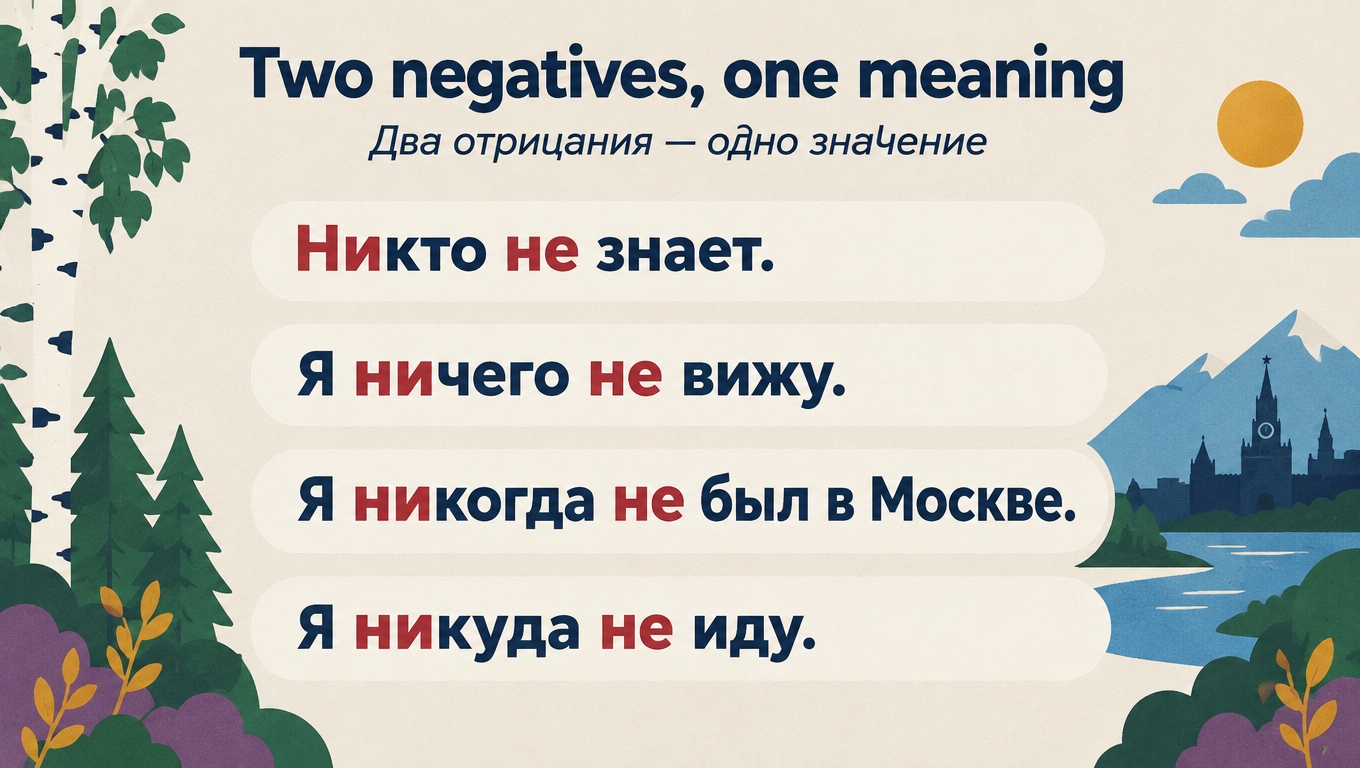
The genitive arrives, and it does three jobs at once: saying what you do not have, saying how much of something there is, and following the seven prepositions that always take it. Nothing, nobody, never and nowhere come with it, and Russian double negation stops being a mystery.
⏱ About 60 minutes26 phrases34 exercises
What you will learn
Recognise the genitive as the case of absence and of quantity, and know the two questions it answers: Кого? Чего?
Form the genitive singular of masculine, feminine and neuter nouns, including the -ы / -и spelling rule after гкхжшщч
Form the genitive plural of the high-frequency nouns — книг, работ, мест, слов, денег, жизней — and know which ones insert a fleeting vowel
Say what you do not have with нет and what you do have with есть, and keep the noun in the right case in both
Negate a whole sentence with ничего, никого, никогда, нигде and никуда, and tell them apart from their stressed не- twins by ear
Use the seven genitive prepositions из, с, от, до, у, для and без, and choose between из and с by mirroring в and на
Quick review
Say these aloud before you start. They come from earlier lessons.
У меня́ есть кни́га.I have a book.Listen in Russian:Slow in Russian:У меня́ есть кни́га.
Я не понима́ю.I do not understand.Listen in Russian:Slow in Russian:Я не понима́ю.
Я живу́ в Москве́.I live in Moscow.Listen in Russian:Slow in Russian:Я живу́ в Москве́.
Он идёт на рабо́ту.He is going to work.Listen in Russian:Slow in Russian:Он идёт на рабо́ту.
У нас больша́я семья́.We have a big family.Listen in Russian:Slow in Russian:У нас больша́я семья́.
Как дела́?How are things?Listen in Russian:Slow in Russian:Как дела́?
Theory
Кого? Чего? — the case of what is not there
The genitive answers two questions, Кого? and Чего?, and it does three jobs you will use every day: saying that something is absent, saying how much of something there is, and following seven prepositions. English has no case ending for any of this, but it has the meanings — "of", "’s", "some", "any" — so the idea is not new to you, only the ending is.
You have already been using the genitive for four lessons without being told. The меня in «Уменяестькнига» is the genitive of я. The времени in «Скольковремени?» is the genitive of время. The дела in «Какдела?» is the nominative plural of дело, and «нетпроблем» in your head right now is a genitive plural too. Today you get to see the machine instead of the chunks.
The one idea worth holding on to is this: the genitive is the case of absence and of an unspecified amount. «Естькнига» is nominative because one definite book is there; «неткниги» is genitive because no book at all is there. That single contrast explains most of what follows, including why много and нет govern the same case.
У меня́ есть кни́га.I have a book. (nominative — one specific book is there)Listen in Russian:Slow in Russian:У меня́ есть кни́га.
У меня́ нет кни́ги.I don’t have a book. (genitive — no book is there)Listen in Russian:Slow in Russian:У меня́ нет кни́ги.
У меня́ мно́го книг.I have a lot of books. (genitive plural — an amount, not things)Listen in Russian:Slow in Russian:У меня́ мно́го книг.
Я из Росси́и.I am from Russia. (genitive after из)Listen in Russian:Slow in Russian:Я из Росси́и.
The endings: four shapes, and one spelling rule
In the singular, masculine and neuter nouns add -а or -я: вопроса, ответа, места, слова, музея. Feminine nouns in -а add -ы or -и: работы, воды, книги, ошибки. Feminine nouns in -я and third-declension nouns in a soft sign add -и: России, Италии, жизни. Three shapes, and if you know the gender and the ending of the nominative you already know which one applies.
The choice between -ы and -и is not free. After г, к, х, ж, ш, щ or ч Russian spells -и and never -ы, so книга gives книги and ошибка gives ошибки, while работа gives работы and вода gives воды. You met this spelling rule in Lesson 1 with the plural; it is the same rule, and it applies to the genitive too.
The plural is less tidy, and it is honest to say so. Most masculines take -ов, -ев or -ей: вопросов, ответов, музеев, врачей. Most feminines and most neuters take no ending at all: книг, работ, проблем, мест, слов, дел. The third declension takes -ей: жизней, дверей, площадей. Two things go wrong often enough to deserve naming: a fleeting vowel appears where the ending would leave the word unsupported — ошибка becomes ошибок, деньги becomes денег — and the stress may move onto the ending. Lesson 12 gives you the complete map; today, learn the genitive plural of each new noun as part of the noun.
вопро́с — вопро́са — вопро́совquestion — of a question — of questionsListen in Russian:Slow in Russian:вопро́с — вопро́са — вопро́сов
рабо́та — рабо́ты — рабо́тwork — of work — of jobsListen in Russian:Slow in Russian:рабо́та — рабо́ты — рабо́т
ме́сто — ме́ста — местplace — of a place — of placesListen in Russian:Slow in Russian:ме́сто — ме́ста — мест
жизнь — жи́зни — жи́знейlife — of a life — of livesListen in Russian:Slow in Russian:жизнь — жи́зни — жи́зней
нет + genitive, есть + nominative
This is the construction the whole lesson exists for, and it is smaller than it looks. «Уменяестьвремя» becomes «Уменянетвремени». One word disappears, one word arrives, and the noun changes its ending. Nothing else moves — not the pronoun, not the word order, not the intonation.
The important restriction is that нет in this sense is present tense only. In the past Russian says небыло, in the future небудет, and the noun stays in the genitive in both: «Уменянебыловремени», «Уменянебудетвремени». English collapses all three into "don’t have / didn’t have / won’t have", which is why learners keep saying *небыловремя.
нет also stands on its own, with no уменя in front of it, meaning "there is no" or "there are no": «Нетпроблем», «Здесьнетметро», «Хлебанет». And it has a colloquial twin, нету, which does exactly the same job in speech and is avoided in writing — «Денегнету». Recognise нету, produce нет.
У меня́ есть вода́. — У меня́ нет воды́.I have water. — I have no water.Listen in Russian:Slow in Russian:У меня́ есть вода́. — У меня́ нет воды́.
У нас есть де́ньги. — У нас нет де́нег.We have money. — We have no money.Listen in Russian:Slow in Russian:У нас есть де́ньги. — У нас нет де́нег.
Здесь нет магази́на.There is no shop here.Listen in Russian:Slow in Russian:Здесь нет магази́на.
У меня́ не бы́ло вре́мени.I didn’t have time. (нет becomes не было in the past)Listen in Russian:Slow in Russian:У меня́ не бы́ло вре́мени.
ни- and не-: nothing, nobody, never, nowhere
Six words carry negation through a whole sentence: никто, ничто, никогда, нигде, никуда, and the forms of the first two. Every one of them has a stressed twin written with не — некого, нечего, некогда, негде, некуда — and the difference is not spelling, it is stress. If the first syllable carries the stress, the prefix is не- and the meaning is "there is nobody / nothing / no time / nowhere to …". If the stress sits further back, the prefix is ни- and the word simply negates.
The ни- words need a partner. Russian negates twice and both halves are compulsory: «Яничегонезнаю», «Онаникогонезнает», «Онникуданеидёт». Drop the не from the verb and the sentence is wrong, not merely casual. The single exception is a sentence that already contains нет — «Уменяничегонет» needs nothing more, because нет is the negation.
Two details finish the picture. With a preposition the ни splits off and the preposition goes in the middle: ниукого, ниочём, нидочего. And ничего on its own, said with a shrug, means "never mind, it’s nothing" — you will hear it constantly. The stressed не- forms belong to an impersonal construction with a dative subject: «Мненечегосказать», «Мненекогда».
Я ничего́ не понима́ю.I don’t understand anything.Listen in Russian:Slow in Russian:Я ничего́ не понима́ю.
Она́ никого́ не зна́ет.She doesn’t know anyone.Listen in Russian:Slow in Russian:Она́ никого́ не зна́ет.
Я никогда́ не был в Москве́.I have never been to Moscow.Listen in Russian:Slow in Russian:Я никогда́ не был в Москве́.
Мне не́чего сказа́ть.I have nothing to say. (stressed не-, impersonal construction)Listen in Russian:Slow in Russian:Мне не́чего сказа́ть.
The seven prepositions that take the genitive
Seven prepositions govern the genitive: из, с, от, до, у, для, без. Learn them as preposition-plus-noun chunks rather than as a list — изРоссии, сработы, отврача, довокзала, уменя, длятебя, безденег — and the case ending arrives for free with the chunk. This is the same way you learnt вМоскве and наработе, and it works for the same reason. One exception worth knowing now: с has a second life with the instrumental, where it means "with" — смолоком, сбратом. That is Lesson 10, and it is a different с with a different meaning.
Two of them, из and с, are the pair that causes almost all the mistakes, and there is exactly one rule. из mirrors в and с mirrors на: whichever preposition you use for "where" decides the one for "where from". вмагазин — измагазина, вРоссии — изРоссии; наработу — сработы, навокзале — свокзала. There is nothing else to weigh up, and *изработы is simply not Russian.
The remaining five are each one idea. от is departure from a person or from a point — письмоотбрата, онапришлаотврача. до is a limit in space or time — довокзала, доутра. для is "for" a person or a purpose — дляменя, длядетей. без is "without" — безмолока, безпроблем. And у is the one you already know: at someone’s place, and the possession construction уменяесть. Now you know which case it governs.
Мы идём из магази́на.We are coming from the shop.Listen in Russian:Slow in Russian:Мы идём из магази́на.
Он идёт с рабо́ты.He is coming back from work.Listen in Russian:Slow in Russian:Он идёт с рабо́ты.
До вокза́ла далеко́.The station is a long way off.Listen in Russian:Slow in Russian:До вокза́ла далеко́.
Ко́фе без молока́, пожа́луйста.Coffee without milk, please.Listen in Russian:Slow in Russian:Ко́фе без молока́, пожа́луйста.
The genitive: four noun classes, three shapes
Form
вопро́с (m)
рабо́та (f)
ме́сто (n)
жизнь (f, 3rd declension)
Кто? Что? — Nominative
вопро́с
рабо́та
ме́сто
жизнь
Кого? Чего? — Genitive singular
вопро́са
рабо́ты
ме́ста
жи́зни
много … — Genitive plural
вопро́сов
рабо́т
мест
жи́зней
The ending you add
-а / -я
-ы / -и
-а / -я
-и (sg), -ей (pl)
This is the whole genitive in four columns. Singular: -а or -я for masculine and neuter, -ы or -и for feminine nouns in -а (write -и after гкхжшщч, so книги and ошибки but работы), and -и for third-declension nouns in a soft sign. Plural: -ов / -ев / -ей for most masculines, nothing at all for most feminines and neuters, -ей for the third declension. The genitive plural is the least predictable form in the noun system — learn it with the noun. Lesson 12 gives the complete map.
есть + Nominative against нет + Genitive
Form
есть + Nominative — "I have"
нет + Genitive — "I haven’t got"
кни́га (f)
Уменя́естькни́га.
Уменя́неткни́ги.
вре́мя (n, -мя)
Уменя́естьвре́мя.
Уменя́нетвре́мени.
вода́ (f, uncountable)
Уменя́естьвода́.
Уменя́нетводы́.
де́ньги (plural only)
Уменя́естьде́ньги.
Уменя́нетде́нег.
Only the noun changes. The уменя chunk you have been saying since Lesson 4 stays exactly as it was, and so does the word order. This construction exists in the present tense only: in the past and future Russian replaces нет with небыло and небудет and keeps the genitive — Уменянебыловремени, Уменянебудетвремени.
Откуда? из and с mirror в and на
Form
го́род (m)
Росси́я (f)
рабо́та (f)
вокза́л (m)
Куда? — в / на + Accusative
вго́род
вРосси́ю
нарабо́ту
навокза́л
Где? — в / на + Prepositional
вго́роде
вРосси́и
нарабо́те
навокза́ле
Откуда? — из / с + Genitive
изго́рода
изРосси́и
срабо́ты
свокза́ла
One pairing removes all the guesswork: из mirrors в, and с mirrors на. You went вгород and наработу, so you come back изгорода and сработы. The preposition you chose for "where" decides the preposition for "where from" — there is no other rule to remember, and *изработы is simply not Russian.
ни- (unstressed) against не- (stressed)
Form
the question word
ни- : "not any …"
не- : "there is no … to …"
who / what
кто / что
никого́ / ничего́
не́кого / не́чего
where (location)
где
нигде́
не́где
where to (direction)
куда́
никуда́
не́куда
when
когда́
никогда́
не́когда
Listen for the stress, not the spelling — it is the only thing that tells these apart. If the first syllable carries the stress the prefix is не-, and the word belongs to an impersonal construction with a dative subject and an infinitive: Мненечегосказать, Мненекудаидти, Мненекогда. If the stress sits further back the prefix is ни-, and the word simply negates — but then Russian needs a second не on the verb: Яничегонезнаю. With a preposition the ни splits off and the preposition goes in the middle: ниукого, ниочём, нидочего.
Vocabulary
Learn each word with its stress mark and its pronunciation. Nouns are given with their gender, animacy and their full six-case declension; verbs are given with their aspect and, where one exists, their partner verb.
Russian
English
Gender / aspect
Pronunciation
Audio
мно́гоadverb
much, many, a lot
adverb
/ˈmnoɡə/muh-NOH-guh
Listen in Russian:Slow in Russian:много
ма́лоadverb
little, few, not much
adverb
/ˈmalə/MAH-luh
Listen in Russian:Slow in Russian:мало
не́сколькоnumeral
a few, several
numeral
/ˈnʲeskəlʲkə/NYEH-skul-kuh
Listen in Russian:Slow in Russian:несколько
никто́pronoun
nobody, no one
pronoun
/nʲɪˈkto/nik-TOH
Listen in Russian:Slow in Russian:никто
ничто́pronoun
nothing
pronoun
/nʲɪˈʂto/nih-CHTOH
Listen in Russian:Slow in Russian:ничто
никогда́adverb
never
adverb
/nʲɪkɐɡˈda/nih-kug-DAH
Listen in Russian:Slow in Russian:никогда
нигде́adverb
nowhere, not anywhere
adverb
/nʲɪˈɡdʲe/nig-DYEH
Listen in Russian:Slow in Russian:нигде
никуда́adverb
nowhere, to nowhere
adverb
/nʲɪkʊˈda/nih-koo-DAH
Listen in Russian:Slow in Russian:никуда
не́туparticle
there isn't, there aren't (colloquial)
particle
/ˈnʲetʊ/NYEH-too
Listen in Russian:Slow in Russian:нету
изpreposition
out of, from (inside)
preposition
/is/EES
Listen in Russian:Slow in Russian:из
сpreposition
off, from (a surface or an event)
preposition
/s/S
Listen in Russian:Slow in Russian:с
отpreposition
away from (a person or a point)
preposition
/ot/OHT
Listen in Russian:Slow in Russian:от
доpreposition
as far as; until
preposition
/do/DOH
Listen in Russian:Slow in Russian:до
уpreposition
at, by (someone's place); у + genitive = possession
preposition
/u/OO
Listen in Russian:Slow in Russian:у
дляpreposition
for (a person or a purpose)
preposition
/dlʲa/DLYAH
Listen in Russian:Slow in Russian:для
безpreposition
without
preposition
/bʲes/BYES
Listen in Russian:Slow in Russian:без
вре́мяneuter · inanimate
time
neuter · inanimate
/ˈvrʲemʲə/VRYEH-myuh
Listen in Russian:Slow in Russian:время
де́ньгиinanimate
money
inanimate
/ˈdʲenʲɡʲɪ/DYEN-gih
Listen in Russian:Slow in Russian:деньги
рабо́таfeminine · inanimate
work, job
feminine · inanimate
/rɐˈbotə/ruh-BOH-tuh
Listen in Russian:Slow in Russian:работа
ме́стоneuter · inanimate
place; seat, spot
neuter · inanimate
/ˈmʲestə/MYEH-stuh
Listen in Russian:Slow in Russian:место
слово́neuter · inanimate
word
neuter · inanimate
/ˈslovə/sluh-VOH
Listen in Russian:Slow in Russian:слово
де́лоneuter · inanimate
matter, affair, business
neuter · inanimate
/ˈdʲelə/DYEH-luh
Listen in Russian:Slow in Russian:дело
жизньfeminine · inanimate
life
feminine · inanimate
/ʐɨznʲ/ZHIHZN
Listen in Russian:Slow in Russian:жизнь
пробле́маfeminine · inanimate
problem
feminine · inanimate
/prɐˈblʲemə/pruh-BLYEH-muh
Listen in Russian:Slow in Russian:проблема
оши́бкаfeminine · inanimate
mistake, error
feminine · inanimate
/ɐˈʂɨpkə/uh-SHIHP-kuh
Listen in Russian:Slow in Russian:ошибка
вопро́сmasculine · inanimate
question
masculine · inanimate
/vɐˈpros/vuh-PROHS
Listen in Russian:Slow in Russian:вопрос
отве́тmasculine · inanimate
answer, reply
masculine · inanimate
/ɐˈtvʲet/uh-TVYET
Listen in Russian:Slow in Russian:ответ
ско́лькоadverb
how much, how many
adverb
/ˈskolʲkə/SKOHL-kuh
Listen in Russian:Slow in Russian:сколько
нетparticle
no; there is not
particle
/nʲet/NYET
Listen in Russian:Slow in Russian:нет
кни́гаfeminine · inanimate
book
feminine · inanimate
/ˈknʲiɡə/kuh-NEE-guh
Listen in Russian:Slow in Russian:книга
вода́feminine · inanimate
water
feminine · inanimate
/vɐˈda/vuh-DAH
Listen in Russian:Slow in Russian:вода
врачmasculine · animate
doctor
masculine · animate
/vratɕ/VRAHCH
Listen in Russian:Slow in Russian:врач
Росси́яfeminine · inanimate
Russia
feminine · inanimate
/rɐˈsʲijə/ruh-SEE-yuh
Listen in Russian:Slow in Russian:Россия
вокза́лmasculine · inanimate
railway station
masculine · inanimate
/vɐɡˈzal/vug-ZAHL
Listen in Russian:Slow in Russian:вокзал
Full six-case declension of the 16 nouns in this lesson
Each case is listed with the question word that selects it. Find the question you are answering and the ending follows.
Singular
Form
вре́мя (n)
де́ньги
рабо́та (f)
ме́сто (n)
слово́ (n)
де́ло (n)
жизнь (f)
пробле́ма (f)
оши́бка (f)
вопро́с (m)
отве́т (m)
кни́га (f)
вода́ (f)
врач (m)
Росси́я (f)
вокза́л (m)
nom · Кто? Что?
вре́мя
—
рабо́та
ме́сто
сло́во
де́ло
жизнь
пробле́ма
оши́бка
вопро́с
отве́т
книга
вода
врач
Росси́я
вокзал
gen · Кого? Чего?
вре́мени
—
рабо́ты
ме́ста
сло́ва
де́ла
жи́зни
пробле́мы
оши́бки
вопро́са
отве́та
книги
воды
врача
Росси́и
вокзала
dat · Кому? Чему?
вре́мени
—
рабо́те
ме́сту
сло́ву
де́лу
жи́зни
пробле́ме
оши́бке
вопро́су
отве́ту
книге
воде
врачу
Росси́и
вокзалу
acc · Кого? Что?
вре́мя
—
рабо́ту
ме́сто
сло́во
де́ло
жизнь
пробле́му
оши́бку
вопро́с
отве́т
книгу
воду
врача
Росси́ю
вокзал
instr · Кем? Чем?
вре́менем
—
рабо́той
ме́стом
сло́вом
де́лом
жи́знью
пробле́мой
оши́бкой
вопро́сом
отве́том
книгой
водой
врачом
Росси́ей
вокзалом
prep · Оком? Очём?
вре́мени
—
рабо́те
ме́сте
сло́ве
де́ле
жи́зни
пробле́ме
оши́бке
вопро́се
отве́те
книге
воде
враче
Росси́и
вокзале
Plural
Form
вре́мя (n)
де́ньги
рабо́та (f)
ме́сто (n)
слово́ (n)
де́ло (n)
жизнь (f)
пробле́ма (f)
оши́бка (f)
вопро́с (m)
отве́т (m)
кни́га (f)
вода́ (f)
врач (m)
Росси́я (f)
вокза́л (m)
nom · Кто? Что?
времена́
де́ньги
рабо́ты
места́
слова́
дела́
жи́зни
пробле́мы
оши́бки
вопро́сы
отве́ты
книги
во́ды
врачи́
—
вокзалы
gen · Кого? Чего?
времён
де́нег
рабо́т
мест
слов
дел
жи́зней
пробле́м
оши́бок
вопро́сов
отве́тов
книг
вод
враче́й
—
вокзалов
dat · Кому? Чему?
времена́м
де́ньгам
рабо́там
места́м
слова́м
дела́м
жи́зням
пробле́мам
оши́бкам
вопро́сам
отве́там
книгам
во́дам
врача́м
—
вокзалам
acc · Кого? Что?
времена́
де́ньги
рабо́ты
места́
слова́
дела́
жи́зни
пробле́мы
оши́бки
вопро́сы
отве́ты
книги
во́ды
враче́й
—
вокзалы
instr · Кем? Чем?
времена́ми
де́ньгами
рабо́тами
места́ми
слова́ми
дела́ми
жи́знями
пробле́мами
оши́бками
вопро́сами
отве́тами
книгами
во́дами
врача́ми
—
вокзалами
prep · Оком? Очём?
времена́х
де́ньгах
рабо́тах
места́х
слова́х
дела́х
жи́знях
пробле́мах
оши́бках
вопро́сах
отве́тах
книгах
во́дах
врача́х
—
вокзалах
A dash means the form does not exist. Plural-only nouns such as де́ньги and су́тки have no singular, and indeclinable nouns such as ко́фе and метро́ keep one form in all six cases.
Ready-to-use phrases
У меня́ нет вре́мени.
I haven’t got any time.
IPA/ʊ mʲɪˈna nʲet ˈvrʲemʲɪnʲɪ/
Say itoo mih-NYAH NYET VRYEH-mih-nih.
The sentence of the lesson. есть takes the nominative, нет takes the genitive, and the уменя chunk does not move at all. время is an -мя noun, hence времени.
neutralgenitivenegationtime
Listen in Russian:Slow in Russian:У меня нет времени.
У меня́ нет де́нег.
I haven’t got any money.
IPA/ʊ mʲɪˈna nʲet ˈdʲenʲɪk/
Say itoo mih-NYAH NYET DYEH-nikh.
деньги has no singular, so the genitive plural денег is the only form there is. The fleeting о appears because the ending is zero.
neutralgenitivenegationshopping
Listen in Russian:Slow in Russian:У меня нет денег.
У нас мно́го рабо́ты.
We’ve got a lot of work.
IPA/ʊ nas ˈmnoɡə rɐˈbotɨ/
Say itoo NAHS muh-NOH-guh ruh-BOH-tih.
много governs the genitive. With an uncountable noun like работа that genitive is singular: работы, not работ.
neutralgenitivenumberswork
Listen in Russian:Slow in Russian:У нас много работы.
У меня́ ма́ло вре́мени.
I haven’t got much time.
IPA/ʊ mʲɪˈna ˈmalə ˈvrʲemʲɪnʲɪ/
Say itoo mih-NYAH MAH-luh VRYEH-mih-nih.
мало behaves exactly like много — same case, same word order.
neutralgenitivenumberstime
Listen in Russian:Slow in Russian:У меня мало времени.
Ско́лько у тебя́ де́нег?
How much money have you got?
IPA/ˈskolʲkə ʊ tʲɪˈbʲa ˈdʲenʲɪk/
Say itSKOHL-kuh oo tih-BYAH DYEH-nikh?
сколько governs the genitive just like много. Read literally the order is "how much at you of money?" — Russian has no verb "to have" to put anywhere.
informalgenitivequestionsshopping
Listen in Russian:Slow in Russian:Сколько у тебя денег?
У меня́ мно́го книг.
I’ve got a lot of books.
IPA/ʊ mʲɪˈna ˈmnoɡə ˈknʲik/
Say itoo mih-NYAH muh-NOH-guh kuh-NEEKH.
With a countable noun много takes the genitive plural, and the genitive plural of книга drops its ending entirely: книг.
neutralgenitivepluralobjects
Listen in Russian:Slow in Russian:У меня много книг.
У меня́ не́сколько вопро́сов.
I have a few questions.
IPA/ʊ mʲɪˈna ˈnʲeskəlʲkə vɐˈprosof/
Say itoo mih-NYAH NYEH-skul-kuh vuh-PROH-suf.
несколько + genitive plural. The final в of вопросов devoices to [f] before the pause.
neutralgenitivepluralquestions
Listen in Russian:Slow in Russian:У меня несколько вопросов.
Я ничего́ не понима́ю.
I don’t understand anything.
IPA/ja nʲɪtɕɪˈvo nʲe pənʲɪˈmaju/
Say itYAH nih-chih-VOH NYEH puh-nih-MAH-yoo.
Russian negates twice and neither half is optional: ничего and the не on the verb. The г of ничего is pronounced [в].
neutralgenitivenegationpronouns
Listen in Russian:Slow in Russian:Я ничего не понимаю.
У меня́ ничего́ нет.
I haven’t got anything.
IPA/ʊ mʲɪˈna nʲɪtɕɪˈvo nʲet/
Say itoo mih-NYAH nih-chih-VOH NYET.
With нет there is no second не — нет already carries the negation. This is the one place where double negation does not apply.
neutralgenitivenegationpronouns
Listen in Russian:Slow in Russian:У меня ничего нет.
Я никого́ здесь не зна́ю.
I don’t know anyone here.
IPA/ja nʲɪkɐˈvo zdʲesʲ nʲe ˈznaju/
Say itYAH nih-kuh-VOH ZDYES NYEH ZNAH-yoo.
никого is the genitive of кто with the negative prefix. Double negation again, and the negative pronoun sits in front of the verb.
neutralgenitivenegationpronouns
Listen in Russian:Slow in Russian:Я никого здесь не знаю.
Я никогда́ не был в Москве́.
I have never been to Moscow.
IPA/ja nʲɪkɐɡˈda nʲe bɨl f mɐˈskvʲe/
Say itYAH nih-kug-DAH NYEH BIHL v muh-SKVYEH.
A woman says никогданебыла. Russian has no perfect tense, so "have never been" is simply the past plus никогда. вМоскве is the prepositional case of Lesson 5.
neutralgenitivenegationtimetravel
Listen in Russian:Slow in Russian:Я никогда не был в Москве.
Он никуда́ не идёт.
He isn’t going anywhere.
IPA/on nʲɪkʊˈda nʲe ɪˈdʲot/
Say itOHN nih-koo-DAH NYEH ih-DYOHT.
никуда is the direction form, the negative twin of куда; нигде is the location form. идёт needs no stress mark because ё is always stressed.
neutralgenitivenegationmotion
Listen in Russian:Slow in Russian:Он никуда не идёт.
Я нигде́ не рабо́таю.
I don’t work anywhere.
IPA/ja nʲɪˈɡdʲe nʲe rɐˈbotəju/
Say itYAH nig-DYEH NYEH ruh-BOH-tuh-yoo.
neutralgenitivenegationwork
Listen in Russian:Slow in Russian:Я нигде не работаю.
Я из Росси́и.
I’m from Russia.
IPA/ja ɪz rɐˈsʲijɪ/
Say itYAH iz ruh-SEE-ih.
из + genitive for "out of" a country, a town or a building — the mirror of в. Here the з stays voiced because России begins with a consonant.
neutralgenitivegeographyintroductions
Listen in Russian:Slow in Russian:Я из России.
Она́ из Ита́лии.
She’s from Italy.
IPA/ɐˈna ɪz ɪˈtalʲɪjɪ/
Say ituh-NAH iz ih-TAH-lih-ih.
Feminine nouns in -ия keep their -и- and add -и in the genitive: Италия — Италии. The same shape as Россия — России.
neutralgenitivegeography
Listen in Russian:Slow in Russian:Она из Италии.
Мы идём из магази́на.
We’re coming from the shop.
IPA/mɨ ɪˈdʲom ɪz məɡɐˈzʲinə/
Say itMIH ih-DYOHM iz muh-guh-ZEE-nuh.
You go вмагазин, so you come back измагазина. из always mirrors в; с always mirrors на.
neutralgenitivemotioncity
Listen in Russian:Slow in Russian:Мы идём из магазина.
Он идёт с рабо́ты.
He’s on his way home from work.
IPA/on ɪˈdʲot s rɐˈbotɨ/
Say itOHN ih-DYOHT s ruh-BOH-tih.
наработу — сработы. Because "at work" is наработе, "from work" is сработы, never *изработы.
neutralgenitivemotionwork
Listen in Russian:Slow in Russian:Он идёт с работы.
Она́ пришла́ от врача́.
She’s come back from the doctor’s.
IPA/ɐˈna prʲɪʂˈla ɐt vrɐˈtɕa/
Say ituh-NAH prih-SHLAH ut vruh-CHAH.
от is departure from a person or from a point, not from inside a building — that is из. A man says пришёл, a woman пришла.
neutralgenitivemotionhealth
Listen in Russian:Slow in Russian:Она пришла от врача.
Письмо́ от бра́та.
A letter from my brother.
IPA/pʲɪsʲˈmo ɐt ˈbratə/
Say itpih-SMOH ud BRAH-tuh.
A noun phrase with no verb at all: the genitive after от says everything.
neutralgenitivefamilyobjects
Listen in Russian:Slow in Russian:Письмо от брата.
До вокза́ла далеко́.
The station is a long way off.
IPA/də vɐɡˈzalə dɐlʲɪˈko/
Say itduh vug-ZAH-luh duh-lih-KOH.
до + genitive is "as far as" in space and "until" in time: доутра, довечера. The preposition is unstressed and reduces to [də].
neutralgenitivetransportcity
Listen in Russian:Slow in Russian:До вокзала далеко.
Э́то для тебя́.
This is for you.
IPA/ˈɛtə dlʲa tʲɪˈbʲa/
Say itEH-tuh dlyuh tih-BYAH.
для + genitive is the ordinary "for" a person or a purpose. Informal ты form; the polite version is длявас.
neutralgenitiveeveryday
Listen in Russian:Slow in Russian:Это для тебя.
Ко́фе без молока́, пожа́луйста.
Coffee without milk, please.
IPA/ˈkofʲe bʲez mɐlɐˈka pɐˈʐalujstə/
Say itKOH-fyuh biz muh-luh-KAH, puh-ZHAH-luy-stuh.
без + genitive, and молоко́ gives молока́ with the stress on the ending. Before the voiced м the з of без stays [з].
politegenitivefoodrestaurant
Listen in Russian:Slow in Russian:Кофе без молока, пожалуйста.
У него́ нет сестры́.
He hasn’t got a sister.
IPA/ʊ nʲɪˈvo nʲet sʲɪˈstrɨ/
Say itoo nih-VOH NYET sih-STRIH.
After a preposition the third-person pronouns gain an initial н: унего, унеё, уних. The genitive of сестра́ is сестры́, with the stress on the ending.
neutralgenitivenegationfamily
Listen in Russian:Slow in Russian:У него нет сестры.
Нет пробле́м!
No problem!
IPA/nʲet prɐˈblʲem/
Say itNYET pruh-BLYEM!
The genitive plural of проблема is проблем, with no ending. This is the standard "no problem", and it is a genitive standing on its own with no noun to agree with.
neutralgenitivenegationeveryday
Listen in Russian:Slow in Russian:Нет проблем!
У меня́ нет воды́.
I haven’t got any water.
IPA/ʊ mʲɪˈna nʲet vɐˈdɨ/
Say itoo mih-NYAH NYET vuh-DIH.
вода́ in the nominative but воды́ in the genitive: a feminine -а noun takes -ы, and the stress stays on the ending in both.
neutralgenitivenegationfood
Listen in Russian:Slow in Russian:У меня нет воды.
Де́нег не́ту.
There’s no money.
IPA/ˈdʲenʲɪk ˈnʲetʊ/
Say itDYEH-nikh NYEH-too.
нету is the colloquial twin of нет in exactly this use — the noun first, the negation last. It is very common in speech and avoided in writing; нет is always safe.
informalgenitivenegationshopping
Listen in Russian:Slow in Russian:Денег нету.
Dialogues
After work
Tom runs into Anna in the street. They are friends, so they use ты.
Tom
Привет, Анна! Ты идёшь с работы?
Hi Anna! Are you on your way home from work?
Listen in Russian:Slow in Russian:Привет, Анна! Ты идёшь с работы?
Anna
Привет! Да, я иду с работы.
Hi! Yes, I’m coming from work.
Listen in Russian:Slow in Russian:Привет! Да, я иду с работы.
Tom
У тебя есть время? Я иду в кафе.
Have you got time? I’m going to a café.
Listen in Russian:Slow in Russian:У тебя есть время? Я иду в кафе.
Anna
Нет, у меня мало времени. У меня много работы.
No, I’ve got very little time. I’ve got a lot of work.
Listen in Russian:Slow in Russian:Нет, у меня мало времени. У меня много работы.
Tom
Сколько у тебя работы?
How much work have you got?
Listen in Russian:Slow in Russian:Сколько у тебя работы?
Anna
Много. И у меня нет денег.
A lot. And I’ve got no money.
Listen in Russian:Slow in Russian:Много. И у меня нет денег.
Tom
Ничего! Завтра у меня нет работы.
Never mind! Tomorrow I’ve got no work.
Listen in Russian:Slow in Russian:Ничего! Завтра у меня нет работы.
Anna
Завтра хорошо! Спасибо.
Tomorrow is good! Thank you.
Listen in Russian:Slow in Russian:Завтра хорошо! Спасибо.
A new colleague
Ivan and Marina have only just met at the office, so they use вы.
Ivan
Здравствуйте! Вы из России?
Hello! Are you from Russia?
Listen in Russian:Slow in Russian:Здравствуйте! Вы из России?
Marina
Нет, я из Италии. А вы?
No, I’m from Italy. And you?
Listen in Russian:Slow in Russian:Нет, я из Италии. А вы?
Ivan
Я из Москвы. Вы работаете здесь?
I’m from Moscow. Do you work here?
Listen in Russian:Slow in Russian:Я из Москвы. Вы работаете здесь?
Marina
Да, я работаю здесь. А вы?
Yes, I work here. And you?
Listen in Russian:Slow in Russian:Да, я работаю здесь. А вы?
Ivan
Я тоже. У вас много работы?
So do I. Have you got a lot of work?
Listen in Russian:Slow in Russian:Я тоже. У вас много работы?
Marina
Да, много. Но у меня мало времени.
Yes, a lot. But I’ve got very little time.
Listen in Russian:Slow in Russian:Да, много. Но у меня мало времени.
Ivan
У вас есть вопросы?
Have you got any questions?
Listen in Russian:Slow in Russian:У вас есть вопросы?
Marina
Да, у меня несколько вопросов. Спасибо!
Yes, I have a few questions. Thank you!
Listen in Russian:Slow in Russian:Да, у меня несколько вопросов. Спасибо!
Nothing in the fridge
Tom and Anna are at home on a Sunday morning, looking in the fridge.
Tom
Анна, у нас есть хлеб?
Anna, have we got any bread?
Listen in Russian:Slow in Russian:Анна, у нас есть хлеб?
Anna
Нет, у нас нет хлеба.
No, we haven’t got any bread.
Listen in Russian:Slow in Russian:Нет, у нас нет хлеба.
Tom
А молоко?
And milk?
Listen in Russian:Slow in Russian:А молоко?
Anna
Молока тоже нет. И воды нет.
No milk either. And no water.
Listen in Russian:Slow in Russian:Молока тоже нет. И воды нет.
Tom
У нас нет денег?
Have we got no money?
Listen in Russian:Slow in Russian:У нас нет денег?
Anna
Есть, но мало.
We have some, but not much.
Listen in Russian:Slow in Russian:Есть, но мало.
Tom
Я иду в магазин. Что ты хочешь?
I’m going to the shop. What do you want?
Listen in Russian:Slow in Russian:Я иду в магазин. Что ты хочешь?
Anna
Хлеб, молоко и воду. Спасибо!
Bread, milk and water. Thanks!
Listen in Russian:Slow in Russian:Хлеб, молоко и воду. Спасибо!
Exercises
Answer actively — try to recall the Russian before you look at any hint.
Case ChoiceExercise 1
Choose the correct form of книга.
Уменянет ___ . (книга)
Case ChoiceExercise 2
Choose the correct form of работа.
Онидётс ___ . (работа)
Ending ChoiceExercise 3
Choose the ending.
Genitive singular of «вопрос»: вопрос___
Ending ChoiceExercise 4
Choose the ending.
Genitive singular of «работа»: работ___
Multiple ChoiceExercise 5
Choose the correct sentence.
Which sentence means "I haven’t got any money"?
Fill GapExercise 6
Fill the gap with the genitive of время.
Уменянет ___ . (время)
Fill GapExercise 7
Fill the gap with the Russian for "nothing".
Я ___ непонимаю. (nothing)
Fill GapExercise 8
Fill the gap with the right preposition.
Онапришла ___ врача. (from)
Translate To RussianExercise 9
Translate into Russian.
I haven’t got any time.
Translate To RussianExercise 10
Translate into Russian.
She is from Italy.
Translate To EnglishExercise 11
Translate into English.
Уменя́нетде́нег.
True FalseExercise 12
Answer true or false.
«Уменянеткнига» is correct Russian.
Match PairsExercise 13
Pair the prepositions.
Match each genitive preposition with its meaning.
Flashcard Self RatingExercise 14
Recall the English meaning, then rate how well you knew it.
без
Stress ChoiceExercise 15
Choose the correctly stressed form.
Where does the stress fall in «деньги»?
Listen And ChooseExercise 16
Play the audio and pick the match.
Listen and choose the sentence you hear.
Case ChoiceExercise 17
Choose the correct form of магазин.
Мыидёмиз ___ . (магазин)
Case ChoiceExercise 18
Choose the correct form of брат.
Этописьмоот ___ . (брат)
Case ChoiceExercise 19
Choose the correct form of вокзал.
До ___ далеко. (вокзал)
Case ChoiceExercise 20
Choose the correct form of молоко.
Кофебез ___ , пожалуйста. (молоко)
Ending ChoiceExercise 21
Choose the ending.
Genitive singular of «место»: мест___
Ending ChoiceExercise 22
Choose the ending.
Genitive singular of «жизнь»: жизн___
Multiple ChoiceExercise 23
Choose the rule.
Both из and с can mean "from". How do you choose between them?
Translate To RussianExercise 24
Translate into Russian.
We have a lot of work.
Translate To RussianExercise 25
Translate into Russian.
I don’t understand anything.
Translate To RussianExercise 26
Translate into Russian.
He is walking home from work.
Translate To EnglishExercise 27
Translate into English.
Онникуда́неидёт.
Sentence TransformExercise 28
Keep the meaning of the chunk, change the construction.
Rewrite this sentence with нет: «Уменяестькнига.»
Sentence TransformExercise 29
Rewrite it to mean "I didn’t have time."
Put this into the past and negate it: «Уменяестьвремя.»
Word OrderExercise 30
Put the words in order.
Build the sentence: "I don’t know anyone here."
Pronoun ChoiceExercise 31
Choose the correct form of я.
У ___ нетвремени.
Stress ChoiceExercise 32
Choose the correctly stressed form.
Where does the stress fall in «ничего»?
Listen And TypeExercise 33
Play the audio and type what you hear.
Listen and type the sentence.
Translate To RussianExercise 34
Translate into Russian.
I have never been to Moscow.
Speak now
Say each sentence aloud three times: slowly, at normal speed, then from memory. Then swap one noun for another you know and put it into the genitive — that swap is the drill that makes the ending automatic. Say the ending loudly; the whole lesson lives in the last two sounds of the noun.
У меня́ нет вре́мени.I haven’t got any time.Listen in Russian:Slow in Russian:У меня́ нет вре́мени.
У меня́ мно́го рабо́ты.I have a lot of work.Listen in Russian:Slow in Russian:У меня́ мно́го рабо́ты.
Я ничего́ не понима́ю.I don’t understand anything.Listen in Russian:Slow in Russian:Я ничего́ не понима́ю.
Я никогда́ не рабо́таю до́ма.I never work at home.Listen in Russian:Slow in Russian:Я никогда́ не рабо́таю до́ма.
Он идёт с рабо́ты.He is coming back from work.Listen in Russian:Slow in Russian:Он идёт с рабо́ты.
Ко́фе без молока́, пожа́луйста.Coffee without milk, please.Listen in Russian:Slow in Russian:Ко́фе без молока́, пожа́луйста.
Lesson checkpoint
Before you move on, make sure you can do all of this without looking:
Take five nouns you already know and give the genitive singular of each, out loud, without looking
Say three things you do not have, using нет and the genitive
Say where you are from with из, and where you have just come from with с — then explain out loud why the two prepositions differ
Negate «Японимаюэто» with ничего, then negate it again with никогда, and say both aloud
Give the genitive plural of книга, работа, место and жизнь
Say «Уменяестьвремя» in the past and in the future, both negative
Remember this
The genitive answers Кого? Чего? and does three jobs at this level: absence after нет, an amount after много, мало, несколько and сколько, and the object of seven prepositions.
Genitive singular: -а or -я for masculine and neuter, -ы or -и for feminine nouns in -а, -и for feminine nouns in -я and for third-declension nouns in a soft sign. After г, к, х, ж, ш, щ or ч write -и, never -ы.
Genitive plural: -ов, -ев or -ей for most masculines, no ending at all for most feminines and neuters, -ей for the third declension. It is the least predictable form in the noun system, so learn it with each noun — книг, работ, мест, слов, денег, ошибок, жизней.
есть takes the nominative, нет takes the genitive: Уменяестькнига — Уменянеткниги. нет is present tense only; the past and future use небыло and небудет, still with the genitive.
Unstressed ни- negates and needs a second не on the verb: Яничегонезнаю. Stressed не- means "there is nothing or nobody to …" and stands in an impersonal construction with a dative subject: Мненечегосказать, Мненекогда. With a preposition the ни splits: ниукого, ниочём.
из mirrors в and с mirrors на: вмагазин — измагазина, наработу — сработы. от is away from a person or a point, до is as far as or until, для is for, без is without, у is at someone’s place.