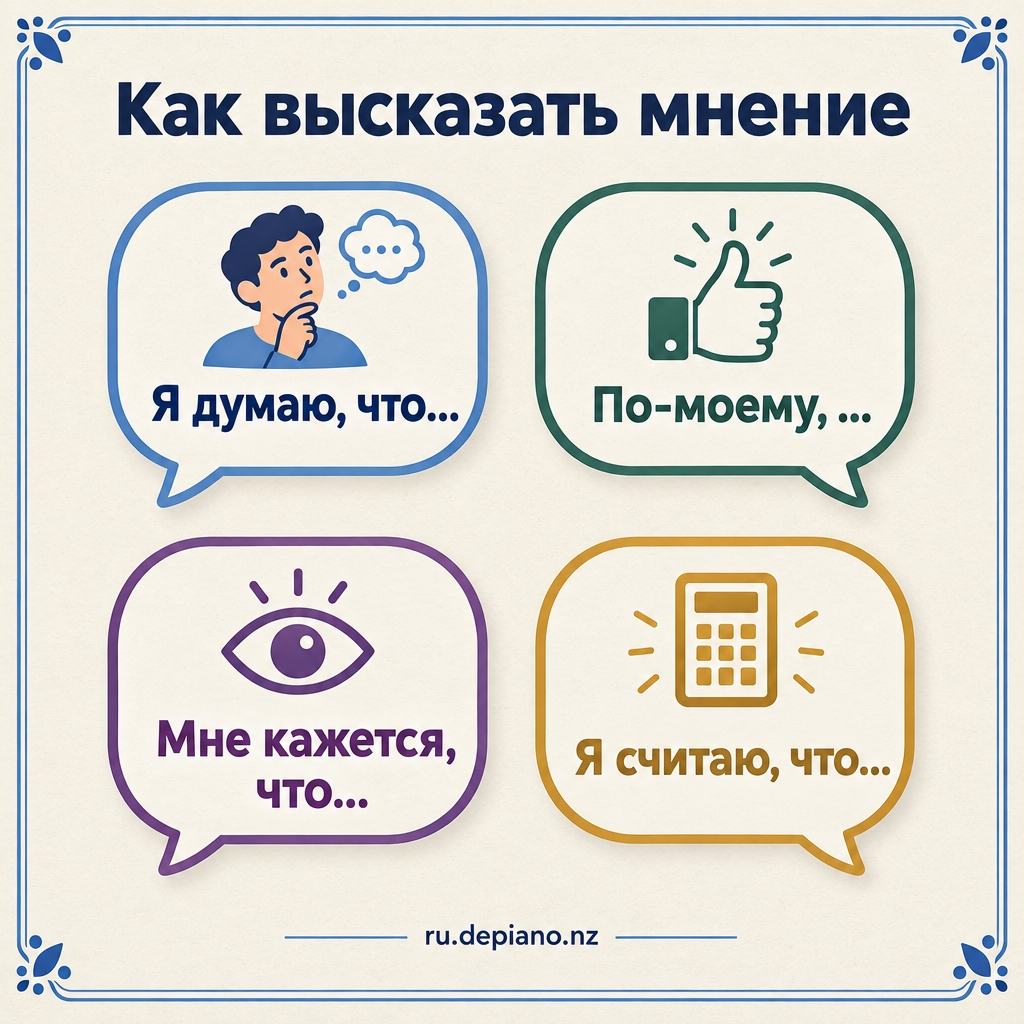
Say what you think and how you feel, and make the sentences hold together: four opinion frames, polite agreement and disagreement, the two families of feeling words, and the connector kit — потомучто, поэтому, но, однако, хотя, если and чтобы — that turns separate statements into real speech.
⏱ About 55 minutes26 phrases32 exercises
What you will learn
Give an opinion four ways — ядумаю, мнекажется, по-моему and помоемумнению — and pick the frame that fits the register
Agree and disagree correctly: ясогласен / согласнас + the instrumental, янесогласен, and the polite hedge янесовсемсогласен
Link ideas with the connector kit and keep потомучто and поэтому pointing in the right direction — reason backward, result forward
Use чтобы with an infinitive or a past form depending on whether the doer changes, and never confuse the conjunction чтобы with the two-word чтобы
Keep a genuine future tense after если where English drops back to the present, and tell the real condition from the counterfactual еслибы
Express feelings in both Russian families — the impersonal dative (мнежалко, мнеобидно) and the agreeing short adjective (ярад, онарада) — and soften a disagreement like a native speaker
Quick review
Say these aloud before you start. They come from earlier lessons.
Мне нравится эта музыка.I like this music. (Lesson 4 — the dative-experiencer frame this lesson builds on)Listen in Russian:Slow in Russian:Мне нравится эта музыка.
Мне было скучно вчера.I was bored yesterday. (Lessons 2 and 4 — the impersonal state in the past, with было)Listen in Russian:Slow in Russian:Мне было скучно вчера.
У меня нет времени.I haven't got any time. (Lesson 8 — нет + the genitive)Listen in Russian:Slow in Russian:У меня нет времени.
Когда я приеду, я позвоню тебе.When I arrive I shall ring you. (Lesson 14 — a genuine future after когда; если behaves exactly the same)Listen in Russian:Slow in Russian:Когда я приеду, я позвоню тебе.
Я хотел бы чашку чая, пожалуйста.I would like a cup of tea, please. (Lesson 19 — the conditional with бы)Listen in Russian:Slow in Russian:Я хотел бы чашку чая, пожалуйста.
Вы не могли бы мне помочь?Could you help me? (Lesson 19 — the polite request frame)Listen in Russian:Slow in Russian:Вы не могли бы мне помочь?
Theory
Four ways to say what you think
Everything you have said so far in this course states facts: I am a student, I live in Moscow, it was cold yesterday. Now you need sentences that state what you think about the facts, and Russian has four ready-made frames for it, ordered here from the bluntest to the most careful. Ядумаю, что… is the plain one: a nominative subject, a verb, and an ordinary statement after что, exactly like "I think that…". Мнекажется, что… says the same thing and means literally "it seems to me that…". По-моему, … is the conversational workhorse — "in my view" — and помоемумнению, …, three separate words, is the frame you write rather than say.
The difference between ядумаю and мнекажется is not decoration; it is grammar, and that is why it matters. Ядумаю has a subject — you — doing the thinking. Мнекажется puts you in the dative and hands the subject role to the seeming itself, the same shape as мненравится in Lesson 4 and мнетрудно in Lesson 9: the person who feels is not the subject of the sentence. That distance between you and your own statement is what makes мнекажется softer, and it is why Russians reach for it precisely when they are about to disagree with you.
Agreement and disagreement have their own single word. Ясогласен from a man, ясогласна from a woman — a short adjective that agrees with the speaker and is followed by с + the instrumental for the thing agreed with: стобой, свами, сэтиммнением. The negative is не straight in front: янесогласен. And the polite way to disagree without a full contradiction is янесовсемсогласен, "I do not entirely agree". Notice what is missing: no verb "to agree" anywhere. Russian does the whole job with four short adjective forms.
Я думаю, что этот фильм очень хороший.I think this film is very good.Listen in Russian:Slow in Russian:Я думаю, что этот фильм очень хороший.
Мне кажется, что она не знает.I think she does not know. (literally "It seems to me that she does not know.")Listen in Russian:Slow in Russian:Мне кажется, что она не знает.
По-моему, завтра будет дождь.In my opinion it will rain tomorrow.Listen in Russian:Slow in Russian:По-моему, завтра будет дождь.
Я не совсем согласна с вами.I do not entirely agree with you. (a woman, formal)Listen in Russian:Slow in Russian:Я не совсем согласна с вами.
The connector kit: direction, contrast, register
Separate short sentences are not yet speech. What makes them speech is connectors, and the kit in this lesson covers nearly every link you will need at this level. The two most important are mirror images. Потомучто looks backwards: it brings in the reason for something already said — Янепозвонил, потомучтонезнал. Поэтому looks forwards: it brings in the result of what was just said — Былохолодно, поэтомумынепошливпарк. English hides the direction inside flexible words like "so" and "because", which is why every learner swaps these two at first. Remember the direction, not the translation.
For contrast there are three weights. Но is the plain "but" of a real obstacle or contradiction, introduced in Lesson 3. А switches the subject without contradicting anything: Этомойбрат, аэтоегожена. Однако is the formal "however" — mid-sentence, after a comma, it means exactly но, but it makes you sound considered rather than conversational, and it belongs in an email or a careful argument. Хотя concedes a point and then overrides it: Хотяшёлдождь, мыпошлигулять. And такчто is the spoken "so" that closes a chain: Шёлдождь, такчтомынепошлигулять.
Above these sit the discourse markers, the words that organise talk rather than join clauses. Конечно, "of course", is the strongest agreement word there is. Можетбыть, "maybe", is the everyday hedge. Кстати, "by the way", lets you change the subject without losing the floor. Вообще generalises in front of a statement ("in general") and strengthens a negative behind не ("at all"). Насамомделе, "actually", announces that you are about to contradict an expectation. Most of them are parentheticals and take a comma when they open a sentence. And to be honest about levels: A1 only asks for потомучто, поэтому, но, а, если and когда — the rest of the kit is A2, and it is here deliberately, because this is the part of the language that makes you sound like a person rather than a textbook.
Я не позвонил, потому что не знал.I did not ring because I did not know.Listen in Russian:Slow in Russian:Я не позвонил, потому что не знал.
Было холодно, поэтому мы не пошли в парк.It was cold, so we did not go to the park.Listen in Russian:Slow in Russian:Было холодно, поэтому мы не пошли в парк.
Он хороший человек, однако с ним трудно работать.He is a good person, but he is difficult to work with.Listen in Russian:Slow in Russian:Он хороший человек, однако с ним трудно работать.
Хотя шёл дождь, мы пошли гулять.Although it was raining, we went for a walk.Listen in Russian:Slow in Russian:Хотя шёл дождь, мы пошли гулять.
что and чтобы: reporting against wanting
Two words, two letters apart, and a wall that every learner climbs. Что introduces a fact — something reported, thought, known or said: Ядумаю, чтоондома. Онасказала, чтопридёт. The clause after что is an ordinary sentence in an ordinary tense. Чтобы introduces a wanted action — a purpose or a wish — and the clause after it is not ordinary at all: its verb form depends on one thing only, which is whether the two actions have the same doer.
Same doer, infinitive: Япозвонил, чтобыспроситьоработе — the person who rang and the person who asks are one and the same, so спросить stands in its bare infinitive and чтобы means simply "in order to". Different doer, past form and nothing else: Яхочу, чтобытыпришёл — the wanting is mine, the coming is yours, and the second verb wears the past shape пришёл even though the event is tomorrow. That shape carries no past time at all. It is the subjunctive, the same form the particle бы uses in Lesson 19 — and that is not a coincidence, because чтобы is literally что and бы grown together.
The two classic errors follow from all this: *Яхочу, чтотыпридёшь, where что has been used for a wish because English says "I want that you will come", and *Яхочу, чтобытыприйти, where the infinitive has survived a change of doer. One more distinction to file away: written as one word, чтобы is the conjunction; written as two, чтобы is the question word что plus the particle бы — Чтобытыхотел? "What would you like?" The space makes the difference on paper, and the particle stays unstressed in speech. All of this is A2 territory; at A1 you are only expected to recognise чтобы with an infinitive.
Я думаю, что он дома.I think he is at home.Listen in Russian:Slow in Russian:Я думаю, что он дома.
Я позвонил, чтобы спросить о работе.I rang in order to ask about the work.Listen in Russian:Slow in Russian:Я позвонил, чтобы спросить о работе.
Я хочу, чтобы ты пришёл завтра.I want you to come tomorrow.Listen in Russian:Slow in Russian:Я хочу, чтобы ты пришёл завтра.
Что бы ты хотел?What would you like? (two words: the pronoun plus the particle)Listen in Russian:Slow in Russian:Что бы ты хотел?
если: the future tense that English hides
English talks about the future in an if-clause by stepping back into the present: "If it rains tomorrow, I will stay at home." There is no future tense after "if". Russian refuses to do this. After если about the future it keeps a genuine future form: Еслизавтрабудетдождь, яостанусьдома. You have in fact already met this rule — Lesson 14 taught exactly the same thing about когда: Когдаяприеду, япозвонютебе. The two connectors behave identically, and one habit covers both.
The rule often goes unnoticed because a perfective verb wears its future in disguise: in Еслитыпридёшь, мыбудемоченьрады the form придёшь is the perfective future of прийти (Lessons 14–15), not a present. An imperfective future cannot hide at all: Еслибудетвремя, япозвонютебе — будет is visibly a future, on both sides of the comma. So the habit to install is short: after если and когда pointing at the future, the verb stays in the future. The English present tense there is a local quirk of English, not a universal one.
Add бы and the whole meaning turns. Еслибыуменябыловремя, ябыпозвонил — "if I had time, I would ring" — is the conditional of Lesson 19: a condition that does not hold, built with the particle бы in both halves. Keep the two frames strictly apart: если with a future for the real conditions of your week, еслибы with a past form for the lives you are not living.
Если будет время, я позвоню тебе.If there is time, I shall ring you.Listen in Russian:Slow in Russian:Если будет время, я позвоню тебе.
Если ты придёшь, мы будем очень рады.If you come, we shall be very glad.Listen in Russian:Slow in Russian:Если ты придёшь, мы будем очень рады.
Когда я приеду, я позвоню тебе.When I arrive I shall ring you. (Lesson 14 — the same rule)Listen in Russian:Slow in Russian:Когда я приеду, я позвоню тебе.
Если бы у меня было время, я бы позвонил.If I had time, I would ring.Listen in Russian:Slow in Russian:Если бы у меня было время, я бы позвонил.
Feelings: two families that look like one
English reports feelings with "I am" plus an adjective: I am glad, I am sorry, I am hurt. Russian splits the same ground into two grammatical families, and mixing them is the classic mistake of this lesson. Family one you already know: the impersonal dative. Мнехолодно in Lesson 4, мнетрудно in Lesson 9, and the new members here are мнежалко and мнеобидно. There is no subject anywhere; the person who feels stands in the dative; the feeling word never changes; the past adds было: мнебыложалко. Жалко takes what is pitied in the genitive — мнежалковремени, мнежалкоденег — though with a definite person or thing the accusative is equally common: мнежалкокнигу. Обидно is the feeling of having been slighted, of having been treated unfairly, and when it is felt on somebody else's behalf it takes за + the accusative: мнеобиднозанеё.
Family two has exactly one member in this lesson: рад. It is a short adjective — a predicate only, never standing in front of a noun — and it agrees with the subject: ярад from a man, ярада from a woman, мырады from both. The subject stands in the nominative, and in the past the copula comes back: ябылрад, онабыларада. So "I am glad" is ярад, a faithful English-shaped sentence, while "I am hurt" is мнеобидно, with no "I" in sight. *Мнерад is not Russian, and neither is *яобидно. Which family a feeling word belongs to is simply something to memorise — and in this lesson рад is the odd one out.
These frames double as politeness tools. Мнежалко, чтотынеможешьприйти — "I am sorry you cannot come" — is the standard softener for a refusal, and here жалко has no object at all. And hedging is how Russian disagrees without friction: мнекажется in front of a judgement, можетбыть in front of a correction, несовсем in front of a negative. Янесовсемсогласен, номнекажется, что… is a sentence you could hear in any office in Moscow — and after this lesson you own every piece of it.
Мне жалко, что ты не можешь прийти.I am sorry you cannot come.Listen in Russian:Slow in Russian:Мне жалко, что ты не можешь прийти.
Мне обидно, когда ты не звонишь.It hurts when you do not ring.Listen in Russian:Slow in Russian:Мне обидно, когда ты не звонишь.
Я очень рад вас видеть!I am very glad to see you! (a man speaking)Listen in Russian:Slow in Russian:Я очень рад вас видеть!
Она была очень рада, что мы пришли.She was very glad that we had come.Listen in Russian:Slow in Russian:Она была очень рада, что мы пришли.
The connector kit — what each connector does, and where the comma goes
Form
What it does
Punctuation
Example
потому́что
brings in the REASON — it looks backward
one conjunction: the comma goes before потому́, never before что
Янепозвони́л, потому́чтонезнал.
поэ́тому
brings in the RESULT — it looks forward
the comma goes before поэ́тому; as an adverb it can also move inside its own clause
Бы́лохо́лодно, поэ́томумынепошли́впарк.
но
but: a real contradiction, an obstacle
the comma goes before но
Японима́ютебя́, ноянесогла́сен.
а
and / whereas: a switch of subject, no contradiction (Lesson 3)
the comma goes before а
Э́томойбрат, аэ́тоего́жена́.
одна́ко
however — formal, written, considered
mid-sentence the comma goes before одна́ко
Онхоро́шийчелове́к, одна́коснимтру́днорабо́тать.
хотя́
although: it concedes a fact and then overrides it
the comma goes before хотя́ when the concessive clause comes second
Мыпошли́гуля́ть, хотя́шёлдождь.
такчто
so, with the result that — spoken, and it closes the chain
the comma goes before так; the two words are never written as one
Шёлдождь, такчтомынепошли́гуля́ть.
что́бы
so that; and after хоте́ть — the wish construction
the comma goes before что́бы; same doer → infinitive, different doer → past form
Яхочу́, что́бытыпришёл.
е́сли
if
the comma goes before е́сли; the clause keeps a genuine future tense
Е́слибу́детвре́мя, япозвоню́тебе́.
коне́чно · мо́жетбыть
of course · maybe — the agreement word and the hedge
parentheticals: a comma follows when they open a sentence
Мо́жетбыть, за́втра.
кста́ти · вообще́ · наса́момде́ле
by the way · in general / at all · actually
parentheticals: a comma follows when they open a sentence
Кста́ти, гдетвоя́сестра́?
Direction is the whole trick with the first two: потомучто looks backward to the reason, поэтому looks forward to the result. The rest of the kit — однако, хотя, такчто, чтобы and the discourse markers — is A2 material, and it is here deliberately: Lessons 17–23 push past the A1 minimum on purpose.
что · чтобы · потомучто · поэтому — the four that everyone mixes up
Form
что
что́бы
потому́что
поэ́тому
part of speech
pronoun and conjunction
conjunction — что and the particle бы grown together
one conjunction written as two words
adverb
meaning
that; what
so that; (that) after a wish
because
that is why, so
what follows it
an ordinary statement in any tense
same doer: an infinitive. Different doer: a past form — and nothing else
the cause — the fact behind what has just been said
the result — what followed from it
direction
reports a fact you believe
points at an action you want
← backward, to the reason
→ forward, to the result
example
Яду́маю, чтоэ́тохорошо́.
Яхочу́, что́бытыпришёл.
Янезнал, потому́чтонеспроси́л.
Уменя́небы́ловре́мени, поэ́томуянепозвони́л.
что and чтобы are not variants of one another: что reports, чтобы wants. And because the particle бы is unstressed while the conjunction is not, the stress mark is also what keeps the conjunction apart from the two-word question чтобытыхотел? The wish construction sits at A2, not A1.
Feelings: the impersonal dative against the short adjective
Form
мнежа́лко · мнеоби́дно
ярад · яра́да
мненра́вится (Lesson 4)
who feels
the dative — мне · тебе́ · ей · нам
the nominative — я · она́ · мы
the dative — мне · тебе́ · ей
what agrees
nothing — the feeling word never changes
four forms: рад, ра́да · ра́до · ра́ды
нра́вится · нра́вятся — the verb follows the thing liked
in the past
add бы́ло: мнебы́ложа́лко
the copula returns: ябылрад, она́была́ра́да
мненра́вилось · нра́вились
what it takes
a genitive or accusative object, or a что / когда́ clause
за + the accusative when the hurt is for somebody else; a что clause
the nominative for the thing liked
example
Мнежа́лко, чтотынемо́жешьприйти́.
Яо́ченьрад, чтовыздесь.
Мненра́витсяэ́тотфильм.
The trap is *мнерад: рад is not impersonal. The impersonal family has no subject at all — the person sits in the dative and the feeling word never changes — while рад is a short adjective that agrees with a nominative subject. Both translate English feelings, and only the grammar tells you which frame you are in.
Vocabulary
Learn each word with its stress mark and its pronunciation. Nouns are given with their gender, animacy and their full six-case declension; verbs are given with their aspect and, where one exists, their partner verb.
Russian
English
Gender / aspect
Pronunciation
Audio
потому́ чтоconjunction
because
conjunction
/pətɐˈmu ʂto/puh-tuh-MOO SHTOH
Listen in Russian:Slow in Russian:потому что
поэ́томуadverb
that is why, so, therefore
adverb
/pɐˈɛtəmʊ/puh-EH-tuh-moo
Listen in Russian:Slow in Russian:поэтому
одна́коconjunction
however, but (bookish)
conjunction
/ɐdˈnakə/ud-NAH-kuh
Listen in Russian:Slow in Russian:однако
хотя́conjunction
although, even though
conjunction
/xɐˈtʲa/khuh-TYAH
Listen in Russian:Slow in Russian:хотя
е́слиconjunction
if
conjunction
/ˈjesʲlʲɪ/YEH-slih
Listen in Russian:Slow in Russian:если
что́быconjunction
so that, in order that; (that) — after a wish
conjunction
/ˈʂtobə/SHTOH-bih
Listen in Russian:Slow in Russian:чтобы
так чтоconjunction
so, with the result that
conjunction
/tak ʂto/TAHK SHTOH
Listen in Russian:Slow in Russian:так что
коне́чноadverb
of course, certainly
adverb
/kɐˈnʲeʂnə/kuh-NYESH-nuh
Listen in Russian:Slow in Russian:конечно
мо́жет бытьphrase
maybe, perhaps
phrase
/ˈmoʐɨt bɨtʲ/MOH-zhit BIHT
Listen in Russian:Slow in Russian:может быть
кста́тиadverb
by the way, incidentally
adverb
/ˈkstatʲɪ/kuh-STAH-tih
Listen in Russian:Slow in Russian:кстати
вообще́adverb
in general; at all
adverb
/vəɐpˈɕːe/vuh-up-SHCHEH
Listen in Russian:Slow in Russian:вообще
на са́мом де́леphrase
actually, as a matter of fact
phrase
/nə sɐˈmom ˈdʲelʲe/nuh SAH-mum DYEH-lyuh
Listen in Russian:Slow in Russian:на самом деле
по-мо́емуadverb
in my opinion, as I see it
adverb
/pəˈmojɪmʊ/puh-MOH-yih-moo
Listen in Russian:Slow in Russian:по-моему
мне ка́жетсяphrase
it seems to me, I think
phrase
/mnʲe ˈkaʐɨtsə/muh-NYEH KAH-zhih-tsyuh
Listen in Russian:Slow in Russian:мне кажется
согла́сенadjective
agreeing; I agree
adjective
/sɐˈɡlasʲɪn/suh-GLAH-sin
Listen in Russian:Slow in Russian:согласен
радadjective
glad, pleased
adjective
/rat/RAHT
Listen in Russian:Slow in Russian:рад
жа́лкоadverb
it is a pity; I feel sorry for
adverb
/ˈʐalkə/ZHAHL-kuh
Listen in Russian:Slow in Russian:жалко
оби́дноadverb
it hurts; it is a slight
adverb
/ɐˈbʲidnə/uh-BEED-nuh
Listen in Russian:Slow in Russian:обидно
мне́ниеneuter · inanimate
opinion, view
neuter · inanimate
/ˈmnʲenʲɪje/muh-NYEH-nih-yuh
Listen in Russian:Slow in Russian:мнение
оби́даfeminine · inanimate
offence, hurt, slight
feminine · inanimate
/ɐˈbʲidə/uh-BEE-duh
Listen in Russian:Slow in Russian:обида
чтоpronoun
what
pronoun
/ʂto/SHTOH
Listen in Russian:Slow in Russian:что
ду́матьimperfective
to think
imperfective
/ˈdumətʲ/DOO-myut
Listen in Russian:Slow in Russian:думать
когда́adverb
when
adverb
/kɐɡˈda/kug-DAH
Listen in Russian:Slow in Russian:когда
аconjunction
and, whereas; but (mildly)
conjunction
/a/AH
Listen in Russian:Slow in Russian:а
ноconjunction
but
conjunction
/no/NOH
Listen in Russian:Slow in Russian:но
сказа́тьperfective
to say, to tell
perfective
/skɐˈzatʲ/skuh-ZYAT
Listen in Russian:Slow in Russian:сказать
нра́витьсяimperfective
to be pleasing — мне нра́вится means "I like"
imperfective
/ˈnravʲɪt͜sə/NRAH-vih-tsyuh
Listen in Russian:Slow in Russian:нравиться
ску́чноadverb
boring — мне скучно = I am bored
adverb
/ˈskuʂnə/SKOOSH-nuh
Listen in Russian:Slow in Russian:скучно
интере́сноadverb
interesting — мне интересно = I find it interesting
adverb
/ɪntʲɪˈrʲesnə/in-tih-RYEH-snuh
Listen in Russian:Slow in Russian:интересно
хо́лодноadverb
cold — мне холодно = I am cold
adverb
/ˈxolədnə/KHOH-lud-nuh
Listen in Russian:Slow in Russian:холодно
гру́стноadverb
sad — мне грустно = I feel sad
adverb
/ˈɡrusnə/GROO-snuh
Listen in Russian:Slow in Russian:грустно
тру́дноadverb
hard, difficult — мне трудно = I am finding it hard
adverb
/ˈtrudnə/TROOD-nuh
Listen in Russian:Slow in Russian:трудно
легко́adverb
easy, light — мне легко = I find it easy
adverb
/lʲɪxˈko/likh-KOH
Listen in Russian:Slow in Russian:легко
пробле́маfeminine · inanimate
problem
feminine · inanimate
/prɐˈblʲemə/pruh-BLYEH-muh
Listen in Russian:Slow in Russian:проблема
Full six-case declension of the 3 nouns in this lesson
Each case is listed with the question word that selects it. Find the question you are answering and the ending follows.
Singular
Form
мне́ние (n)
оби́да (f)
пробле́ма (f)
nom · Кто? Что?
мне́ние
оби́да
пробле́ма
gen · Кого? Чего?
мне́ния
оби́ды
пробле́мы
dat · Кому? Чему?
мне́нию
оби́де
пробле́ме
acc · Кого? Что?
мне́ние
оби́ду
пробле́му
instr · Кем? Чем?
мне́нием
оби́дой
пробле́мой
prep · Оком? Очём?
мне́нии
оби́де
пробле́ме
Plural
Form
мне́ние (n)
оби́да (f)
пробле́ма (f)
nom · Кто? Что?
мне́ния
оби́ды
пробле́мы
gen · Кого? Чего?
мне́ний
оби́д
пробле́м
dat · Кому? Чему?
мне́ниям
оби́дам
пробле́мам
acc · Кого? Что?
мне́ния
оби́ды
пробле́мы
instr · Кем? Чем?
мне́ниями
оби́дами
пробле́мами
prep · Оком? Очём?
мне́ниях
оби́дах
пробле́мах
Ready-to-use phrases
Я ду́маю, что э́то хоро́ший фильм.
I think it is a good film.
IPA/ja ˈduməjʊ ʂto ˈɛtə xɐˈroʂɨj fʲilʲm/
Say itYAH DOO-muh-yoo, SHTOH EH-tuh khuh-ROH-shiy FEELM.
The plainest way to give an opinion: думать plus что plus an ordinary statement in an ordinary tense. Two things to get right. The comma goes before что, always, and Russian keeps the subject pronoun я in front of думаю where English happily drops the "that". Note also the direction: думать takes что and never чтобы, because you are reporting a fact you believe, not wishing something into being.
neutralopinionsconnectorshobbies
Listen in Russian:Slow in Russian:Я думаю, что это хороший фильм.
Мне ка́жется, что она́ не зна́ет.
I think she does not know. (literally "It seems to me that she does not know.")
IPA/mnʲe ˈkaʐɨtsə ʂto ɐˈna nʲe ˈznajɪt/
Say itmuh-NYEH KAH-zhih-tsyuh, SHTOH uh-NAH NYEH ZNAH-yit.
Same meaning as ядумаю, but the grammar is different and so is the tone. Here the person who thinks is in the DATIVE (мне), not the nominative, because the subject of the sentence is the seeming itself — literally "to me it seems". That is the same shape as мненравится (Lesson 4) and мнетрудно (Lesson 9). The effect is softer and less committed, which is why Russians use it so heavily when they are about to disagree with you.
neutralopinionsconnectorsimpersonalfeelings
Listen in Russian:Slow in Russian:Мне кажется, что она не знает.
По-мо́ему, э́то о́чень тру́дно.
In my opinion, that is very difficult.
IPA/pəˈmojɪmʊ ˈɛtə ˈotɕɪnʲ ˈtrudnə/
Say itpuh-MOH-yih-moo, EH-tuh OH-chin TROOD-nuh.
The conversational opinion word, built on мой exactly as по-русски was built in Lesson 2. It is a parenthetical, so a comma follows it when it opens the sentence, and it does not need что: the statement after it stands on its own. Register matters here — по-моему is what you say to friends and colleagues you know; помоемумнению, three separate words, is what you write.
informalopinionsconnectorsregister
Listen in Russian:Slow in Russian:По-моему, это очень трудно.
По моему́ мне́нию, фильм ску́чный.
In my opinion the film is boring. (formal)
IPA/pə mɐjɪˈmu ˈmnʲenʲɪju fʲilʲm ˈskuʂnɨj/
Say itpuh muh-yih-MOO muh-NYEH-nih-yoo, FEELM SKOO-chniy.
The formal frame, and it shows off the -ие declension: мнение keeps its -и- in every form, so the dative here is мнению, never *мненью. Note that моему is the dative of мой agreeing with a neuter noun — the same -ему ending as the noun itself, and like every oblique form of мой it moves the stress onto that ending. Say this in an essay or at a meeting; say по-моему to a friend.
formalopinionsregister
Listen in Russian:Slow in Russian:По моему мнению, фильм скучный.
Я согла́сен с тобо́й.
I agree with you. (said by a man, informal)
IPA/ja sɐˈɡlasʲɪn s təˈboj/
Say itYAH suh-GLAH-sin s tuh-BOY.
согласен is a short adjective, so it agrees with the subject: a man says ясогласен, a woman says ясогласна. What you agree WITH goes in the instrumental after с — стобой, свами, сэтиммнением. Never *согласеннатебя and never *согласентебе.
informalopinionsinstrumentalgovernmentregister
Listen in Russian:Slow in Russian:Я согласен с тобой.
Я не согла́сна с ва́ми.
I do not agree with you. (said by a woman, formal)
IPA/ja nʲe sɐˈɡlasnə s ˈvamʲɪ/
Say itYAH NYEH suh-GLAH-snuh s VAH-mih.
Three markers at once. The feminine -а tells you a woman is speaking. The вы-form вами tells you the two people are not close, or that more than one person is being addressed. And не sits immediately in front of the word it negates, as it always does. The stress stays on the stem in all four forms of this adjective, unlike должна and больна, where the feminine moves it to the ending.
Listen in Russian:Slow in Russian:Я не согласна с вами.
Что ты ду́маешь об э́том фи́льме?
What do you think about this film?
IPA/ʂto tɨ ˈduməjɪʂ əb ˈɛtəm ˈfʲilʲmʲe/
Say itSHTOH TIH DOO-muh-yish ub EH-tum FEEL-myuh?
The question that starts every conversation about opinions, and a useful preposition drill at the same time: думатьо + the prepositional, "to think about". Before э the preposition о becomes об, and the adjective этот and the noun фильм both take the prepositional ending -е. Compare кактебефильм?, the shorter and more colloquial version of the same question.
neutralopinionsquestionsprepositionalhobbies
Listen in Russian:Slow in Russian:Что ты думаешь об этом фильме?
Я не позвони́л, потому́ что не знал.
I did not ring because I did not know.
IPA/ja nʲe pəzvɐˈnʲilʲ pətɐˈmu ʂto nʲe znal/
Say itYAH NYEH puh-zvuh-NEEL, puh-tuh-MOO SHTOH NYEH ZNAHL.
потомучто looks backwards: the fact is already on the table and the connector brings in the cause. The comma goes before потому, not before что, because the two words are one conjunction. Note the double negative too — Russian keeps не in both halves where English drops the second one.
neutralconnectorspastsyntax
Listen in Russian:Slow in Russian:Я не позвонил, потому что не знал.
Бы́ло хо́лодно, поэ́тому мы не пошли́ в парк.
It was cold, so we did not go to the park.
IPA/ˈbɨlə ˈxolədnə pəˈɛtəmʊ mɨ nʲe pəʂˈlʲi f park/
Say itBIH-luh KHOH-lud-nuh, puh-EH-tuh-moo MIH NYEH puh-SHLEE f PAHRK.
поэтому runs the opposite way: the cause comes first and the connector brings in the result. Compare the two sentences side by side and the direction is obvious — Янепозвонил, потомучтонезнал against Янезнал, поэтомунепозвонил. Also worth noticing: былохолодно is impersonal, with было carrying the past and no subject anywhere in the sentence (Lesson 4).
neutralconnectorspastimpersonalweathersyntax
Listen in Russian:Slow in Russian:Было холодно, поэтому мы не пошли в парк.
Я понима́ю тебя́, но я не согла́сен.
I understand you, but I do not agree.
IPA/ja pənʲɪˈmaju tʲɪˈbʲa no ja nʲe sɐˈɡlasʲɪn/
Say itYAH puh-nih-MAH-yoo tih-BYAH, NOH YAH NYEH suh-GLAH-sin.
The standard polite disagreement. но is the right connector because the second clause really does contradict the first; а would be wrong here, since а switches to a different subject without contradicting anything. Russian keeps both pronouns — японимаютебя, ноянесогласен — where English would drop the second "I".
neutralopinionsconnectorsnegation
Listen in Russian:Slow in Russian:Я понимаю тебя, но я не согласен.
Он хоро́ший челове́к, одна́ко с ним тру́дно рабо́тать.
He is a good person, but he is difficult to work with.
IPA/on xɐˈroʂɨj tɕɪləˈvʲek ɐdˈnakə s nʲim ˈtrudnə rɐˈbotətʲ/
Say itOHN khuh-ROH-shiy chih-luh-VYEK, ud-NAH-kuh s NEEM TROOD-nuh ruh-BOH-tyut.
однако is но wearing formal clothes, and this sentence is exactly where you meet it: a considered judgement about a person. Two other things are worth seeing. сним is the instrumental of он after a preposition, which is why it grows its н- (Lesson 4). And трудноработать is impersonal — there is no subject, the difficulty just is.
Listen in Russian:Slow in Russian:Он хороший человек, однако с ним трудно работать.
Хотя́ шёл дождь, мы пошли́ гуля́ть.
Although it was raining, we went for a walk.
IPA/xɐˈtʲa ʂol doʂtʲ mɨ pəʂˈlʲi ɡʊˈlʲatʲ/
Say itkhuh-TYAH SHOHL DOHCH, MIH puh-SHLEE goo-LYAT.
A concessive clause that comes first, which is the more emphatic of the two orders; put it second and the comma still sits before хотя: Мыпошлигулять, хотяшёлдождь. The weather formula идётдождь becomes шёлдождь in the past, with the verb in the masculine because дождь is masculine. шёл keeps its stress on the ё, and ё is never given an extra acute.
neutralconnectorspastweathersyntax
Listen in Russian:Slow in Russian:Хотя шёл дождь, мы пошли гулять.
Е́сли бу́дет вре́мя, я позвоню́ тебе́.
If there is time, I shall ring you.
IPA/ˈjesʲlʲɪ ˈbudʲɪt ˈvrʲemʲə ja pəzvɐˈnʲu tʲɪˈbʲe/
Say itYEH-slih BOO-dit VRYEH-myuh, YAH puh-zvuh-NYOO tih-BYEH.
The tense trap in one sentence. English says "if there is time" and drops back to the present; Russian keeps a genuine future, будет. The same is true of the verb in the other half — позвоню is future too. Where a perfective verb is used, that future form is a present-tense shape (еслитыпридёшь), which is what makes the two languages look alike and is not.
neutralconnectorsfuturetimesyntax
Listen in Russian:Slow in Russian:Если будет время, я позвоню тебе.
Я хочу́, что́бы ты пришёл.
I want you to come.
IPA/ja xɐˈʂu ˈʂtobə tɨ prʲɪˈʂol/
Say itYAH khuh-CHOO, SHTOH-bih TIH prih-SHOHL.
The construction that has no English equivalent. You want somebody else to do something, so the second verb goes after чтобы in a PAST form — пришёл — even though the meaning is future. Never *яхочу, чтотыпридёшь and never *яхочу, чтобытыприйти. That past shape is the subjunctive, the same one бы uses; чтобы is simply что and бы grown together. пришёл keeps its stress on the ё, which therefore carries no acute.
neutralconnectorsaspectsyntax
Listen in Russian:Slow in Russian:Я хочу, чтобы ты пришёл.
Я позвони́л, что́бы спроси́ть о рабо́те.
I rang in order to ask about the work.
IPA/ja pəzvɐˈnʲilʲ ˈʂtobə sprəˈsʲitʲ ə rɐˈbotʲe/
Say itYAH puh-zvuh-NEEL, SHTOH-bih spruh-SEET uh ruh-BOH-tyuh.
The other job of чтобы. Here the doer of both actions is the same person, so the verb after чтобы is an infinitive and the meaning is plain purpose: "in order to ask". One rule decides which of the two shapes you need — same doer, infinitive; different doer, past form. спроситьо + the prepositional gives оработе.
neutralconnectorspastprepositionalwork
Listen in Russian:Slow in Russian:Я позвонил, чтобы спросить о работе.
Так что ты реши́л?
So what did you decide?
IPA/tak ʂto tɨ rʲɪˈʂɨl/
Say itTAHK SHTOH TIH rih-SHIHL?
такчто closes an argument rather than opening one: the reason has just been given, and this asks for the consequence. Both words are monosyllables, so the whole connector carries no stress mark at all — the only one in this lesson that does not. Keep them separate; такчто is not a Russian word.
informalconnectorspastquestions
Listen in Russian:Slow in Russian:Так что ты решил?
Коне́чно, я приду́!
Of course I shall come!
IPA/kɐˈnʲeʂnə ja prʲɪˈdu/
Say itkuh-NYESH-nuh, YAH prih-DOO!
The strongest agreement word Russian has, and the one that needs no argument behind it. It is a parenthetical, so it takes a comma. Say the чн as [шн]: конечно is [kɐˈnʲeʂnə], one of the small group of words — with скучно — where the spelling and the sound genuinely part company. приду is the perfective future of прийти, and it means "I shall arrive", not "I am arriving".
neutralconnectorsfuturepoliteness
Listen in Russian:Slow in Russian:Конечно, я приду!
Мо́жет быть, за́втра.
Maybe tomorrow.
IPA/ˈmoʐɨt bɨtʲ ˈzaftrə/
Say itMOH-zhit BIHT, ZAHF-truh.
The everyday hedge, and the most useful two words in this lesson for sounding natural rather than blunt. It is the third person of мочь plus the infinitive быть frozen into a parenthetical — literally "it can be" — so the rest of the sentence is untouched by it. On its own as a whole reply it means "possibly, I am not sure", which is the polite Russian way of not committing.
neutralconnectorstimepoliteness
Listen in Russian:Slow in Russian:Может быть, завтра.
Кста́ти, где твоя́ сестра́?
By the way, where is your sister?
IPA/ˈkstatʲɪ ɡdʲe tvɐˈja sʲɪˈstra/
Say itkuh-STAH-tih, guh-DYEH tvuh-YAH sih-STRAH?
кстати lets you change the subject without losing the floor, and it takes a comma after it when it opens a sentence. The rest of the sentence is a zero-copula question straight out of Lesson 1 — где plus the nominative, no verb at all. The opening cluster кст- has no vowel in it and never gains one.
informalconnectorsquestionsfamily
Listen in Russian:Slow in Russian:Кстати, где твоя сестра?
Я вообще́ не понима́ю.
I do not understand at all.
IPA/ja vəɐpˈɕːe nʲe pənʲɪˈmaju/
Say itYAH vuh-up-SHCHEH NYEH puh-nih-MAH-yoo.
After a negative, вообще means "at all" and strengthens it. In front of a whole statement it means "as a rule, in general" — Вообщеянелюблюкофе — and the position of the word is the only thing that tells you which meaning you have. The stress is on the last syllable and both opening о are reduced but still audible.
neutralconnectorsnegationpresent
Listen in Russian:Slow in Russian:Я вообще не понимаю.
На са́мом де́ле э́то о́чень интере́сно.
Actually, it is very interesting.
IPA/nə sɐˈmom ˈdʲelʲe ˈɛtə ˈotɕɪnʲ ɪntʲɪˈrʲesnə/
Say itnuh SAH-mum DYEH-lyuh EH-tuh OH-chin in-tih-RYEH-snuh.
The corrective phrase. You use it when what comes next contradicts what the listener expects, and it is neutral enough for speech and writing alike. It is a prepositional phrase — на plus the prepositional of дело, with the adjective in the prepositional too — so it is literally "on the real thing". интересно here is impersonal: "it is interesting", with no subject.
neutralconnectorsopinions
Listen in Russian:Slow in Russian:На самом деле это очень интересно.
Мне жа́лко, что ты не мо́жешь прийти́.
I am sorry you cannot come.
IPA/mnʲe ˈʐalkə ʂto tɨ nʲe ˈmoʐɨʂ prʲɪjˈtʲi/
Say itmuh-NYEH ZHAHL-kuh, SHTOH TIH NYEH MOH-zhish priy-TEE.
Two different jobs of жалко in one lesson. With an object it means "I feel sorry for": мнежалковремени, мнежалкокнигу. Here it has no object at all and means "I am sorry that…", which is the ordinary Russian apology for a refusal or a piece of bad news. The experiencer is dative and there is no subject in either use.
neutralfeelingsimpersonalconnectorspoliteness
Listen in Russian:Slow in Russian:Мне жалко, что ты не можешь прийти.
Мне оби́дно, когда́ ты не звони́шь.
It hurts when you do not ring.
IPA/mnʲe ɐˈbʲidnə kɐˈɡda tɨ nʲe zvɐˈnʲiʂ/
Say itmuh-NYEH uh-BEED-nuh, kug-DAH TIH NYEH zvuh-NEESH.
обидно is stronger than English "hurt" sounds: it is the feeling of having been slighted, of having been treated unfairly, and it is normally followed by что or когда. The experiencer is dative and there is no subject. The verb in the когда-clause is present because this is a repeated situation, not one future event — that distinction is the whole point of the если rule.
informalfeelingsimpersonalconnectorsfamily
Listen in Russian:Slow in Russian:Мне обидно, когда ты не звонишь.
Я о́чень рад!
I am very glad! (said by a man)
IPA/ja ˈotɕɪnʲ rat/
Say itYAH OH-chin RAHT!
The exception in this lesson, and the one to keep separate from the impersonals. рад is a short adjective, so the sentence has a real subject in the nominative — я — and the predicate agrees with it: ярад, онарада, мырады. *Мнерад is not Russian. A woman says яоченьрада, and the past brings the copula back: ябылрад, ябыларада.
neutralfeelingsadjectivesagreementgreetings
Listen in Russian:Slow in Russian:Я очень рад!
Она́ ра́да, что мы здесь.
She is glad that we are here.
IPA/ɐˈna ˈradə ʂto mɨ zdʲesʲ/
Say ituh-NAH RAH-duh, SHTOH MIH ZDYES.
рад with a что-clause behind it, which is how you say somebody is glad about a particular thing. The feminine -а on рада agrees with она, and the stress stays on the stem in all four forms. The zero copula does its usual work: no verb anywhere, just онарада.
neutralfeelingsadjectivesagreementconnectors
Listen in Russian:Slow in Russian:Она рада, что мы здесь.
Мне ску́чно без тебя́.
I am bored without you.
IPA/mnʲe ˈskuʂnə bʲɪs tʲɪˈbʲa/
Say itmuh-NYEH SKOOSH-nuh bis tih-BYAH.
The impersonal family at its simplest: dative experiencer, no subject, no verb. без governs the genitive, so ты becomes тебя (Lesson 8). скучно is pronounced with [шн], not [чн], exactly like конечно. Say the same thing about the past and only one word changes: мнебылоскучнобезтебя.
informalfeelingsimpersonalfamily
Listen in Russian:Slow in Russian:Мне скучно без тебя.
Dialogues
Coming out of the cinema
Irina and Ben are friends, so they use ты. They have just watched a film and they do not agree about it.
Irina
Как тебе фильм?
What did you think of the film?
Listen in Russian:Slow in Russian:Как тебе фильм?
Ben
Мне кажется, это был не очень хороший фильм.
I don't think it was a very good film.
Listen in Russian:Slow in Russian:Мне кажется, это был не очень хороший фильм.
Irina
Я не согласна. Музыка была хорошая, и актёры играли очень хорошо.
I disagree. The music was good and the actors acted very well.
Listen in Russian:Slow in Russian:Я не согласна. Музыка была хорошая, и актёры играли очень хорошо.
Ben
Но мне было скучно, потому что я ничего не понял.
But I was bored, because I didn't understand anything.
Listen in Russian:Slow in Russian:Но мне было скучно, потому что я ничего не понял.
Irina
По-моему, ты не слушал музыку.
I don't think you were listening to the music.
Listen in Russian:Slow in Russian:По-моему, ты не слушал музыку.
Ben
Может быть. Но мне обидно, когда ты не слушаешь меня.
Maybe. But it hurts when you don't listen to me.
Listen in Russian:Slow in Russian:Может быть. Но мне обидно, когда ты не слушаешь меня.
Irina
Извини. На самом деле я рада, что мы пошли в кино.
Sorry. Actually I'm glad we went to the cinema.
Listen in Russian:Slow in Russian:Извини. На самом деле я рада, что мы пошли в кино.
Ben
Я тоже рад. Давай завтра посмотрим фильм дома.
I'm glad too. Let's watch a film at home tomorrow.
Listen in Russian:Slow in Russian:Я тоже рад. Давай завтра посмотрим фильм дома.
A colleague who did not come in
Olga and Rustam work in the same office. They are not close friends, so both of them use вы throughout.
Olga
Рустам, вы знаете, что Иван не пришёл сегодня?
Rustam, did you know that Ivan didn't come in today?
Listen in Russian:Slow in Russian:Рустам, вы знаете, что Иван не пришёл сегодня?
Rustam
Да, я знаю. Мне кажется, он был у врача.
Yes, I know. I think he was at the doctor's.
Listen in Russian:Slow in Russian:Да, я знаю. Мне кажется, он был у врача.
Olga
Поэтому он не позвонил?
Is that why he didn't ring?
Listen in Russian:Slow in Russian:Поэтому он не позвонил?
Rustam
Конечно. Однако нам надо решить вопрос сегодня.
Of course. But we need to settle the question today.
Listen in Russian:Slow in Russian:Конечно. Однако нам надо решить вопрос сегодня.
Olga
Я согласна. Если вы позвоните ему, я напишу письмо.
I agree. If you ring him, I'll write the letter.
Listen in Russian:Slow in Russian:Я согласна. Если вы позвоните ему, я напишу письмо.
Rustam
Хорошо. Я хочу, чтобы он ответил до вечера.
All right. I want him to reply before the evening.
Listen in Russian:Slow in Russian:Хорошо. Я хочу, чтобы он ответил до вечера.
Olga
Кстати, вы не могли бы объяснить ему проблему?
By the way, could you explain the problem to him?
Listen in Russian:Slow in Russian:Кстати, вы не могли бы объяснить ему проблему?
Rustam
Да, конечно. На самом деле это очень легко.
Yes, of course. Actually it's very easy.
Listen in Russian:Slow in Russian:Да, конечно. На самом деле это очень легко.
Olga
Спасибо! Я очень рада.
Thank you! I am very glad.
Listen in Russian:Slow in Russian:Спасибо! Я очень рада.
A telephone call between friends
Lena rings Aisha, who is upset about a friend. Both of them use ты, and both are careful about how they put things.
Lena
Аиша, как дела? Ты дома?
Aisha, how are you? Are you at home?
Listen in Russian:Slow in Russian:Аиша, как дела? Ты дома?
Aisha
Да. Мне очень грустно сегодня.
Yes. I'm very sad today.
Listen in Russian:Slow in Russian:Да. Мне очень грустно сегодня.
Lena
Почему? У тебя проблема?
Why? Have you got a problem?
Listen in Russian:Slow in Russian:Почему? У тебя проблема?
Aisha
Да. Моя подруга не пришла в кафе и не позвонила.
Yes. My friend didn't come to the café and she didn't ring.
Listen in Russian:Slow in Russian:Да. Моя подруга не пришла в кафе и не позвонила.
Lena
Как жалко! Может быть, она не знала, где кафе?
What a pity! Maybe she didn't know where the café was?
Listen in Russian:Slow in Russian:Как жалко! Может быть, она не знала, где кафе?
Aisha
Она знала! Мне обидно, потому что мы были хорошими подругами.
She knew! It hurts, because we were good friends.
Listen in Russian:Slow in Russian:Она знала! Мне обидно, потому что мы были хорошими подругами.
Lena
Я понимаю. Однако я думаю, что она позвонит завтра.
I understand. But I think she'll ring tomorrow.
Listen in Russian:Slow in Russian:Я понимаю. Однако я думаю, что она позвонит завтра.
Aisha
Может быть. Мне скучно. Пойдём в парк?
Maybe. I'm bored. Shall we go to the park?
Listen in Russian:Slow in Russian:Может быть. Мне скучно. Пойдём в парк?
Exercises
Answer actively — try to recall the Russian before you look at any hint.
Fill GapExercise 1
Fill the gap with the connector: "I did not ring because I did not know."
Янепозвонил, ___ незнал.
Fill GapExercise 2
Fill the gap with the connector: "It was cold, so we did not go to the park."
Былохолодно, ___ мынепошливпарк.
Multiple ChoiceExercise 3
Choose the connector.
Which connector completes the sentence? «Янепошёлнаработу, ___ уменянебыловремени.» — "I did not go to work because I had no time."
Multiple ChoiceExercise 4
Choose the definition.
What does поэтому bring into a sentence?
Translate To RussianExercise 5
Translate into Russian.
I think that this is a good film.
Translate To RussianExercise 6
Translate into Russian.
In my opinion, that is very difficult.
Multiple ChoiceExercise 7
A woman says "I agree with you" to a colleague she addresses as вы. Choose her exact words.
Я ___ свами.
Pronoun ChoiceExercise 8
Choose the right form of ты: "I agree with you" (to a friend).
Ясогласен ___.
Case ChoiceExercise 9
Choose the right form of она: "I feel hurt on her behalf."
Мнеобидно ___ — nobody asked her.
Stress ChoiceExercise 10
Choose the correctly stressed form.
Where does the stress fall in «конечно»?
Stress ChoiceExercise 11
Choose the correctly stressed form.
Where does the stress fall in the conjunction «чтобы»?
Multiple ChoiceExercise 12
Choose the form that completes "I want you to come tomorrow."
Яхочу, чтобыты ___ завтра.
Fill GapExercise 13
Fill the gap: "I rang in order to ask about the work."
Япозвонил, ___ спроситьоработе.
True FalseExercise 14
Answer true or false.
After чтобы, when the two actions have different doers, the second verb stands in the infinitive.
Translate To RussianExercise 15
Translate into Russian.
I want her to ring tomorrow.
Multiple ChoiceExercise 16
Choose the form that completes "If it rains tomorrow, we shall not go to the park."
Еслизавтра ___ дождь, мынепойдёмвпарк.
True FalseExercise 17
Answer true or false.
To say "If it rains tomorrow", Russian uses a present tense after если, exactly like English.
Word OrderExercise 18
Put the words in order. Two of them do not belong.
Build the sentence: "I think she does not know."
Match PairsExercise 19
Pair the connectors.
Match each connector with its job.
Translate To EnglishExercise 20
Translate into English.
Онхорошийчеловек, однакоснимтрудноработать.
Listen And TypeExercise 21
Listen and type the sentence.
Type what you hear.
Listen And ChooseExercise 22
Listen and choose the correct meaning.
What do you hear?
Flashcard Self RatingExercise 23
Recall the meaning and the frame it lives in, then rate how well you knew it.
обидно
Ending ChoiceExercise 24
Choose the right form of мнение.
Ясогласенсвашим ___ (мнение).
Ending ChoiceExercise 25
Choose the right form of фильм.
Чтотыдумаешьобэтом ___ (фильм)?
Multiple ChoiceExercise 26
A man welcomes his guests: "I am very glad that you have come!" Choose his words.
___ , чтовыпришли!
Sentence TransformExercise 27
Rewrite it so that it means "It seems to me that it is difficult."
Soften the blunt statement: «Этотрудно.»
Sentence TransformExercise 28
Rewrite them as one sentence.
Join the two sentences with но: «Японимаютебя. Янесогласен.»
Translate To RussianExercise 29
Translate into Russian.
It was cold, so we did not go to the park.
True FalseExercise 30
Answer true or false.
«Яхочу, чтобытыприходилзавтра» is the right way to say "I want you to come tomorrow."
ConjugationExercise 31
Give the past form of казаться that completes «Мне ___, чтоонанезнала».
казаться — оно (past)
Sentence TransformExercise 32
Rewrite it the way Russian actually says "I want you to come tomorrow."
Fix the broken sentence: «Яхочу, чтотыпридёшьзавтра.»
Speak now
Say each line aloud three times: slowly, at normal speed, then from memory. Then change one word and say your own version — a different film, a different reason, a different person you want something from. The frames stay exactly as they are; only the words inside them move.
Я думаю, что этот фильм очень хороший.I think this film is very good.Listen in Russian:Slow in Russian:Я думаю, что этот фильм очень хороший.
Мне кажется, завтра будет дождь.I think it will rain tomorrow. (literally "It seems to me…")Listen in Russian:Slow in Russian:Мне кажется, завтра будет дождь.
По-моему, это очень трудно.In my opinion, that is very difficult.Listen in Russian:Slow in Russian:По-моему, это очень трудно.
Я не совсем согласен с вами.I do not entirely agree with you. (polite disagreement)Listen in Russian:Slow in Russian:Я не совсем согласен с вами.
Мне жалко, что ты не можешь прийти.I am sorry you cannot come.Listen in Russian:Slow in Russian:Мне жалко, что ты не можешь прийти.
Я хочу, чтобы мы пошли в кино.I want us to go to the cinema.Listen in Russian:Slow in Russian:Я хочу, чтобы мы пошли в кино.
Lesson checkpoint
Before you move on, make sure you can do all of this without looking:
Give one opinion about this lesson four ways — ядумаю, мнекажется, по-моему, помоемумнению — and say out loud which frame is the softest and which one you would write rather than say
Agree with a friend, then disagree politely with a colleague: ясогласен / согласнастобой, янесовсемсогласенсвами — and check that the short adjective agrees with you, not with them
Say why you did not ring yesterday with потомучто, then tell the same story the other way round with поэтому, and check that the direction of each connector matches the order of the facts
Make three чтобы sentences: one with the same doer (infinitive), one with a different doer (past form), and one two-word question with чтобы
Say two if-sentences about tomorrow with если and a genuine future tense, then check you have not slipped into the English present-tense habit
Express three feelings — pity, hurt, gladness — and name the family of each: мнежалко and мнеобидно (impersonal, dative) against ярад and ярада (short adjective, nominative subject)
Remember this
Four opinion frames, blunt to soft: ядумаю, что… states a belief, мнекажется, что… literally hands the thought to "the seeming" with a dative experiencer, по-моему opens a spoken sentence as a parenthetical, and помоемумнению is the written frame. In a disagreement the soft frame is the Russian one.
Потомучто looks backwards to the reason, поэтому looks forwards to the result. The comma goes before the whole connector, and because it is a single conjunction it never goes between потому and что.
Но contradicts, а switches without contradicting, однако is но in formal clothes, хотя concedes a point and overrides it, and такчто closes a chain in speech. A comma stands before each of them when they join clauses.
After чтобы: same doer, infinitive — япозвонил, чтобыспросить; different doer, past form — яхочу, чтобытыпришёл. That past shape is the subjunctive and carries no past time. Two words, чтобы, is the pronoun plus the particle: чтобытыхотел?
After если and когда pointing at the future, Russian keeps a genuine future tense where English drops back to the present: Еслибудетвремя, япозвоню. Еслибы with a past form is the counterfactual conditional of Lesson 19.
Feelings come in two families. The impersonal dative — мнежалко, мнеобидно, мнегрустно — has no subject and an unchanging feeling word; рад is a short adjective that agrees with a nominative subject: ярад, онарада, мырады. *Мнерад is not Russian.