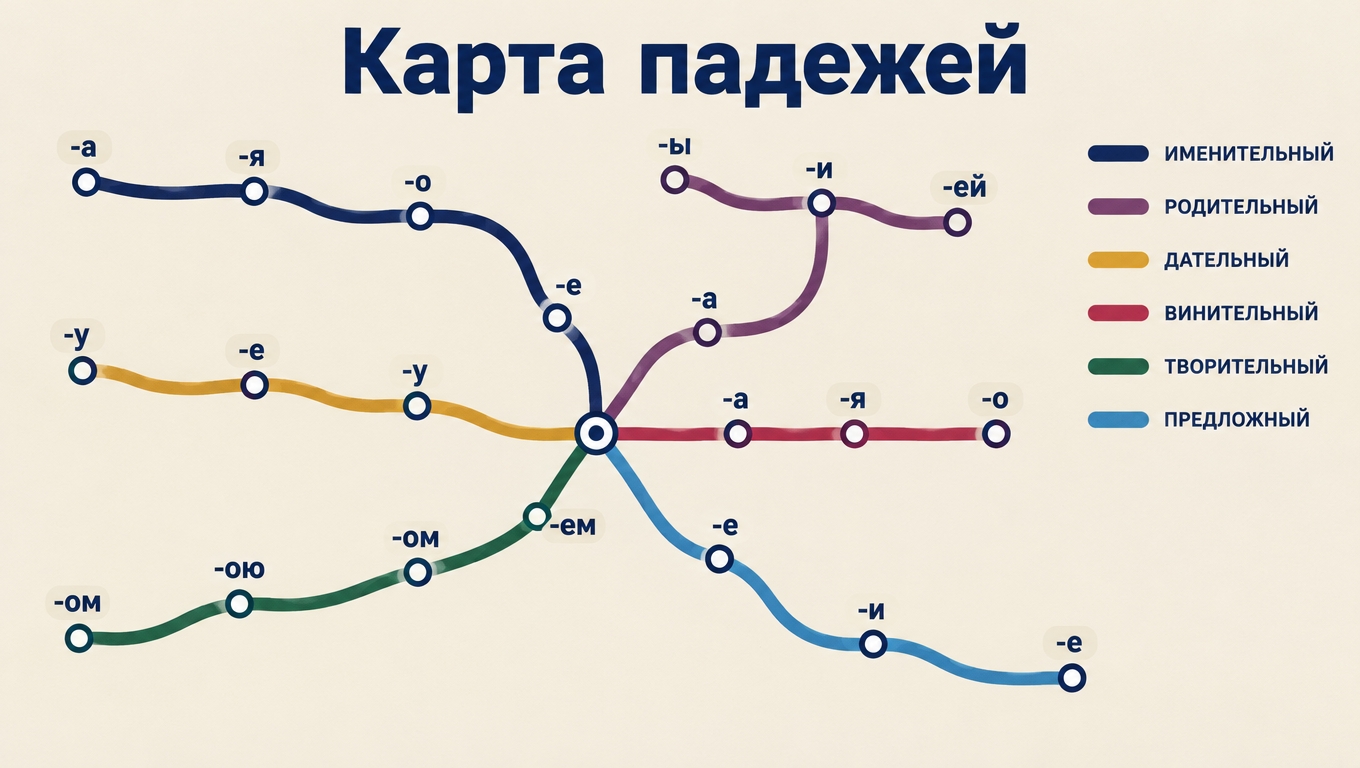
Twelve lessons in, the whole noun system goes on one page: six cases against four noun shapes, three declensions including the soft-sign third, the animacy rule in full, adjectives that follow their noun into every case, and every A1 preposition sorted by the case it governs. No new field of vocabulary — this is the map you have been building since Lesson 5.
⏱ About 65 minutes26 phrases43 exercises
What you will learn
Identify any Russian noun form by the question it answers — Кто? Что?, Кого? Чего?, Кому? Чему?, Кого? Что?, Кем? Чем?, Оком? Очём? — and say which case each question belongs to
Read and reproduce the complete case map: six cases across masculine, feminine, neuter and plural, for any regular noun you know
Sort nouns into the three declensions, decline the third declension (ночь, вещь, дочь, площадь) and handle the -ие, -ия and -ье nouns
Apply the animacy rule in full — where the accusative copies the genitive and where it copies the nominative, in the singular and in the plural
Make adjectives and possessives agree in the oblique cases: вбольшомгороде, сновымдругом, омоейработе
Sort every A1 preposition by the case it governs, and form the genitive plural of the high-frequency nouns — книг, окон, писем, людей, рублей
Quick review
Say these aloud before you start. They come from earlier lessons.
Я живу́ в Москве́.I live in Moscow. (Lesson 5 — the prepositional)Listen in Russian:Slow in Russian:Я живу́ в Москве́.
Я иду́ на рабо́ту.I am going to work. (Lesson 6 — the accusative of direction)Listen in Russian:Slow in Russian:Я иду́ на рабо́ту.
У меня́ нет вре́мени.I haven’t got any time. (Lesson 8 — the genitive)Listen in Russian:Slow in Russian:У меня́ нет вре́мени.
Мне на́до рабо́тать.I have to work. (Lesson 9 — the dative of the person)Listen in Russian:Slow in Russian:Мне на́до рабо́тать.
Я рабо́таю врачо́м.I work as a doctor. (Lesson 10 — the instrumental)Listen in Russian:Slow in Russian:Я рабо́таю врачо́м.
Ско́лько э́то сто́ит?How much is it? (Lesson 11 — numerals and money)Listen in Russian:Slow in Russian:Ско́лько э́то сто́ит?
Theory
Six questions, one map
You have now met all six Russian cases, one lesson at a time: the nominative in Lesson 1, the prepositional in Lesson 5, the accusative in Lesson 6, the genitive in Lesson 8, the dative in Lesson 9 and the instrumental in Lesson 10. This lesson puts them on one page and gives you the tool that eventually makes the page unnecessary — the question each case answers.
Кто? Что? gives the nominative: the dictionary form, the subject, what is there. Кого? Чего? gives the genitive: absence, possession, an amount, and the case after из, с, от, до, у, для and без. Кому? Чему? gives the dative: the person or thing an action is aimed at, and the case after к and по. Кого? Что? gives the accusative: the direct object, and the destination after в and на. Кем? Чем? gives the instrumental: the companion, the tool, the profession, and the case after над, под, между and с in its "with" sense. Оком? Очём? gives the prepositional: location and topic, after в, на and о.
Two of those questions look almost identical, and that is the whole difficulty: Кого? Чего? (genitive) and Кого? Что? (accusative). In practice you never choose between them by ear. The preposition or the verb in front of the noun has already decided: изМосквы is genitive because из always is, вМоскву is accusative because it answers куда?. Learn each preposition together with its case, and the question becomes a way of checking yourself rather than a decision you have to make in mid-sentence.
Э́то моя́ сестра́.This is my sister. (Кто? — nominative)Listen in Russian:Slow in Russian:Э́то моя́ сестра́.
Я живу́ у сестры́.I live at my sister’s. (Кого? — genitive after у)Listen in Russian:Slow in Russian:Я живу́ у сестры́.
Я иду́ к сестре́.I am going to my sister’s. (Кому? — dative after к)Listen in Russian:Slow in Russian:Я иду́ к сестре́.
Я говорю́ с сестро́й.I am talking with my sister. (Кем? — instrumental after с)Listen in Russian:Slow in Russian:Я говорю́ с сестро́й.
Three declensions, and the soft-sign sisters
Every Russian noun belongs to one of three declensions, and which one is decided by the nominative singular ending alone. The first is -а or -я: книга, мама, папа, Россия. The second is a bare consonant, -о, -е or -й: стол, врач, брат, окно, письмо, музей. The third is a feminine noun in a soft sign: ночь, вещь, дочь, площадь, жизнь. Three groups, and once you know which one a noun is in, every ending follows.
The third declension is the one you have not yet seen systematically, and it is the most regular of the three. The soft sign disappears before every ending, so the genitive, dative and prepositional singular are all -и (ночи, вещи, площади), the instrumental singular is -ью (ночью, вещью, площадью), and the accusative equals the nominative because these nouns are inanimate. The plural is -и in the nominative and accusative and -ей in the genitive; the dative, instrumental and prepositional are -ям, -ями, -ях after a soft stem (площадям, жизнями) but -ам, -ами, -ах after ж, ш, щ or ч (ночам, вещами). One of them has already become part of your everyday vocabulary without you noticing: ночью, "at night", is simply the instrumental of ночь, exactly as утром and вечером are the instrumentals of утро and вечер.
Two sub-groups look irregular and are not. Nouns in -ия and -ие put -и where an ordinary -а or -о noun puts -е: вРоссии, оРоссии, вздании, оздании, but вшколе and описьме (здание means "building"; you have not met the word yet, it is here only to show the shape). Nouns in -ье keep the -е in the dative and prepositional and add a soft sign before -и and -ю, so семья gives семье, осемье, but семьи and семью. And two nouns, дочь and мать, build their plural on a different stem — дочь gives дочери, дочерей, дочерям. One warning worth stating plainly: a soft sign at the end of a noun does not by itself mean feminine. день and дождь are masculine and belong to the second declension (дня, дню, днём, одне); ночь, вещь and площадь are feminine and belong to the third (ночи, ночи, ночью, оночи). There is no way to see this from the ending, so a noun in -ь is learnt with its gender — which is good practice for every Russian noun anyway.
ночь — но́чи — но́чью — ноче́йnight — of the night — at night — of nightsListen in Russian:Slow in Russian:ночь — но́чи — но́чью — ноче́й
вещь — ве́щи — ве́щью — веще́йthing — of the thing — with the thing — of thingsListen in Russian:Slow in Russian:вещь — ве́щи — ве́щью — веще́й
дочь — до́чери — до́черью — дочере́йdaughter — of the daughter — with the daughter — of daughters (the plural is built on a different stem)Listen in Russian:Slow in Russian:дочь — до́чери — до́черью — дочере́й
в Росси́и · в семье́ · в зда́нииin Russia · in the family · in the building — -ия and -ие take -и in the prepositional (в России, в здании), but an -ье noun keeps -ье: в семье, о семьеListen in Russian:Slow in Russian:в Росси́и · в семье́ · в зда́нии
Animacy: the rule that decides the accusative
The accusative answers two questions, Кого? and Что?, and the two are not decoration — they name the rule. If what you see, love, wait for or buy is a person or an animal, the noun is animate, and for masculine nouns the accusative singular copies the genitive: явижустол, but явижубрата, яждуврача, язнаюучителя. If it is a thing, the accusative copies the nominative: явижустол, ячитаюкнигу, яждупоезд.
Feminine nouns in -а show no contrast at all in the singular — the ending is -у whether the noun breathes or not: яждумаму, яждусестру, явижукнигу. The place where animacy really bites is the plural, and there it bites every time. All animate nouns, of all three genders, take the genitive plural in the accusative: явижуврачей, явижумам, явижулюдей, явижусестёр. Inanimate nouns keep the nominative plural: явижустолы, явижукниги, явижуокна.
Two honest footnotes. The first is that the plural rule is where learners lose the most marks, because English gives no warning at all: "I can see the doctors" and "I can see the tables" look identical, and in Russian they do not. The second is that a handful of nouns cross the line — a few inanimates behave like animates in the plural (кукла gives явижукукол, робот gives явижуроботов), and люди is animate whatever its singular человек may look like. None of that changes the rule; it only means you learn a noun together with its behaviour, exactly as you already learn it with its gender.
Я ви́жу дом.I can see the house. (inanimate: accusative = nominative)Listen in Russian:Slow in Russian:Я ви́жу дом.
Я ви́жу бра́та.I can see my brother. (animate masculine: accusative = genitive)Listen in Russian:Slow in Russian:Я ви́жу бра́та.
Я жду ма́му.I am waiting for mum. (animate feminine in -а: the ending does not change)Listen in Russian:Slow in Russian:Я жду ма́му.
Я ви́жу люде́й и столы́.I can see people and tables. (plural: animate takes the genitive, inanimate does not)Listen in Russian:Slow in Russian:Я ви́жу люде́й и столы́.
Adjectives and possessives follow the noun everywhere
You have been agreeing adjectives in the nominative since Lesson 3: большойдом, большаякнига, большоеокно, большиедома. Nothing about that changes except that the adjective now has endings for the other five cases too, and it always copies the case of the noun it belongs to. вбольшомгороде, оновойработе, сновымдругом, изнашегодома, подмоимстолом. If the noun is in the prepositional, so is the adjective; there is no version of Russian in which only one of them moves.
The endings come in three sets, and they are as regular as the noun endings you already know. Masculine and neuter share one: -ого, -ому, -ым, -ом (нового, новому, новым, оновом). Feminine has a single form, -ой, doing four jobs at once — genitive, dative, instrumental and prepositional (новой, новой, новой, оновой) — which makes it the cheapest paradigm in the language. The plural has one set for all genders: -ых, -ым, -ыми, -ых. The accusative then follows the animacy rule from the previous section: for inanimate nouns it copies the nominative, for animate ones the genitive.
Two details finish it. The spelling rule from Lesson 1 still applies, so after г, к, х, ж, ш, щ, ч and after any soft stem the endings are -его, -ему, -им, -ем and, in the plural, -их, -им, -ими, -их: русского, русскому, русским, орусском — never руссково, even though [v] is what you hear. And the possessives мой, твой, наш and ваш decline on the same table, with different stress: мой gives моего, моему, моим, омоём, моя gives моей, моей, мою, омоей, while наш and ваш keep the stress on the stem — нашего, нашему, нашим, онашем. Before a vowel о becomes об, so "about the window" is обокне and "about me" is обомне.
Я живу́ в большо́м го́роде.I live in a big city. (masculine prepositional)Listen in Russian:Slow in Russian:Я живу́ в большо́м го́роде.
Мы говори́м о но́вой рабо́те.We are talking about the new job. (feminine prepositional)Listen in Russian:Slow in Russian:Мы говори́м о но́вой рабо́те.
Я жду моего́ но́вого дру́га.I am waiting for my new friend. (animate masculine: both words copy the genitive)Listen in Russian:Slow in Russian:Я жду моего́ но́вого дру́га.
Мои́ де́ти живу́т в на́шем большо́м до́ме.My children live in our big house. (plural possessive, masculine prepositional)Listen in Russian:Slow in Russian:Мои́ де́ти живу́т в на́шем большо́м до́ме.
Plurals: the genitive plural, and the nouns with no singular
The genitive plural is the least predictable form in Russian noun morphology, and this is the lesson that systematises it. There are three shapes. Most masculine nouns take -ов, -ев or -ей: столов, музеев, врачей, рублей, людей. Most feminine nouns in -а and most neuter nouns in -о take nothing at all: книг, работ, мам, окон, писем, мест, слов, дел. Third-declension nouns take -ей: ночей, вещей, площадей, дочерей, жизней. The zero-ending group very often needs a fleeting vowel to keep the word pronounceable — ошибка becomes ошибок, деньги becomes денег, сутки becomes суток — and that vowel cannot be predicted from anything, which is why the genitive plural is learnt with the noun rather than derived from it.
Four of the nouns you need most have no singular at all: деньги, сутки, очки and брюки. They are plural-only, which means their whole paradigm is the plural and everything that agrees with them agrees in the plural — моиочки, новыебрюки, большиеденьги. Their stress behaves differently in each: деньги, сутки and брюки keep it on the first syllable throughout (денег, суток, брюк), while очки puts it on the ending in every single form (очков, очкам, очками). The four genitive plurals are денег, суток, очков and брюк, and those are the forms you need after нет, много, мало and сколько.
The good news is that the other five cases in the plural are entirely regular, and most of the work is already done: -ам or -ям in the dative, -ами or -ями in the instrumental, -ах or -ях in the prepositional, for every gender and every declension. Only the nominative plural, the genitive plural and the accusative plural need learning, and the accusative is decided by the animacy rule you have just read. Three forms per noun — nominative plural, genitive plural, animate or not — and the rest is mechanical.
мно́го книг, о́кон, пи́сем, рубле́йa lot of books, windows, letters, roubles — three different genitive-plural shapesListen in Russian:Slow in Russian:мно́го книг, о́кон, пи́сем, рубле́й
мно́го люде́йa lot of people (человек becomes люди; the genitive is людей)Listen in Russian:Slow in Russian:мно́го люде́й
У меня́ нет де́нег и очко́в.I haven’t got any money or glasses. (both plural-only: genitive plural денег and очков)Listen in Russian:Slow in Russian:У меня́ нет де́нег и очко́в.
По́езд идёт су́тки.The train takes twenty-four hours. (duration = the bare accusative, no preposition)Listen in Russian:Slow in Russian:По́езд идёт су́тки.
THE CASE MAP: six cases against four noun shapes
Form
стол (m)
кни́га (f)
окно́ (n)
plural
Кто? Что? — Nominative
стол
кни́га
окно́
столы́ · кни́ги · о́кна
Кого́? Чего́? — Genitive
стола́
кни́ги
окна́
столо́в · книг · о́кон
Кому́? Чему́? — Dative
столу́
кни́ге
окну́
стола́м · кни́гам · о́кнам
Кого́? Что? — Accusative
стол
кни́гу
окно́
столы́ · кни́ги · о́кна
Кем? Чем? — Instrumental
столо́м
кни́гой
окно́м
стола́ми · кни́гами · о́кнами
Оком? Очём? — Prepositional
остоле́
окни́ге
обокне́
остола́х · окни́гах · обо́кнах
One table, and that is the whole nominal system. Read it as three columns of endings rather than six cases to memorise. Singular: the masculine adds -а, -у, nothing, -ом, -е; the feminine adds -ы/-и, -е, -у, -ой, -е; the neuter adds -а, -у, nothing, -ом, -е — so masculine and neuter are identical everywhere except the nominative and accusative. Plural: the endings are the same for all three genders, -ы/-и, -ов/-∅/-ей, -ам/-ям, -ы/-и or the genitive plural for animates, -ами/-ями, -ах/-ях. Two spelling details sit in the last row: о becomes об before a vowel (обокне), and after гкхжшщч the feminine and plural endings are always written -и, never -ы.
The preposition map: which case each A1 preposition governs
Form
Кого́? Чего́? — Genitive
Кому́? Чему́? — Dative
Куда́? Кого́? Что? — Accusative
Кем? Чем? — Instrumental
Оком? Очём? — Prepositional
в — in, into
—
—
в
—
в
на — on, onto
—
—
на
—
на
с — off, from / with
с
—
—
с
—
за — behind / for
—
—
за
за
—
че́рез — across, through; in (time)
—
—
че́рез
—
—
к — to, towards (a person)
—
к
—
—
—
по — along, around
—
по
—
—
—
из, от, до, для, без, у — all genitive only
из · от · до · для · без · у
—
—
—
—
над, под, ме́жду — all instrumental only
—
—
—
над · под · ме́жду
—
о — about
—
—
—
—
о · об (before a vowel)
Seventeen prepositions, five cases, and only five of them are flexible: в, на, с, за and через. Every other one takes exactly one case for ever, so learn it as a chunk — изРоссии, отврача, довечера, дляменя, безденег, уокна, кврачу, погороду, надстолом, подстолом, междудомами, окниге — and the ending arrives with the chunk. For the five flexible ones the question decides: где? (вМоскве) or куда? (вМоскву); откуда? (сработы) or скем? (сбратом); зачем? (задомом) or зачто? (заобед, спасибозакофе). And о becomes об before a vowel: обокне, обомне.
The three declensions, singular
Form
1st — кни́га · Росси́я
2nd — стол · окно́ · музе́й
3rd — ночь · вещь
Кто? Что? — Nominative
кни́га · Росси́я
стол · окно́ · музе́й
ночь · вещь
Кого́? Чего́? — Genitive
кни́ги · Росси́и
стола́ · окна́ · музе́я
но́чи · ве́щи
Кому́? Чему́? — Dative
кни́ге · Росси́и
столу́ · окну́ · музе́ю
но́чи · ве́щи
Кого́? Что? — Accusative
кни́гу · Росси́ю
стол · окно́ · музе́й
ночь · вещь
Кем? Чем? — Instrumental
кни́гой · Росси́ей
столо́м · окно́м · музе́ем
но́чью · ве́щью
Оком? Очём? — Prepositional
окни́ге · оРосси́и
остоле́ · обокне́ · омузе́е
оно́чи · ове́щи
Which declension a noun belongs to is decided by its nominative ending, and that is the only thing to look at. The first is -а or -я (книга, Россия, папа); the second is a bare consonant, -о, -е or -й (стол, окно, письмо, музей); the third is a feminine noun in a soft sign (ночь, вещь, дочь, площадь, жизнь). Inside the third declension the soft sign disappears before every ending, which is why the genitive, dative and prepositional are all -и and the instrumental is -ью. Nouns in -ия and -ие take -и where an ordinary -а noun takes -е: вРоссии, but вшколе. One warning: a soft sign at the end of a noun does not by itself mean feminine. день and дождь are masculine and belong to the second declension (дня, дню, днём, одне); ночь and вещь are feminine and belong to the third (ночи, ночи, ночью, оночи). Learn the gender with the noun.
Animacy: which form the accusative copies
Form
стол (m, thing)
врач (m, person)
кни́га (f, thing)
ма́ма (f, person)
Кто? Что? — Nominative singular
стол
врач
кни́га
ма́ма
Кого́? Что? — Accusative singular
стол
врача́
кни́гу
ма́му
Кого́? Чего́? — Genitive singular
стола́
врача́
кни́ги
ма́мы
Кто? Что? — Nominative plural
столы́
врачи́
кни́ги
ма́мы
Кого́? Что? — Accusative plural
столы́
враче́й
кни́ги
мам
Кого́? Чего́? — Genitive plural
столо́в
враче́й
книг
мам
Read down the second and third rows and the rule appears: a masculine noun that is a person copies its genitive in the accusative (явижуврача), a masculine noun that is a thing copies its nominative (явижустол), and a feminine noun in -а takes -у either way, so feminines show no contrast at all in the singular. In the plural the contrast covers everything: every animate noun takes the genitive plural — явижуврачей, явижумам, явижулюдей, явижусестёр — while every inanimate noun keeps the nominative plural: явижустолы, явижукниги. A few inanimates cross the line in the plural (кукла gives явижукукол, робот gives явижуроботов); they are rare, and you can learn them if you meet them.
Adjective and possessive endings in the oblique cases
Form
masculine and neuter
feminine
plural
Како́й? Чей? — Nominative
но́вый · мой
но́вая · моя́
но́вые · мои́
Какого́? Чьего́? — Genitive
но́вого · моего́
но́вой · мое́й
но́вых · мои́х
Какому́? Чьему́? — Dative
но́вому · моему́
но́вой · мое́й
но́вым · мои́м
Како́й? Чей? — Accusative, inanimate
но́вый · мой
но́вую · мою́
но́вые · мои́
Какого́? Чьего́? — Accusative, animate
но́вого · моего́
но́вую · мою́
но́вых · мои́х
Каки́м? Чьим? — Instrumental
но́вым · мои́м
но́вой · мое́й
но́выми · мои́ми
Окако́м? Очьём? — Prepositional
оно́вом · омоём
оно́вой · омое́й
оно́вых · омои́х
Three sets of endings, and the feminine one is the cheapest you will ever buy: -ой does four jobs at once (genitive, dative, instrumental and prepositional), so «оновойработе», «кновойработе» and «сновойработой» all use the same word. Masculine and neuter share -ого, -ому, -ым, -ом; the plural of every gender shares -ых, -ым, -ыми, -ых. The spelling rule from Lesson 1 still applies — after г, к, х, ж, ш, щ, ч and after any soft stem write -его, -ему, -им, -ем: русского, русскому, русским, орусском. Never руссково, even though that is what it sounds like, because the г is pronounced [v]. Stress follows the adjective, not the case: новый keeps it on the stem in every form, большой keeps it on the ending (большого, большому, большим, обольшом). наш and ваш are stem-stressed like новый: нашего, нашему, нашим, онашем.
Vocabulary
Learn each word with its stress mark and its pronunciation. Nouns are given with their gender, animacy and their full six-case declension; verbs are given with their aspect and, where one exists, their partner verb.
Russian
English
Gender / aspect
Pronunciation
Audio
ночьfeminine · inanimate
night
feminine · inanimate
/notɕ/NOHCH
Listen in Russian:Slow in Russian:ночь
вещьfeminine · inanimate
thing; item, possession
feminine · inanimate
/vʲeɕː/VYESHCH
Listen in Russian:Slow in Russian:вещь
су́ткиinanimate
a full day (twenty-four hours)
inanimate
/ˈsutkʲɪ/SOOT-kih
Listen in Russian:Slow in Russian:сутки
очки́inanimate
glasses, spectacles
inanimate
/ɐtɕˈkʲi/uh-CHKEE
Listen in Russian:Slow in Russian:очки
брю́киinanimate
trousers
inanimate
/ˈbrʲukʲɪ/BRYOO-kih
Listen in Russian:Slow in Russian:брюки
заpreposition
behind (with the instrumental); for (with the accusative)
preposition
/za/ZAH
Listen in Russian:Slow in Russian:за
вpreposition
in, at (of a place); into, to (of a direction)
preposition
/v/F
Listen in Russian:Slow in Russian:в
наpreposition
on, at (of a place); onto, on to (of a direction)
preposition
/na/NAH
Listen in Russian:Slow in Russian:на
оpreposition
about (with the Prepositional)
preposition
/o/OH
Listen in Russian:Slow in Russian:о
изpreposition
out of, from (inside)
preposition
/is/EES
Listen in Russian:Slow in Russian:из
сpreposition
off, from (a surface or an event)
preposition
/s/S
Listen in Russian:Slow in Russian:с
уpreposition
at, by (someone's place); у + genitive = possession
preposition
/u/OO
Listen in Russian:Slow in Russian:у
дляpreposition
for (a person or a purpose)
preposition
/dlʲa/DLYAH
Listen in Russian:Slow in Russian:для
безpreposition
without
preposition
/bʲes/BYES
Listen in Russian:Slow in Russian:без
кpreposition
to, towards (a person or a thing) — takes the dative
preposition
/k/K
Listen in Russian:Slow in Russian:к
поpreposition
around, along (an area); by means of — takes the dative
preposition
/po/POH
Listen in Russian:Slow in Russian:по
надpreposition
above, over
preposition
/nat/NAHT
Listen in Russian:Slow in Russian:над
подpreposition
under, below
preposition
/pot/POHT
Listen in Russian:Slow in Russian:под
ме́ждуpreposition
between, among
preposition
/ˈmʲeʐdʊ/MYEH-zhdoo
Listen in Russian:Slow in Russian:между
че́резpreposition
across, over; through
preposition
/ˈtɕerʲɪs/CHEH-ris
Listen in Russian:Slow in Russian:через
столmasculine · inanimate
table
masculine · inanimate
/stol/STOHL
Listen in Russian:Slow in Russian:стол
кни́гаfeminine · inanimate
book
feminine · inanimate
/ˈknʲiɡə/kuh-NEE-guh
Listen in Russian:Slow in Russian:книга
окно́neuter · inanimate
window
neuter · inanimate
/ɐˈkno/uk-NOH
Listen in Russian:Slow in Russian:окно
письмо́neuter · inanimate
letter (written message)
neuter · inanimate
/pʲɪˈsʲmo/pih-SMOH
Listen in Russian:Slow in Russian:письмо
жизньfeminine · inanimate
life
feminine · inanimate
/ʐɨznʲ/ZHIHZN
Listen in Russian:Slow in Russian:жизнь
дочьfeminine · animate
daughter
feminine · animate
/dotɕ/DOHCH
Listen in Russian:Slow in Russian:дочь
пло́щадьfeminine · inanimate
square
feminine · inanimate
/ˈploɕːɪtʲ/PLOH-shchut
Listen in Russian:Slow in Russian:площадь
де́ньгиinanimate
money
inanimate
/ˈdʲenʲɡʲɪ/DYEN-gih
Listen in Russian:Slow in Russian:деньги
братmasculine · animate
brother
masculine · animate
/brat/BRAHT
Listen in Russian:Slow in Russian:брат
большо́йadjective
big, large
adjective
/bɐlʲˈʂoj/bul-SHOY
Listen in Russian:Slow in Russian:большой
но́выйadjective
new
adjective
/ˈnovɨj/NOH-viy
Listen in Russian:Slow in Russian:новый
мойpronoun
my, mine
pronoun
/moj/MOY
Listen in Russian:Slow in Russian:мой
рубльmasculine · inanimate
rouble (the Russian currency)
masculine · inanimate
/rublʲ/ROOBL
Listen in Russian:Slow in Russian:рубль
челове́кmasculine · animate
person; (plural) people
masculine · animate
/tɕɪlɐˈvʲek/chih-luh-VYEK
Listen in Russian:Slow in Russian:человек
Full six-case declension of the 16 nouns in this lesson
Each case is listed with the question word that selects it. Find the question you are answering and the ending follows.
Singular
Form
ночь (f)
вещь (f)
су́тки
очки́
брю́ки
стол (m)
кни́га (f)
окно́ (n)
письмо́ (n)
жизнь (f)
дочь (f)
пло́щадь (f)
де́ньги
брат (m)
рубль (m)
челове́к (m)
nom · Кто? Что?
ночь
вещь
—
—
—
стол
книга
окно́
письмо́
жизнь
дочь
площадь
—
брат
рубль
челове́к
gen · Кого? Чего?
но́чи
ве́щи
—
—
—
стола́
книги
окна́
письма́
жи́зни
до́чери
площади
—
бра́та
рубля́
челове́ка
dat · Кому? Чему?
но́чи
ве́щи
—
—
—
столу́
книге
окну́
письму́
жи́зни
до́чери
площади
—
бра́ту
рублю́
челове́ку
acc · Кого? Что?
ночь
вещь
—
—
—
стол
книгу
окно́
письмо́
жизнь
дочь
площадь
—
бра́та
рубль
челове́ка
instr · Кем? Чем?
но́чью
ве́щью
—
—
—
столо́м
книгой
окно́м
письмо́м
жи́знью
до́черью
площадью
—
бра́том
рублём
челове́ком
prep · Оком? Очём?
но́чи
ве́щи
—
—
—
столе́
книге
окне́
письме́
жи́зни
до́чери
площади
—
бра́те
рубле́
челове́ке
Plural
Form
ночь (f)
вещь (f)
су́тки
очки́
брю́ки
стол (m)
кни́га (f)
окно́ (n)
письмо́ (n)
жизнь (f)
дочь (f)
пло́щадь (f)
де́ньги
брат (m)
рубль (m)
челове́к (m)
nom · Кто? Что?
но́чи
ве́щи
су́тки
очки́
брю́ки
столы́
книги
о́кна
пи́сьма
жи́зни
до́чери
площади
де́ньги
бра́тья
рубли́
лю́ди
gen · Кого? Чего?
ноче́й
веще́й
су́ток
очко́в
брюк
столо́в
книг
о́кон
пи́сем
жи́зней
дочере́й
площаде́й
де́нег
бра́тьев
рубле́й
люде́й
dat · Кому? Чему?
ноча́м
веща́м
су́ткам
очка́м
брю́кам
стола́м
книгам
о́кнам
пи́сьмам
жи́зням
дочеря́м
площадя́м
де́ньгам
бра́тьям
рубля́м
лю́дям
acc · Кого? Что?
но́чи
ве́щи
су́тки
очки́
брю́ки
столы́
книги
о́кна
пи́сьма
жи́зни
дочере́й
площади
де́ньги
бра́тьев
рубли́
люде́й
instr · Кем? Чем?
ноча́ми
веща́ми
су́тками
очка́ми
брю́ками
стола́ми
книгами
о́кнами
пи́сьмами
жи́знями
дочеря́ми
площадя́ми
де́ньгами
бра́тьями
рубля́ми
людьми́
prep · Оком? Очём?
ноча́х
веща́х
су́тках
очка́х
брю́ках
стола́х
книгах
о́кнах
пи́сьмах
жи́знях
дочеря́х
площадя́х
де́ньгах
бра́тьях
рубля́х
лю́дях
A dash means the form does not exist. Plural-only nouns such as де́ньги and су́тки have no singular, and indeclinable nouns such as ко́фе and метро́ keep one form in all six cases.
Ready-to-use phrases
Я живу́ в большо́м го́роде.
I live in a big city.
IPA/ja ʐɨˈvu v bɐlʲˈʂom ˈɡorətʲe/
Say itYAH zhih-VOO v bul-SHOHM GOH-ruh-dyuh.
The agreement you have had in the nominative since Lesson 3 now works in every case: the adjective follows its noun into the prepositional, taking -ом, and the masculine hard-stem noun takes -е. Both halves answer where? together.
neutralcasesprepositionaladjectivescity
Listen in Russian:Slow in Russian:Я живу в большом городе.
Мы говори́м о но́вой рабо́те.
We are talking about the new job.
IPA/mɨ ɡəvɐˈrʲim ə ˈnovəj rɐˈbotʲe/
Say itMIH guh-vuh-REEM uh NOH-vuy ruh-BOH-tyuh.
о + prepositional is the "about" case, and the feminine adjective ending -ой does four jobs at once — genitive, dative, instrumental and prepositional — so оновойработе, кновойработе and сновойработой all look identical.
neutralcasesprepositionaladjectiveswork
Listen in Russian:Slow in Russian:Мы говорим о новой работе.
Она́ ду́мает о на́шей до́чери.
She is thinking about our daughter.
IPA/ɐˈna ˈduməjɪt ə ˈnaʂɨj ˈdotɕɪrʲɪ/
Say ituh-NAH DOO-muh-yit uh NAH-shiy DOH-chih-rih.
дочь is third declension, and its singular genitive, dative and prepositional are all one form — дочери. Only the prepositional plural differs (одочерях), and it is built on a different stem entirely.
neutralcasesprepositionalfamilypossessives
Listen in Russian:Slow in Russian:Она думает о нашей дочери.
Я иду́ к врачу́.
I am going to the doctor’s.
IPA/jə ɪˈdu k vrɐˈtɕu/
Say itYAH ih-DOO k vruh-CHOO.
к + dative is movement towards a person or an institution, and it answers Кому?. врач stresses the ending in every oblique form — врача, врачу, врачом, овраче — which is normal for a one-syllable masculine noun.
neutralcasesdativemotionhealth
Listen in Russian:Slow in Russian:Я иду к врачу.
Мы гуля́ем по го́роду.
We are walking around the city.
IPA/mɨ ɡʊˈlʲajɪm pə ˈɡorətʊ/
Say itMIH goo-LYAH-yim puh GOH-ruh-doo.
по + dative means "along, around, all over": погороду, поулице, поРоссии. The preposition is unstressed and reduces to [pə], so in fast speech the ending -у is the only thing telling you the case.
neutralcasesdativemotioncity
Listen in Russian:Slow in Russian:Мы гуляем по городу.
Я е́ду в Москву́.
I am going to Moscow.
IPA/ˈjedʊ f mɐˈskvu/
Say itYAH YEH-doo v muh-SKVOO.
в + accusative answers Куда? — the same preposition as «вМоскве», a different ending. This где? / куда? contrast is the highest-value pair in the whole case system, and it is the one you already have.
travelcasesaccusativemotiontravel
Listen in Russian:Slow in Russian:Я еду в Москву.
Он идёт на вокза́л.
He is on his way to the station.
IPA/on ɪˈdʲot nə vɐɡˈzal/
Say itOHN ih-DYOHT nuh vug-ZAHL.
на, not в, because "at the station" is навокзале. The semantic class picks the preposition and the question picks the case — the two decisions are independent, and that is what makes the map learnable.
neutralcasesaccusativemotiontransport
Listen in Russian:Slow in Russian:Он идёт на вокзал.
Я ви́жу дом, но не ви́жу бра́та.
I can see the house, but I can’t see my brother.
IPA/ja ˈvʲiʐʊ dom no nʲe ˈvʲiʐʊ ˈbratə/
Say itYAH VEE-zhoo DOHM, NOH NYEH VEE-zhoo BRAH-tuh.
The animacy rule in one sentence. дом is a thing, so the accusative copies the nominative; брат is a person, and for masculine nouns the accusative copies the genitive. Nothing else changes — same verb, same word order.
neutralcasesaccusativeanimacyfamily
Listen in Russian:Slow in Russian:Я вижу дом, но не вижу брата.
Она́ ждёт ма́му и сестру́.
She is waiting for her mum and sister.
IPA/ɐˈna ʐdʲot ˈmamʊ ɪ sʲɪˈstru/
Say ituh-NAH ZHDYOHT MAH-moo EE sih-STROO.
Animate feminine nouns in -а take -у in the accusative, which is also the ending an inanimate one takes — яждукнигу. So in the singular feminine nouns never show the animate/inanimate contrast; it lives in the masculine singular and in every plural.
neutralcasesaccusativeanimacyfamily
Listen in Russian:Slow in Russian:Она ждёт маму и сестру.
Я рабо́таю с но́вым дру́гом.
I work with a new friend.
IPA/jə rɐˈbotəjʊ s ˈnovɨm ˈdruɡəm/
Say itYAH ruh-BOH-tuh-yoo s NOH-vim DROO-gum.
с + instrumental means "together with", and the adjective goes instrumental too: новым, not новый. Masculine and neuter adjectives share one instrumental ending, -ым after a hard stem and -им after гкхжшщч or a soft one.
neutralcasesinstrumentaladjectiveswork
Listen in Russian:Slow in Russian:Я работаю с новым другом.
Он стал врачо́м.
He became a doctor.
IPA/on stal vrɐˈtɕom/
Say itOHN STAHL vruh-CHOHM.
Professions and roles go in the instrumental after быть, стать and работать: яработаюврачом, онсталврачом. In the present, where the copula is zero, Russian uses the nominative instead — онврач — which is why the same idea appears in two different cases.
neutralcasesinstrumentalprofessions
Listen in Russian:Slow in Russian:Он стал врачом.
Э́то кни́га моего́ бра́та.
This is my brother’s book.
IPA/ˈɛtə ˈknʲiɡə mɐjɪˈvo ˈbratə/
Say itEH-tuh kuh-NEE-guh muh-yih-VOH BRAH-tuh.
Russian has no possessive ’s: the owner goes in the genitive and follows the thing owned. The г of моего is pronounced [v], never [g]. The possessive agrees with the thing owned, not with the owner — книгамоегобрата, but книгамоейсестры.
neutralcasesgenitivepossessivesfamily
Listen in Russian:Slow in Russian:Это книга моего брата.
У меня́ мно́го книг и пи́сем.
I have a lot of books and letters.
IPA/ʊ mʲɪˈna ˈmnoɡə ˈknʲik ɪ ˈpʲisʲɪm/
Say itoo mih-NYAH muh-NOH-guh kuh-NEEKH EE PEE-sim.
Two genitive plurals with no ending at all, and one of them with a fleeting vowel: книг (from книга) and писем (from письмо). Most feminine nouns in -а and most neuter nouns in -о lose the ending here; most masculines keep -ов/-ев/-ей.
neutralcasesgenitivepluralobjects
Listen in Russian:Slow in Russian:У меня много книг и писем.
Ско́лько люде́й в Москве́?
How many people are there in Moscow?
IPA/ˈskolʲkə lʲʊˈdʲej v mɐˈskvʲe/
Say itSKOHL-kuh lyoo-DEY v muh-SKVYEH?
людей is the genitive plural of люди, which is the plural Russian actually uses for "people"; the plural of человек survives mainly after numerals (пятьчеловек). сколько governs the genitive, exactly as много and нет do.
neutralcasesgenitivepluralnumberscity
Listen in Russian:Slow in Russian:Сколько людей в Москве?
Ско́лько рубле́й?
How many roubles?
IPA/ˈskolʲkə rʊˈblʲej/
Say itSKOHL-kuh roo-BLEY?
рубль is a soft-stem masculine, so its genitive plural is рублей, never *рублов. Numeral government switches at five: дварубля (genitive singular), пятьрублей (genitive plural) — Lesson 11.
neutralcasesgenitivepluralnumbersshopping
Listen in Russian:Slow in Russian:Сколько рублей?
Но́чью бы́ло хо́лодно.
It was cold at night.
IPA/ˈnotɕjʊ ˈbɨlə ˈxolədnə/
Say itNOH-choo BIH-luh KHOH-lud-nuh.
ночью is the instrumental singular of ночь that has frozen into an adverb, just like утром, днём and вечером in Lesson 10. The third declension gives you the adverb for free: learn ночью and you have also learnt a case form.
neutralcasesinstrumentaltimeweather
Listen in Russian:Slow in Russian:Ночью было холодно.
Э́та вещь моя́.
This thing is mine.
IPA/ˈɛtə ˈvʲeɕː mɐˈja/
Say itEH-tuh VYESHCH muh-YAH.
вещь is feminine. A soft sign at the end of a noun does not tell you the gender — день and дождь are masculine — so a noun in -ь has to be learnt with its gender. Almost all of them are feminine and decline like вещь; the masculine ones decline like стол with a soft stem.
neutralcasesnominativeobjectspossessives
Listen in Russian:Slow in Russian:Эта вещь моя.
Мои́ но́вые брю́ки в су́мке.
My new trousers are in the bag.
IPA/mɐˈi ˈnovɨjə ˈbrʲukʲɪ f ˈsumkʲe/
Say itmuh-EE NOH-vih-yuh BRYOO-kih f SOOM-kyuh.
брюки is plural only, and so is its genitive plural брюк: «уменянетбрюк». The adjective agrees in the plural — новые, not новый — and the possessive does too: мои, not мой.
neutralcasesprepositionalpluralobjectsadjectives
Listen in Russian:Slow in Russian:Мои новые брюки в сумке.
Э́то очки́ мое́й ба́бушки.
These are my grandmother’s glasses.
IPA/ˈɛtə ɐtɕˈkʲi mɐˈjoj ˈbabʊʂkʲɪ/
Say itEH-tuh uh-CHKEE muh-EY BAH-boo-shkih.
мой in the feminine has one form, моей, that covers the genitive, dative, instrumental and prepositional — so you cannot tell from that word alone which case you are in. The noun after it can: бабушки is genitive singular.
neutralcasesgenitivepluralfamilyobjects
Listen in Russian:Slow in Russian:Это очки моей бабушки.
По́езд идёт су́тки.
The train takes twenty-four hours.
IPA/ˈpojɪst ɪˈdʲot ˈsutkʲɪ/
Say itPOH-yist ih-DYOHT SOOT-kih.
How long something lasts takes the bare accusative, with no preposition at all: поездидётсутки, яспалвосемьчасов. сутки has no singular, so there is no "one сутки" to fall back on.
travelcasesaccusativetimetransport
Listen in Russian:Slow in Russian:Поезд идёт сутки.
Из окна́ я ви́жу пло́щадь.
From the window I can see the square.
IPA/ɪz ɐˈkna ja ˈvʲiʐʊ ˈploɕːɪtʲ/
Say itiz uk-NAH YAH VEE-zhoo PLOH-shchut.
Two cases in seven letters of preposition. из + genitive is "out of", and the genitive of окно is окна — a neuter noun in -о takes -а, the same ending as a masculine one. площадь is third declension and inanimate, so its accusative is its nominative.
neutralcasesgenitiveaccusativecity
Listen in Russian:Slow in Russian:Из окна я вижу площадь.
До ве́чера!
See you this evening!
IPA/də ˈvʲetɕɪrə/
Say itduh VYEH-chih-ruh!
до + genitive is "until" in time and "as far as" in space — the same preposition as довокзала. The genitive singular of вечер keeps its stem stress (вечера), unlike вода, which moves it to воды.
informalcasesgenitivetimegreetings
Listen in Russian:Slow in Russian:До вечера!
Моя́ су́мка под столо́м.
My bag is under the table.
IPA/mɐˈja ˈsumkə pət stɐˈlom/
Say itmuh-YAH SOOM-kuh put stuh-LOHM.
под + instrumental is "under" as a place; with the accusative it is "under" as a direction (подстол). The д of под devoices to [т] before the voiceless с of столом — [pət stɐˈlom]: a Russian consonant takes its voicing from the one that follows it.
neutralcasesinstrumentalplaceobjects
Listen in Russian:Slow in Russian:Моя сумка под столом.
Мой о́фис над магази́ном.
My office is above the shop.
IPA/moj ˈofʲɪs nəd məɡɐˈzʲinəm/
Say itMOY OH-fis nud muh-guh-ZEE-num.
над + instrumental is "above" and takes no other case at this level. Before the voiced м the д stays [д] — [nəd] — which is the mirror image of подстолом, where the д meets a voiceless с and becomes [т].
neutralcasesinstrumentalplacecity
Listen in Russian:Slow in Russian:Мой офис над магазином.
Ме́жду до́мом и шко́лой есть парк.
There is a park between the house and the school.
IPA/ˈmʲeʐdʊ ˈdoməm ɪ ˈʂkoləj jest park/
Say itMYEH-zhdoo DOH-mum EE SHKOH-luy YEST PAHRK.
между + instrumental governs both nouns at once, so дом becomes домом and школа becomes школой — the masculine -ом and the feminine -ой side by side. есть here is the "there is" of Lesson 4 and takes the nominative.
neutralcasesinstrumentalplacecity
Listen in Russian:Slow in Russian:Между домом и школой есть парк.
За до́мом есть парк.
There is a park behind the house.
IPA/zə ˈdoməm jest park/
Say itzuh DOH-mum YEST PAHRK.
за + instrumental is "behind" as a place, and it completes the set: над (above), под (below), между (between), рядомс (next to), за (behind), перед (in front of). With the accusative за means either direction or "for": «спасибозакофе».
neutralcasesinstrumentalplacecity
Listen in Russian:Slow in Russian:За домом есть парк.
Dialogues
Before the trip
Tom and Anna are getting ready to leave. They are friends, so they use ты.
Tom
Анна, где мои очки?
Anna, where are my glasses?
Listen in Russian:Slow in Russian:Анна, где мои очки?
Anna
Твои очки в сумке, рядом с телефоном.
Your glasses are in the bag, next to the phone.
Listen in Russian:Slow in Russian:Твои очки в сумке, рядом с телефоном.
Tom
А мои брюки?
And my trousers?
Listen in Russian:Slow in Russian:А мои брюки?
Anna
Твои брюки под столом. И твоя книга тоже там.
Your trousers are under the table. And your book is there too.
Listen in Russian:Slow in Russian:Твои брюки под столом. И твоя книга тоже там.
Tom
У нас есть деньги?
Have we got any money?
Listen in Russian:Slow in Russian:У нас есть деньги?
Anna
Денег мало, и у меня нет времени.
There’s very little money, and I haven’t got time.
Listen in Russian:Slow in Russian:Денег мало, и у меня нет времени.
Tom
Ничего! Поезд идёт вечером, а не утром.
Never mind! The train goes in the evening, not in the morning.
Listen in Russian:Slow in Russian:Ничего! Поезд идёт вечером, а не утром.
Anna
Хорошо. Мы идём на вокзал?
Right. Are we going to the station?
Listen in Russian:Slow in Russian:Хорошо. Мы идём на вокзал?
A photograph of the family
Anna is looking at a photograph on Ivan’s phone. They are friends, so they use ты.
Anna
Иван, это твоя семья?
Ivan, is this your family?
Listen in Russian:Slow in Russian:Иван, это твоя семья?
Ivan
Да, это моя семья. Это моя жена и моя дочь.
Yes, this is my family. This is my wife and my daughter.
Listen in Russian:Slow in Russian:Да, это моя семья. Это моя жена и моя дочь.
Anna
Сколько лет твоей дочери?
How old is your daughter?
Listen in Russian:Slow in Russian:Сколько лет твоей дочери?
Ivan
Моей дочери десять лет.
My daughter is ten.
Listen in Russian:Slow in Russian:Моей дочери десять лет.
Anna
А это твой сын? Он студент?
And is this your son? Is he a student?
Listen in Russian:Slow in Russian:А это твой сын? Он студент?
Ivan
Да, это мой сын, он студент.
Yes, this is my son, he’s a student.
Listen in Russian:Slow in Russian:Да, это мой сын, он студент.
Anna
У тебя большая семья! Вы живёте в Москве?
You have a big family! Do you live in Moscow?
Listen in Russian:Slow in Russian:У тебя большая семья! Вы живёте в Москве?
Ivan
Да, мы живём в большом доме рядом с парком.
Yes, we live in a big house next to the park.
Listen in Russian:Slow in Russian:Да, мы живём в большом доме рядом с парком.
A walk around the city
Tom and Anna are planning a route. They are friends, so they use ты.
Tom
Мы идём по улице или по парку?
Are we walking along the street or through the park?
Listen in Russian:Slow in Russian:Мы идём по улице или по парку?
Anna
По улице. Парк рядом с площадью.
Along the street. The park is next to the square.
Listen in Russian:Slow in Russian:По улице. Парк рядом с площадью.
Tom
А где магазин?
And where is the shop?
Listen in Russian:Slow in Russian:А где магазин?
Anna
Магазин за парком, рядом с банком.
The shop is behind the park, next to the bank.
Listen in Russian:Slow in Russian:Магазин за парком, рядом с банком.
Tom
А вокзал далеко?
And is the station far away?
Listen in Russian:Slow in Russian:А вокзал далеко?
Anna
Нет, близко. Вокзал за банком.
No, it’s close. The station is behind the bank.
Listen in Russian:Slow in Russian:Нет, близко. Вокзал за банком.
Tom
Хорошо. Я иду за тобой.
Right. I’m walking behind you.
Listen in Russian:Slow in Russian:Хорошо. Я иду за тобой.
Anna
А я жду тебя у магазина.
And I’ll wait for you by the shop.
Listen in Russian:Slow in Russian:А я жду тебя у магазина.
Exercises
Answer actively — try to recall the Russian before you look at any hint.
Case ChoiceExercise 1
Choose the correct form.
Яживув ___ . (большойгород)
Case ChoiceExercise 2
Choose the correct form of дочь.
Онадумаето ___ . (дочь)
Case ChoiceExercise 3
Choose the correct form of врач.
Яидук ___ . (врач)
Case ChoiceExercise 4
Choose the correct form of площадь.
Мыгуляемпо ___ . (площадь)
Case ChoiceExercise 5
Choose the correct form of окно.
Из ___ явижупарк. (окно)
Case ChoiceExercise 6
Choose the correct form of «мойбрат».
Этокнига ___ . (мойбрат)
Case ChoiceExercise 7
Choose the correct form of люди.
Яневижу ___ . (люди)
Ending ChoiceExercise 8
Choose the ending.
Genitive singular of «ночь»: ноч___
Ending ChoiceExercise 9
Choose the ending.
Instrumental singular of «вещь»: вещ___
Ending ChoiceExercise 10
Choose the ending.
Genitive plural of «окно»: ок___
Ending ChoiceExercise 11
Choose the ending.
Prepositional singular of «Россия»: оРосси___
Ending ChoiceExercise 12
Choose the ending.
Instrumental singular (masculine) of «новый»: нов___
Ending ChoiceExercise 13
Choose the ending.
Genitive plural of «сутки»: су___
Fill GapExercise 14
Fill the gap with the genitive plural of книга.
Уменямного ___ . (книга)
Fill GapExercise 15
Fill the gap with the prepositional of Италия.
Мыживёмв ___ . (Италия)
Fill GapExercise 16
Fill the gap with the instrumental of новый.
Яработаюс ___ другом. (новый)
Fill GapExercise 17
Fill the gap with «моядочь» in the genitive.
Этовещи ___ . (моядочь)
Translate To RussianExercise 18
Translate into Russian.
I live in a big city.
Translate To RussianExercise 19
Translate into Russian.
Where are my glasses?
Translate To RussianExercise 20
Translate into Russian.
We are talking about our daughter.
Translate To RussianExercise 21
Translate into Russian.
The bag is under the table.
Translate To RussianExercise 22
Translate into Russian.
I can see the house, but I can’t see my brother.
Translate To RussianExercise 23
Translate into Russian.
There is a park between the house and the school.
Translate To EnglishExercise 24
Translate into English.
Но́чьюбы́лохо́лодно.
Translate To EnglishExercise 25
Translate into English.
Изокна́яви́жупло́щадь.
Translate To EnglishExercise 26
Translate into English.
Уменя́мно́гокнигипи́сем.
Stress ChoiceExercise 27
Choose the correctly stressed form.
Where does the stress fall in «сутки»?
Stress ChoiceExercise 28
Choose the correctly stressed form.
Which is the correct genitive plural of «площадь»?
Pronoun ChoiceExercise 29
Choose the correct form of the pronoun.
Яидук ___ . (she)
Pronoun ChoiceExercise 30
Choose the correct form of the pronoun.
Мыговоримо ___ . (he)
Numeral AgreementExercise 31
Choose the correct form.
два ___ (рубль)
Numeral AgreementExercise 32
Choose the correct form.
пять ___ (рубль)
Match PairsExercise 33
Pair the chunks with their questions.
Match each chunk with the question it answers.
Match PairsExercise 34
Pair the nouns.
Match each noun with its genitive plural.
Multiple ChoiceExercise 35
Choose the correct sentence.
Which sentence means "There is a shop behind the park"?
True FalseExercise 36
Answer true or false.
«Явижуврач» is correct Russian.
Word OrderExercise 37
Put the words in order.
Build the sentence: "I work with a new friend."
Sentence TransformExercise 38
Keep the sentence, change the noun.
Rewrite «Явижустол» with брат instead of стол.
Sentence TransformExercise 39
Rewrite it so that there is more than one brother.
Put this sentence into the plural: «Явижубрата.»
Listen And TypeExercise 40
Play the audio and type what you hear.
Listen and type the sentence.
Listen And ChooseExercise 41
Play the audio and pick the match.
Listen and choose the sentence you hear.
Flashcard Self RatingExercise 42
Recall the English meaning, then rate how well you knew it.
су́тки
Fill GapExercise 43
Fill the gap with the prepositional of стол.
Мойтелефонна ___ . (стол)
Speak now
Say each sentence aloud three times: slowly, at normal speed, then from memory. Then run the drill that makes this lesson stick — take the noun at the end of the sentence and swap it for another one you know, of a different gender or a different declension, and change every ending that has to change. Say the endings loudly. The whole case system lives in the last two sounds of each word.
Я живу́ в большо́м го́роде.I live in a big city.Listen in Russian:Slow in Russian:Я живу́ в большо́м го́роде.
Я ду́маю о мое́й рабо́те.I am thinking about my work.Listen in Russian:Slow in Russian:Я ду́маю о мое́й рабо́те.
У меня́ мно́го книг и ма́ло вре́мени.I have a lot of books and very little time.Listen in Russian:Slow in Russian:У меня́ мно́го книг и ма́ло вре́мени.
Моя́ су́мка под столо́м, а мои́ очки́ в су́мке.My bag is under the table, and my glasses are in the bag.Listen in Russian:Slow in Russian:Моя́ су́мка под столо́м, а мои́ очки́ в су́мке.
У́тром я иду́ к врачу́, а ве́чером на вокза́л.In the morning I am going to the doctor’s, and in the evening to the station.Listen in Russian:Slow in Russian:У́тром я иду́ к врачу́, а ве́чером на вокза́л.
Я не ви́жу бра́та, но я ви́жу ма́му.I can’t see my brother, but I can see my mum.Listen in Russian:Slow in Russian:Я не ви́жу бра́та, но я ви́жу ма́му.
Lesson checkpoint
Before you move on, make sure you can do all of this without looking:
Take six nouns you already know — one masculine, one feminine, one neuter, one third-declension, one plural-only and one whose stress moves — and say all six cases of each, out loud, without looking at anything
Say where you are, where you are going and where you have just come from, using в, на, из and с, then check that each preposition got the ending its question demands
Describe three things near you with an adjective, out loud: "in the big …", "on the new …", "under my …" — and hear the adjective change with the noun
Give the genitive plural of книга, окно, письмо, человек, рубль, деньги, ночь and вещь
Say five sentences about people and things you can see, and check that every animate accusative matches its genitive and every inanimate one matches its nominative
Explain out loud, in English, why «явижубрата» and «явижустол» differ — then say both sentences and swap the nouns round
Remember this
Six questions identify six cases: Кто? Что? (nominative), Кого? Чего? (genitive), Кому? Чему? (dative), Кого? Что? (accusative), Кем? Чем? (instrumental), Оком? Очём? (prepositional). Ask the question and the ending follows; the preposition in front of the noun has already decided which question you are asking.
Three declensions cover every noun. The first takes -а or -я (книга, Россия), the second a bare consonant, -о, -е or -й (стол, окно, письмо, музей), the third a feminine soft sign (ночь, вещь, дочь, площадь, жизнь). The third is the most regular: -и for the genitive, dative and prepositional singular, -ью for the instrumental. Nouns in -ия and -ие take -и where an ordinary -а or -о noun takes -е (вРоссии, вздании); nouns in -ье keep -ье in the dative and prepositional and add a soft sign before -и and -ю (осемье, семьи, семью).
Animacy decides the accusative. In the singular only masculine nouns show it — явижустол but явижубрата; feminine nouns in -а take -у either way. In the plural every animate noun takes the genitive — явижуврачей, явижумам, явижулюдей — and every inanimate one keeps the nominative: явижустолы, явижукниги.
Adjectives and possessives follow their noun into every case: вбольшомгороде, сновымдругом, омоейработе, изнашегодома. Masculine and neuter share -ого, -ому, -ым, -ом; the feminine -ой covers four cases at once; the plural shares -ых, -ым, -ыми, -ых. After гкхжшщч and after a soft stem, write -его, -ему, -им, -ем.
Every A1 preposition governs a fixed case except five — в, на, с, за and через — which change meaning with the case. из mirrors в and с mirrors на; к and по take the dative; над, под, между and с ("with") take the instrumental; о takes the prepositional and becomes об before a vowel, as in обокне and обомне.
The genitive plural has three shapes: -ов, -ев or -ей for most masculines (столов, музеев, врачей, рублей), nothing at all for most feminine -а nouns and neuter -о nouns (книг, окон, писем), very often with a fleeting vowel (ошибок, денег, суток), and -ей for the third declension (ночей, вещей, дочерей, площадей). Learn it with each noun.