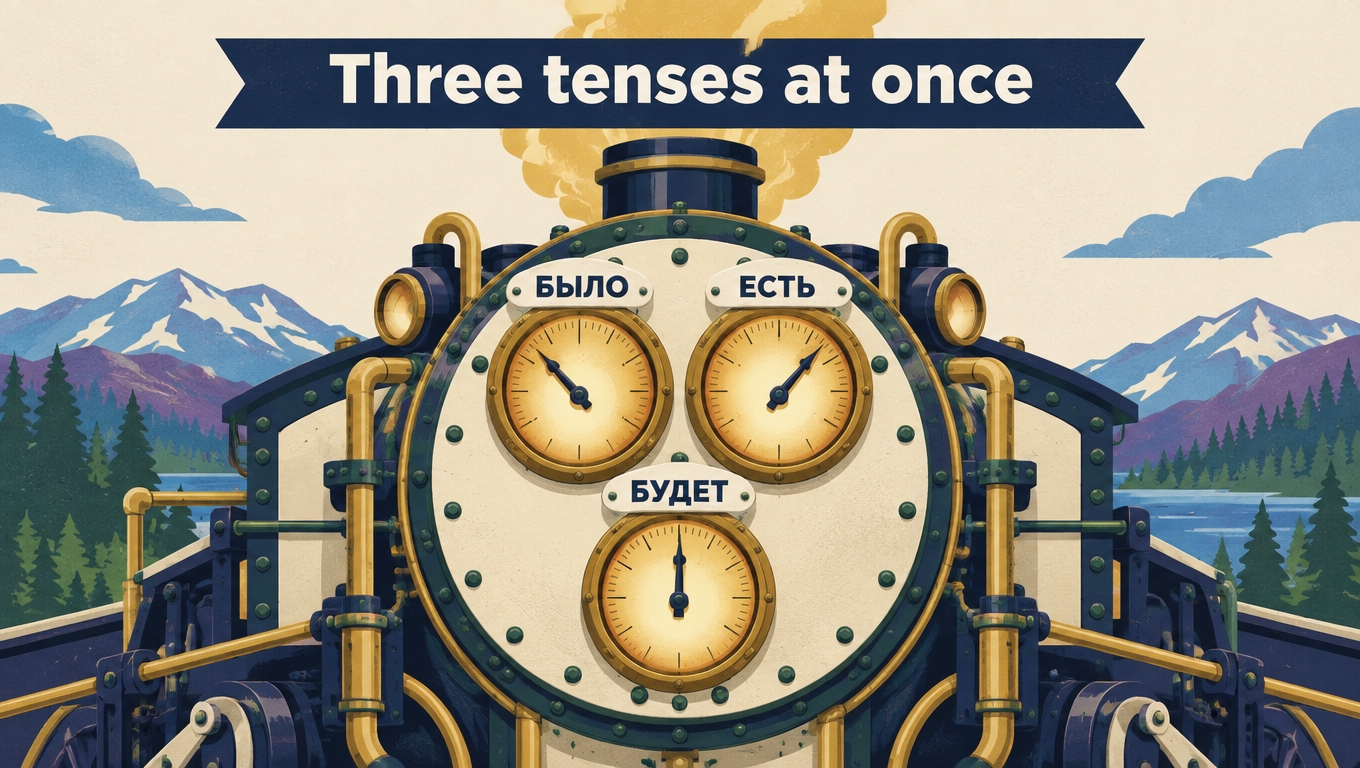
Install the whole Russian verb system in one hour: the base table of three tenses against statement, negative and question, the six present-tense endings, a past tense that marks gender instead of person, and a future built from быть plus an unchanged infinitive.
⏱ About 60 minutes24 phrases34 exercises
What you will learn
Recite the base table — three tenses against statement, negative and question — for any conjugation I verb
Conjugate a regular -ать verb in the present tense across all six forms
Form the past tense and make it agree in gender and number rather than in person
Build the imperfective future with быть plus an unchanged infinitive
Negate with не and turn any statement into a question without changing the word order
Ask and answer questions with the eight core question words: кто, что, где, куда, когда, почему, как, сколько
Quick review
Say these aloud before you start. They come from earlier lessons.
Э́то Москва́.This is Moscow.Listen in Russian:Slow in Russian:Э́то Москва́.
Я студе́нт.I am a student.Listen in Russian:Slow in Russian:Я студе́нт.
Э́то не кни́га.This is not a book.Listen in Russian:Slow in Russian:Э́то не кни́га.
Ты врач?Are you a doctor?Listen in Russian:Slow in Russian:Ты врач?
хорошо́good, wellListen in Russian:Slow in Russian:хорошо́
Спаси́бо! — Пожа́луйста.Thank you! — You are welcome.Listen in Russian:Slow in Russian:Спаси́бо! — Пожа́луйста.
Theory
Eight pronouns, six forms — and the verb does the work
Russian has eight subject pronouns: я, ты, он, она, оно, мы, вы, они. They collapse into six grammatical persons, because он, она and оно all take the same verb ending. That is the whole pronoun system, and you already met four of these words in Lesson 1.
Unlike Italian or Spanish, Russian does not usually drop the pronoun, and unlike English it does not need an auxiliary to make a question or a negative. The verb ending carries the person, the question is carried by intonation, and the negative is one particle. Three simple rules and the engine runs.
One habit to build now: say the pronoun out loud with every verb form while you are learning the table, then start leaving it out once the ending is automatic. Both are correct Russian.
Я чита́ю.I read. / I am reading.Listen in Russian:Slow in Russian:Я чита́ю.
Она́ чита́ет.She reads. / She is reading.Listen in Russian:Slow in Russian:Она́ чита́ет.
Мы чита́ем.We read. / We are reading.Listen in Russian:Slow in Russian:Мы чита́ем.
Они́ чита́ют.They read. / They are reading.Listen in Russian:Slow in Russian:Они́ чита́ют.
Conjugation I: one ending set covers most Russian verbs
Take the infinitive, drop the final -ть, and add six endings: -ю, -ешь, -ет, -ем, -ете, -ют. That single rule conjugates читать, знать, думать, работать, понимать, слушать, играть, гулять and отдыхать — nine of the ten verbs in this lesson.
This is why Russian verb conjugation is a better deal than it looks. There are two conjugations and a handful of genuinely irregular verbs, not five classes of irregularity as in Italian. Once this ending set is automatic you can produce the present tense of a verb you have never seen before, as long as you know which conjugation it belongs to.
The stress of these verbs does not move: where the infinitive is stressed, every conjugated form is stressed too. рабо́тать → рабо́таю, рабо́таешь, рабо́тал. That makes the whole paradigm predictable, which is a real gift for a beginner.
чита́ть → чита́ю, чита́ешь, чита́етto read → I read, you read, he/she readsListen in Russian:Slow in Russian:чита́ть → чита́ю, чита́ешь, чита́ет
зна́ть → зна́ю, зна́ешь, зна́етto know → I know, you know, he/she knowsListen in Russian:Slow in Russian:зна́ть → зна́ю, зна́ешь, зна́ет
рабо́тать → рабо́таю, рабо́таешь, рабо́таетto work → I work, you work, he/she worksListen in Russian:Slow in Russian:рабо́тать → рабо́таю, рабо́таешь, рабо́тает
Sound focus
Negation and questions: one particle and one melody
To negate, put не immediately before the verb. It is a separate word, it is never contracted, and nothing else in the sentence changes. Ячитаю → Янечитаю. That is the entire negative system of the Russian present tense.
To ask a yes/no question, change nothing at all — only your voice. The pattern called ИК-3 is a sharp rise on the stressed syllable of the final word, then a level tail. Тычитаешь. / Тычитаешь? The two sentences are identical on paper.
To ask a wh-question, put the question word at the front and keep the rest of the sentence exactly as it was. Чтотычитаешь? Гдетыработаешь? Когдатыотдыхаешь? No inversion, no auxiliary, no reordering. Compare English "What are you reading?" — Russian does three times less work.
Я не понима́ю.I do not understand.Listen in Russian:Slow in Russian:Я не понима́ю.
Ты чита́ешь?Are you reading? (statement order, rising voice)Listen in Russian:Slow in Russian:Ты чита́ешь?
Что ты чита́ешь?What are you reading?Listen in Russian:Slow in Russian:Что ты чита́ешь?
Почему́ ты не зна́ешь?Why do you not know?Listen in Russian:Slow in Russian:Почему́ ты не зна́ешь?
The time machine: the past has no person
Here is the fact that makes Russian tenses cheap. The past tense does not conjugate for person at all — it conjugates for the gender and number of the subject. Add -л to the infinitive stem and you have four forms: -л (masculine), -ла (feminine), -ло (neuter), -ли (plural).
So ячитал, тычитал, ончитал are all the same word, and the pronoun is what tells you who is meant. A woman says ячитала. A group says мычитали. There is no auxiliary verb, no participle, no agreement chain — four forms in total, against the six of the present.
There is no present-tense form of "to have" involved either. Russian does not build its past the way English or Italian does. One suffix does the whole job.
Я чита́л.I read / I was reading. (male speaker)Listen in Russian:Slow in Russian:Я чита́л.
Я чита́ла.I read / I was reading. (female speaker)Listen in Russian:Slow in Russian:Я чита́ла.
Оно́ рабо́тало.It worked.Listen in Russian:Slow in Russian:Оно́ рабо́тало.
Они́ чита́ли.They read / They were reading.Listen in Russian:Slow in Russian:Они́ чита́ли.
The future: быть plus an infinitive that never moves
The third tense costs you six forms of быть and nothing else. Conjugate быть — буду, будешь, будет, будем, будете, будут — and put the infinitive after it, unchanged. Ябудучитать. Тыбудешьчитать. Мыбудемчитать.
This is the imperfective future, and it is the one you will use most often at this level, because it is the future of every verb you have met so far. The main verb carries no information at all; быть does everything.
There is a second future in Russian, formed without any auxiliary — simply by conjugating a perfective verb, as in япрочитаю "I will have read it". Structurally that form looks exactly like the present tense, which is why the two are best learnt side by side. That is Lesson 14; today one future is enough.
One more thing to notice, because it will surprise you: быть itself has no present-tense form in ordinary use. Ястудент, not Яестьстудент. The verb "to be" exists in the past (был) and in the future (буду), and simply vanishes in between.
Я бу́ду чита́ть.I will read. / I will be reading.Listen in Russian:Slow in Russian:Я бу́ду чита́ть.
Ты бу́дешь рабо́тать?Will you work?Listen in Russian:Slow in Russian:Ты бу́дешь рабо́тать?
Мы бу́дем отдыха́ть.We will rest.Listen in Russian:Slow in Russian:Мы бу́дем отдыха́ть.
Он был до́ма.He was at home.Listen in Russian:Slow in Russian:Он был до́ма.
THE BASE TABLE: three tenses × statement, negative, question
Form
+ statement
− negative
? question
Present
Ячита́ю
Янечита́ю
Тычита́ешь?
Past
Ячита́л
Янечита́л
Тычита́л?
Future
Ябу́дучита́ть
Янебу́дучита́ть
Тыбу́дешьчита́ть?
This is the whole coordinate system of the Russian verb, and it is installed in one hour. Word order never changes between the three columns: не goes before the verb, and a question is the statement with a rising intonation (ИК-3) and a question mark. Learn this grid once and you can put any verb into it.
Conjugation I in the present: читать, знать, работать
Form
чита́ть
зна́ть
рабо́тать
я
чита́ю
зна́ю
рабо́таю
ты
чита́ешь
зна́ешь
рабо́таешь
он / она / оно
чита́ет
зна́ет
рабо́тает
мы
чита́ем
зна́ем
рабо́таем
вы
чита́ете
зна́ете
рабо́таете
они
чита́ют
зна́ют
рабо́тают
One ending set — -ю / -ешь / -ет / -ем / -ете / -ют — covers every regular verb of conjugation I, and that is most of them. Drop the -ть of the infinitive and add the endings.
The past: no person, only gender and number
Form
чита́ть
зна́ть
рабо́тать
он (he) / masculine
чита́л
зна́л
рабо́тал
она (she) / feminine
чита́ла
зна́ла
рабо́тала
оно (it) / neuter
чита́ло
зна́ло
рабо́тало
они (they) / plural
чита́ли
зна́ли
рабо́тали
Russian past tense is easier than the Italian or English one: there is no auxiliary and no participle. Add -л to the infinitive stem and agree with the subject in gender and number. Ячитал, тычитал, ончитал are all identical — the person is invisible, and the pronoun is what carries it.
The future: быть + infinitive
Form
быть (conjugated)
чита́ть (infinitive, unchanged)
я
бу́ду
чита́ть
ты
бу́дешь
чита́ть
он / она / оно
бу́дет
чита́ть
мы
бу́дем
чита́ть
вы
бу́дете
чита́ть
они
бу́дут
чита́ть
This is the imperfective future, and it is the only future you need today. The main verb never changes — all the work is done by быть. Perfective verbs form their future differently, with no auxiliary at all; that is Lesson 14.
Vocabulary
Learn each word with its stress mark and its pronunciation. Nouns are given with their gender, animacy and their full six-case declension; verbs are given with their aspect and, where one exists, their partner verb.
Russian
English
Gender / aspect
Pronunciation
Audio
чита́тьimperfective
to read
imperfective
/tɕɪˈtatʲ/chih-TYAT
Listen in Russian:Slow in Russian:читать
знатьimperfective
to know (a fact, a person, how)
imperfective
/znatʲ/ZNYAT
Listen in Russian:Slow in Russian:знать
ду́матьimperfective
to think
imperfective
/ˈdumətʲ/DOO-myut
Listen in Russian:Slow in Russian:думать
рабо́татьimperfective
to work
imperfective
/rɐˈbotətʲ/ruh-BOH-tyut
Listen in Russian:Slow in Russian:работать
понима́тьimperfective
to understand
imperfective
/pənʲɪˈmatʲ/puh-nih-MYAT
Listen in Russian:Slow in Russian:понимать
слу́шатьimperfective
to listen (to)
imperfective
/ˈsluʂətʲ/SLOO-shit
Listen in Russian:Slow in Russian:слушать
игра́тьimperfective
to play (a game, an instrument)
imperfective
/ɪˈɡratʲ/ih-GRYAT
Listen in Russian:Slow in Russian:играть
гуля́тьimperfective
to walk, to go for a walk
imperfective
/ɡʊˈlʲatʲ/goo-LYAT
Listen in Russian:Slow in Russian:гулять
отдыха́тьimperfective
to rest
imperfective
/ɐtdɨˈxatʲ/uh-dih-KHYAT
Listen in Russian:Slow in Russian:отдыхать
бытьimperfective
to be
imperfective
/bɨtʲ/BIHT
Listen in Russian:Slow in Russian:быть
мыpronoun
we
pronoun
/mɨ/MIH
Listen in Russian:Slow in Russian:мы
выpronoun
you (plural, or formal singular)
pronoun
/vɨ/VIH
Listen in Russian:Slow in Russian:вы
они́pronoun
they
pronoun
/ɐˈnʲi/uh-NEE
Listen in Russian:Slow in Russian:они
оно́pronoun
it (neuter)
pronoun
/ɐˈno/uh-NOH
Listen in Russian:Slow in Russian:оно
ктоpronoun
who
pronoun
/kto/KHTOH
Listen in Russian:Slow in Russian:кто
чтоpronoun
what
pronoun
/ʂto/SHTOH
Listen in Russian:Slow in Russian:что
гдеadverb
where (location)
adverb
/ɡdʲe/guh-DYEH
Listen in Russian:Slow in Russian:где
куда́adverb
where to (direction)
adverb
/kʊˈda/koo-DAH
Listen in Russian:Slow in Russian:куда
когда́adverb
when
adverb
/kɐɡˈda/kug-DAH
Listen in Russian:Slow in Russian:когда
почему́adverb
why
adverb
/pətɕɪˈmu/puh-chih-MOO
Listen in Russian:Slow in Russian:почему
какadverb
how; what … like
adverb
/kak/KAHK
Listen in Russian:Slow in Russian:как
ско́лькоadverb
how much, how many
adverb
/ˈskolʲkə/SKOHL-kuh
Listen in Russian:Slow in Russian:сколько
сейча́сadverb
now; immediately
adverb
/sʲɪˈtɕas/siy-CHAHS
Listen in Russian:Slow in Russian:сейчас
вчера́adverb
yesterday
adverb
/fˈtɕorə/fuh-chih-RAH
Listen in Russian:Slow in Russian:вчера
сего́дняadverb
today
adverb
/sʲɪˈvodʲnʲə/sih-VOHD-nyuh
Listen in Russian:Slow in Russian:сегодня
за́втраadverb
tomorrow
adverb
/ˈzavtrə/ZAHF-truh
Listen in Russian:Slow in Russian:завтра
то́жеadverb
also, too
adverb
/ˈtoʐə/TOH-zhih
Listen in Russian:Slow in Russian:тоже
о́ченьadverb
very
adverb
/ˈotɕɪnʲ/OH-chin
Listen in Russian:Slow in Russian:очень
ра́диоneuter · inanimate
radio
neuter · inanimate
/ˈradʲɪə/RAH-dih-uh
Listen in Russian:Slow in Russian:радио
по-ру́сскиadverb
in Russian
adverb
/pɐˈruskʲɪ/puh-ROO-skih
Listen in Russian:Slow in Russian:по-русски
яpronoun
I
pronoun
/ja/YAH
Listen in Russian:Slow in Russian:я
тыpronoun
you (informal, singular)
pronoun
/tɨ/TIH
Listen in Russian:Slow in Russian:ты
онpronoun
he
pronoun
/on/OHN
Listen in Russian:Slow in Russian:он
она́pronoun
she
pronoun
/ɐˈna/uh-NAH
Listen in Russian:Slow in Russian:она
хорошо́adverb
good, well, OK
adverb
/xərɐˈʂo/khuh-ruh-SHOH
Listen in Russian:Slow in Russian:хорошо
Full six-case declension of the 1 noun in this lesson
Each case is listed with the question word that selects it. Find the question you are answering and the ending follows.
Singular
Form
ра́дио (n)
nom · Кто? Что?
ра́дио
gen · Кого? Чего?
ра́дио
dat · Кому? Чему?
ра́дио
acc · Кого? Что?
ра́дио
instr · Кем? Чем?
ра́дио
prep · Оком? Очём?
ра́дио
Plural
Form
ра́дио (n)
nom · Кто? Что?
ра́дио
gen · Кого? Чего?
ра́дио
dat · Кому? Чему?
ра́дио
acc · Кого? Что?
ра́дио
instr · Кем? Чем?
ра́дио
prep · Оком? Очём?
ра́дио
A dash means the form does not exist. Plural-only nouns such as де́ньги and су́тки have no singular, and indeclinable nouns such as ко́фе and метро́ keep one form in all six cases.
Ready-to-use phrases
Я чита́ю.
I read. / I am reading.
IPA/ja tɕɪˈtaju/
Say itYAH chih-TAH-yoo.
Russian has no separate progressive form. The imperfective present covers both "I read" and "I am reading".
neutralpresentstudy
Listen in Russian:Slow in Russian:Я читаю.
Ты рабо́таешь?
Do you work? / Are you working?
IPA/tɨ rɐˈbotəɪʂ/
Say itTIH ruh-BOH-tuh-yish?
Same words as the statement; the ИК-3 rise lands on -бо-.
informalquestionswork
Listen in Russian:Slow in Russian:Ты работаешь?
Он зна́ет.
He knows.
IPA/on ˈznajɪt/
Say itOHN ZNAH-yit.
знать is class 1, so it takes the -ет ending, not -ит.
neutralpresentmental
Listen in Russian:Slow in Russian:Он знает.
Мы ду́маем.
We think.
IPA/mɨ ˈduməɪm/
Say itMIH DOO-muh-yim.
neutralpresentmental
Listen in Russian:Slow in Russian:Мы думаем.
Они́ игра́ют.
They play.
IPA/ɐˈnʲi ɪˈɡrajʊt/
Say ituh-NEE ih-GRAH-yoot.
Two stresses in the sentence: on the pronoun and on the verb.
neutralpresenthobbies
Listen in Russian:Slow in Russian:Они играют.
Я не понима́ю.
I do not understand.
IPA/ja nʲe pənʲɪˈmaju/
Say itYAH NYEH puh-nih-MAH-yoo.
The single most useful sentence in this lesson. не goes directly before the verb and never merges with it.
neutralnegationcommunication
Listen in Russian:Slow in Russian:Я не понимаю.
Не зна́ю.
I do not know.
IPA/nʲe ˈznaju/
Say itNYEH ZNAH-yoo.
The subject pronoun is freely dropped: the verb ending already says "I". This is normal speech, not slang.
informalnegationmental
Listen in Russian:Slow in Russian:Не знаю.
Ты не слу́шаешь.
You are not listening.
IPA/tɨ nʲe ˈsluʂəɪʂ/
Say itTIH NYEH SLOO-shih-yish.
informalnegationcommunication
Listen in Russian:Slow in Russian:Ты не слушаешь.
Кто э́то?
Who is this?
IPA/kto ˈɛtə/
Say itKHTOH EH-tuh?
Note the zero copula again: literally "who this?". The verb "is" is absent.
neutralquestionspointing
Listen in Russian:Slow in Russian:Кто это?
Что ты чита́ешь?
What are you reading?
IPA/ʂto tɨ tɕɪˈtajɪʂ/
Say itSHTOH TIH chih-TAH-yish?
The question word simply goes in front. Nothing else moves.
neutralquestionsstudy
Listen in Russian:Slow in Russian:Что ты читаешь?
Где ты?
Where are you?
IPA/ɡdʲe tɨ/
Say itguh-DYEH TIH?
informalquestionsplace
Listen in Russian:Slow in Russian:Где ты?
Когда́ ты рабо́таешь?
When do you work?
IPA/kɐɡˈda tɨ rɐˈbotəɪʂ/
Say itkug-DAH TIH ruh-BOH-tuh-yish?
neutralquestionstimework
Listen in Russian:Slow in Russian:Когда ты работаешь?
Почему́ ты не зна́ешь?
Why do you not know?
IPA/pətɕɪˈmu tɨ nʲe ˈznajɪʂ/
Say itpuh-chih-MOO TIH NYEH ZNAH-yish?
neutralquestionsnegation
Listen in Russian:Slow in Russian:Почему ты не знаешь?
Как ты ду́маешь?
What do you think?
IPA/kak tɨ ˈduməɪʂ/
Say itKAHK TIH DOO-muh-yish?
Literally "how do you think?". This is the standard way to ask for an opinion.
neutralquestionsmental
Listen in Russian:Slow in Russian:Как ты думаешь?
Ты понима́ешь по-ру́сски?
Do you understand Russian?
IPA/tɨ pənʲɪˈmajɪʂ pɐˈruskʲɪ/
Say itTIH puh-nih-MAH-yish puh-ROO-skih?
Russian does not need a noun here: the adverb по-русски does the whole job.
informalquestionslanguages
Listen in Russian:Slow in Russian:Ты понимаешь по-русски?
Да, я понима́ю по-ру́сски.
Yes, I understand Russian.
IPA/da ja pənʲɪˈmaju pɐˈruskʲɪ/
Say itDAH, YAH puh-nih-MAH-yoo puh-ROO-skih.
neutrallanguagescommunication
Listen in Russian:Slow in Russian:Да, я понимаю по-русски.
Вчера́ я рабо́тал.
Yesterday I worked.
IPA/fˈtɕorə ja ˈrabotəl/
Say itfuh-chih-RAH YAH ruh-BOH-tul.
A male speaker. A woman says работала — the past tense marks gender, not person.
neutralpasttime
Listen in Russian:Slow in Russian:Вчера я работал.
Сего́дня она́ чита́ет.
Today she is reading.
IPA/sʲɪˈvodʲnʲə ɐˈna tɕɪˈtajɪt/
Say itsih-VOHD-nyuh uh-NAH chih-TAH-yit.
neutralpresenttime
Listen in Russian:Slow in Russian:Сегодня она читает.
За́втра мы бу́дем отдыха́ть.
Tomorrow we will rest.
IPA/ˈzavtrə mɨ ˈbudʲɪm ɐtdɨˈxatʲ/
Say itZAHF-truh MIH BOO-dim uh-dih-KHYAT.
The imperfective future is two words: a form of быть plus the infinitive.
neutralfuturetime
Listen in Russian:Slow in Russian:Завтра мы будем отдыхать.
Я бу́ду чита́ть.
I will read.
IPA/ja ˈbudu tɕɪˈtatʲ/
Say itYAH BOO-doo chih-TYAT.
neutralfuture
Listen in Russian:Slow in Russian:Я буду читать.
Ты бу́дешь рабо́тать?
Will you work?
IPA/tɨ ˈbudʲɪʂ rɐˈbotətʲ/
Say itTIH BOO-dish ruh-BOH-tyut?
informalfuturequestions
Listen in Russian:Slow in Russian:Ты будешь работать?
Он был до́ма.
He was at home.
IPA/on bɨl ˈdomə/
Say itOHN BIHL DOH-muh.
дома is a fixed adverb, stressed on the first syllable, unlike the noun дом.
neutralpastplace
Listen in Russian:Slow in Russian:Он был дома.
Они́ бы́ли там.
They were there.
IPA/ɐˈnʲi ˈbɨlʲɪ tam/
Say ituh-NEE BIH-lih TAHM.
neutralpastplace
Listen in Russian:Slow in Russian:Они были там.
Мы зна́ем э́то.
We know this.
IPA/mɨ ˈznajɪm ˈɛtə/
Say itMIH ZNAH-yim EH-tuh.
neutralpresentmental
Listen in Russian:Slow in Russian:Мы знаем это.
Dialogues
A phone call in the evening
Tom rings Anna after work. Both are at home.
Tom
Привет! Где ты?
Hi! Where are you?
Listen in Russian:Slow in Russian:Привет! Где ты?
Anna
Я дома. А ты?
I am at home. And you?
Listen in Russian:Slow in Russian:Я дома. А ты?
Tom
Я тоже дома. Что ты читаешь?
I am at home too. What are you reading?
Listen in Russian:Slow in Russian:Я тоже дома. Что ты читаешь?
Anna
Я читаю книгу. А ты что читаешь?
I am reading a book. And what are you reading?
Listen in Russian:Slow in Russian:Я читаю книгу. А ты что читаешь?
Tom
Я не читаю. Я слушаю и отдыхаю.
I am not reading. I am listening and resting.
Listen in Russian:Slow in Russian:Я не читаю. Я слушаю и отдыхаю.
Anna
Что ты слушаешь?
What are you listening to?
Listen in Russian:Slow in Russian:Что ты слушаешь?
Tom
Я слушаю радио и отдыхаю.
I am listening to the radio and resting.
Listen in Russian:Slow in Russian:Я слушаю радио и отдыхаю.
Anna
Хорошо!
Good!
Listen in Russian:Slow in Russian:Хорошо!
Yesterday and tomorrow
Anna and Tom compare what they did yesterday and what they will do tomorrow.
Anna
Том, вчера ты работал?
Tom, did you work yesterday?
Listen in Russian:Slow in Russian:Том, вчера ты работал?
Tom
Да, вчера я работал. А ты?
Yes, yesterday I worked. And you?
Listen in Russian:Slow in Russian:Да, вчера я работал. А ты?
Anna
Вчера я читала и отдыхала.
Yesterday I read and rested.
Listen in Russian:Slow in Russian:Вчера я читала и отдыхала.
Tom
А что ты будешь читать завтра?
And what will you read tomorrow?
Listen in Russian:Slow in Russian:А что ты будешь читать завтра?
Anna
Завтра я буду читать и гулять.
Tomorrow I will read and go for a walk.
Listen in Russian:Slow in Russian:Завтра я буду читать и гулять.
Tom
Завтра мы будем гулять?
Tomorrow, will we go for a walk?
Listen in Russian:Slow in Russian:Завтра мы будем гулять?
Anna
Да!
Yes!
Listen in Russian:Slow in Russian:Да!
Tom
Очень хорошо!
Very good!
Listen in Russian:Slow in Russian:Очень хорошо!
At the language exchange
Ivan meets Tom at an evening language exchange and switches to the formal вы.
Ivan
Здравствуйте! Вы понимаете по-русски?
Hello! Do you understand Russian?
Listen in Russian:Slow in Russian:Здравствуйте! Вы понимаете по-русски?
Tom
Не очень хорошо. Я читаю и слушаю.
Not very well. I read and listen.
Listen in Russian:Slow in Russian:Не очень хорошо. Я читаю и слушаю.
Ivan
Вы работаете здесь?
Do you work here?
Listen in Russian:Slow in Russian:Вы работаете здесь?
Tom
Нет, я не работаю здесь. Я студент.
No, I do not work here. I am a student.
Listen in Russian:Slow in Russian:Нет, я не работаю здесь. Я студент.
Ivan
А что вы читаете сейчас?
And what are you reading now?
Listen in Russian:Slow in Russian:А что вы читаете сейчас?
Tom
Сейчас я читаю книгу.
Now I am reading a book.
Listen in Russian:Slow in Russian:Сейчас я читаю книгу.
Ivan
Хорошо!
Good!
Listen in Russian:Slow in Russian:Хорошо!
Tom
Спасибо!
Thank you!
Listen in Russian:Slow in Russian:Спасибо!
Exercises
Answer actively — try to recall the Russian before you look at any hint.
ConjugationExercise 1
Give the present tense form for "ты".
читать — ты
ConjugationExercise 2
Give the present tense form for "они".
знать — они
ConjugationExercise 3
Give the present tense form for "мы".
работать — мы
ConjugationExercise 4
Give the past tense form for a female speaker.
читать — past, feminine
ConjugationExercise 5
Give the future tense form of быть for "вы".
быть — future, вы
ConjugationExercise 6
Give the present tense form for "они".
отдыхать — они
ConjugationExercise 7
Give the past tense plural form.
понимать — past, plural
ConjugationExercise 8
Give the polite imperative for "вы".
слушать — imperative, вы
Translate To RussianExercise 9
Translate into Russian.
I do not understand.
Translate To RussianExercise 10
Translate into Russian.
What are you reading?
Translate To RussianExercise 11
Translate into Russian.
Yesterday she worked.
Translate To RussianExercise 12
Translate into Russian.
Tomorrow we will rest.
Translate To RussianExercise 13
Translate into Russian.
Why do you not know?
Translate To EnglishExercise 14
Translate into English.
Мызна́емэ́то.
Translate To EnglishExercise 15
Translate into English.
Онбылдо́ма.
Translate To EnglishExercise 16
Translate into English.
Тыпонима́ешьпо-ру́сски?
Multiple ChoiceExercise 17
Choose the correct sentence.
Which sentence means "I do not understand"?
Multiple ChoiceExercise 18
Choose the correct description.
How do you form a yes/no question in Russian?
Multiple ChoiceExercise 19
Choose the correct form.
What is the past tense of читать for "она"?
Multiple ChoiceExercise 20
Choose the correct form.
Which form of быть goes with "мы" in the future?
Fill GapExercise 21
Fill the gap: "I am reading a book."
Я ___ книгу.
Fill GapExercise 22
Fill the gap: "When do you work?"
___ тыработаешь?
Fill GapExercise 23
Fill the gap: "They were there."
Они ___ там.
Fill GapExercise 24
Fill the gap: "Tomorrow I will read."
Завтрая ___ читать.
True FalseExercise 25
Answer true or false.
In the Russian past tense, the verb form changes according to the person.
True FalseExercise 26
Answer true or false.
The Russian present tense can mean both "I read" and "I am reading".
Match PairsExercise 27
Pair the words.
Match each Russian question word with its English meaning.
Word OrderExercise 28
Put the words in order.
Build the question: "What are you reading?"
Sentence TransformExercise 29
Rewrite it with не.
Make this sentence negative: «Онапонимаетпо-русски.»
Sentence TransformExercise 30
Rewrite it in the future tense.
Put this sentence into the future: «Ячитаюкнигу.»
Listen And TypeExercise 31
Play the audio and type what you hear.
Listen and type the sentence.
Listen And ChooseExercise 32
Play the audio and pick the match.
Listen and choose the sentence you hear.
Stress ChoiceExercise 33
Choose the correctly stressed form.
Where does the stress fall in «работать»?
Flashcard Self RatingExercise 34
Recall the English meaning, then rate how well you knew it.
сего́дня
Speak now
Run each verb through the base table out loud: statement, negative, question, in all three tenses. Do it for читать first, then swap in a verb of your own. Speed matters more than precision here — the goal is the grid becoming automatic, not each form being perfect.
Я чита́ю кни́гу.I am reading a book.Listen in Russian:Slow in Russian:Я чита́ю кни́гу.
Я не понима́ю.I do not understand.Listen in Russian:Slow in Russian:Я не понима́ю.
Вчера́ я рабо́тал, сего́дня я отдыха́ю.Yesterday I worked, today I am resting.Listen in Russian:Slow in Russian:Вчера́ я рабо́тал, сего́дня я отдыха́ю.
За́втра мы бу́дем гуля́ть.Tomorrow we will go for a walk.Listen in Russian:Slow in Russian:За́втра мы бу́дем гуля́ть.
Что ты де́лаешь сейча́с?What are you doing now?Listen in Russian:Slow in Russian:Что ты де́лаешь сейча́с?
Ты понима́ешь по-ру́сски?Do you understand Russian?Listen in Russian:Slow in Russian:Ты понима́ешь по-ру́сски?
Lesson checkpoint
Before you move on, make sure you can do all of this without looking:
Recite all six present-tense forms of читать from memory, with the pronouns
Say the base table aloud for знать: three tenses, statement, negative, question
Give the four past-tense forms of работать and say which subject each one agrees with
Build the future of отдыхать for all six persons without looking
Ask six questions using six different question words
Negate three of your own sentences with не, then turn two of them into questions by intonation alone
Remember this
Conjugation I present: drop the -ть and add -ю, -ешь, -ет, -ем, -ете, -ют. One ending set covers most Russian verbs.
The negative is one particle, не, placed directly before the verb. Nothing else changes.
A question changes nothing in the word order. It is the statement with a rising intonation (ИК-3) and a question mark.
The past tense marks gender and number, never person: читал, читала, читало, читали. Я, ты and он all take читал.
The imperfective future is быть conjugated plus an infinitive that never changes: ябудучитать.
The verb быть is invisible in the present tense and reappears as был and буду in the past and future.