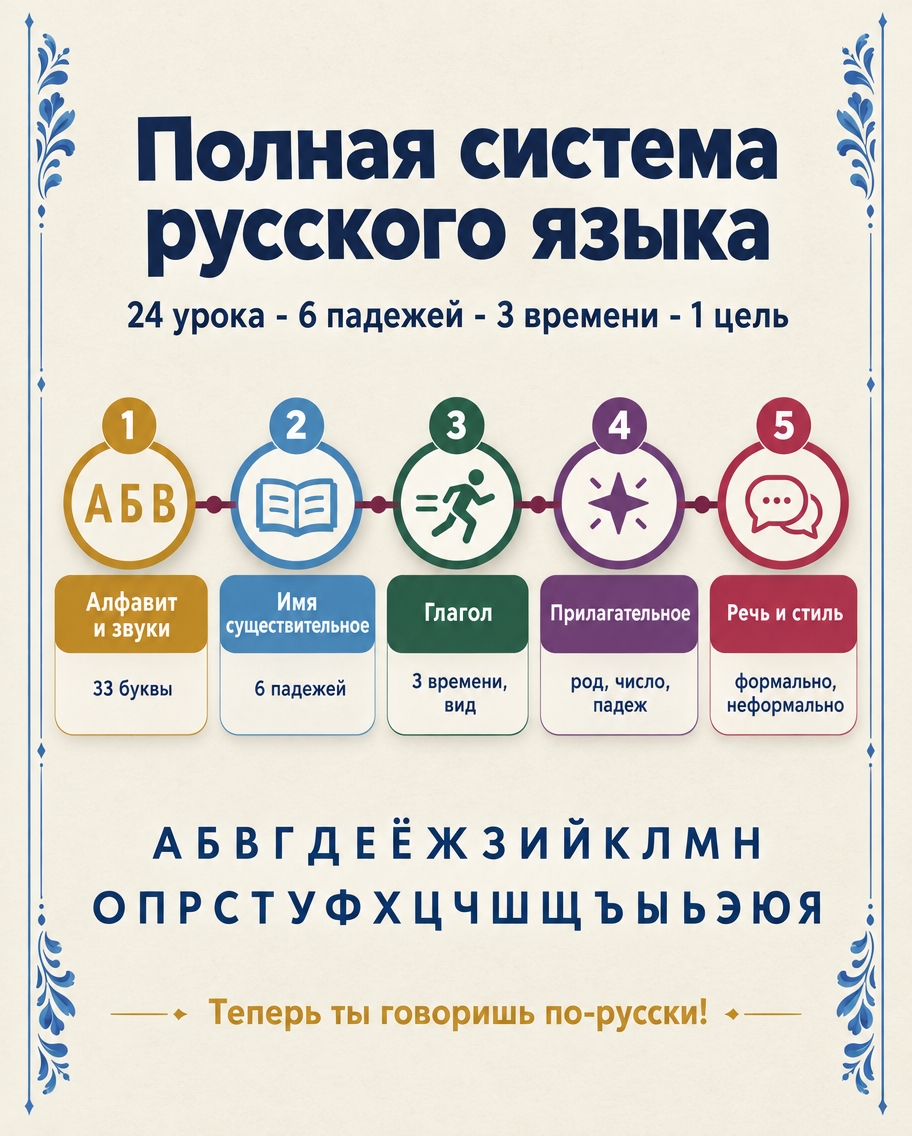
The final challenge: no new grammar, just the two engines — the verb matrix and the case map — running at speed through twelve real-life scenarios, forty-two exercises reaching back over the whole course, and the one-page cheat sheet that sums all of it up.
⏱ About 90 minutes26 phrases42 exercises
What you will learn
Run any verb you know through the complete matrix — three tenses, two aspects, six persons — and say out loud why the perfective column has an empty cell
Answer the six case questions fast enough to pick the right ending mid-sentence, and name the preposition each question is welded to
Choose imperfective or perfective in real time from three tests: is it a process, is it a habit, or is there a result you can point at?
Handle all twelve real-life scenarios — introductions, directions, café, ticket, hotel, doctor, pharmacy, shop, phone call, problem, emergency, small talk — without falling back into English
Grade yourself honestly: the exercises, the dialogues and the speaking prompts tell you exactly which of Lessons 1-23 to revisit
Copy or print the one-page cheat sheet — verb table, case table, preposition map — and keep using it until you no longer need it
Quick review
Say these aloud before you start. They come from earlier lessons.
Скажите, пожалуйста, как пройти к метро.Excuse me, how do I get to the metro?Listen in Russian:Slow in Russian:Скажите, пожалуйста, как пройти к метро.
У меня забронирован номер.I have a room booked.Listen in Russian:Slow in Russian:У меня забронирован номер.
Если будет время, мы пойдём в кино.If there's time we'll go to the cinema.Listen in Russian:Slow in Russian:Если будет время, мы пойдём в кино.
Мне нравится этот город.I like this city.Listen in Russian:Slow in Russian:Мне нравится этот город.
Я не был там раньше.I haven't been there before.Listen in Russian:Slow in Russian:Я не был там раньше.
Сколько стоит билет на поезд?How much is a train ticket?Listen in Russian:Slow in Russian:Сколько стоит билет на поезд?
Theory
No new grammar — everything at once
This is the final lesson, and it teaches you nothing new. That is the point. Everything you need is already in your head from Lessons 1 to 23; what remains is to make it come out fast enough to hold a conversation. The lesson runs like an exam you set yourself: twenty-six phrases that each combine several lessons, three dialogues, the three big tables of the course, forty-two exercises that reach back over everything, and twelve real-life scenarios to act out aloud.
Work through it in one ninety-minute sitting if you can, or split it into three. Do the phrases and dialogues first, then the exercises, then the scenarios — and do the scenarios standing up, out loud, at conversation speed, because writing is not speaking and this lesson is about speaking. Where you hesitate, mark the spot. Hesitation is the only honest diagnostic there is: every stumble names a lesson to revisit, and the prerequisites list below is your map back to it.
What does "knowing Russian" mean at the end of this course? Not reciting tables. It means making three decisions in real time — which aspect, which case, which person — while the other person is still talking. The tables were never the goal; they were the scaffolding. This lesson is the moment you check that the building stands on its own.
Мне, пожалуйста, чашку кофе и счёт.A cup of coffee and the bill, please.Listen in Russian:Slow in Russian:Мне, пожалуйста, чашку кофе и счёт.
Если будет время, я позвоню тебе вечером.If there's time I'll ring you in the evening.Listen in Russian:Slow in Russian:Если будет время, я позвоню тебе вечером.
У меня забронирован номер на три ночи.I have a room booked for three nights.Listen in Russian:Slow in Russian:У меня забронирован номер на три ночи.
Извините, вы не могли бы говорить медленнее?Sorry, could you speak a bit slower?Listen in Russian:Slow in Russian:Извините, вы не могли бы говорить медленнее?
Engine one: the verb, end to end
The first matrix below is the same grid Lesson 2 started and Lesson 16 completed, now with the perfective column filled in. Read it from the aspect inward. The imperfective column is full: a present (говорю), a compound future with быть (будуговорить) and a past (говорил). The perfective column has a hole where the present would be, because its six present-shaped forms — скажу, скажешь, скажет — already ARE its future.
The past is the cheapest row on the page: four forms, no person, identical for both aspects. Only the gender and number of the subject move anything, and the stress can move too — был, была, было, были. So when you speak, the order of decisions is aspect first, tense second, person last. Person, the thing English speakers worry about most, is the smallest of the three.
Two more frames are built from forms you already have. The imperative is the present stem plus -й or -и, plus -те for вы: говори, говорите, скажи, скажите. The conditional is the past tense plus бы: яхотелбы, немоглибывы. Neither needs a new tense, and between them they cover almost every polite thing you will ever want to say. The irregulars — быть, дать, есть, хотеть, мочь, идти and its past шёл — are worth one final pass through Lesson 16 before you attempt the exercises below.
Завтра я буду работать весь день.Tomorrow I shall be working all day.Listen in Russian:Slow in Russian:Завтра я буду работать весь день.
Завтра я напишу письмо и позвоню маме.Tomorrow I shall write the letter and ring Mum.Listen in Russian:Slow in Russian:Завтра я напишу письмо и позвоню маме.
Вчера я читал книгу весь вечер.Yesterday I was reading the book all evening.Listen in Russian:Slow in Russian:Вчера я читал книгу весь вечер.
Я хотел бы чашку чая, пожалуйста.I'd like a cup of tea, please.Listen in Russian:Slow in Russian:Я хотел бы чашку чая, пожалуйста.
Engine two: six questions, not six cases
The second matrix is the case map the whole course was built on. Russian does not ask you to remember six cases; it asks you to remember six questions, each welded to a preposition chunk. Где? answers with в or на plus the prepositional: вМоскве, напочте. Куда? answers with the same в or на plus the accusative: вМоскву, напочту. Укого? is the genitive, кому? the dative, скем? the instrumental, очём? the prepositional again. If you know the question, you know the ending.
Two rows are where English-speakers lose marks, and both are highlighted in the matrix. The accusative row is the animacy row: стол stays стол, but брат becomes брата, and every animate masculine and every animate plural in the language does the same. The prepositional row is the spelling row: the ending is -е for almost everything, but -ии for nouns in -ия and -ие and -и for third-declension feminines.
The third matrix is the preposition map, and the rule behind it is one sentence long: a preposition never changes its case, so learn it with its case as a single item — безденег, кврачу, сбратом, оработе — the way you learn a verb with its government. The only prepositions that govern two cases each are в, на, с, за and по, and there the question word tells you which case you are in: где or куда, скем or откуда.
Книга лежит на столе.The book is lying on the table.Listen in Russian:Slow in Russian:Книга лежит на столе.
Я иду к врачу.I'm on my way to the doctor's.Listen in Russian:Slow in Russian:Я иду к врачу.
Мы говорим о работе.We are talking about work.Listen in Russian:Slow in Russian:Мы говорим о работе.
Я встречаюсь с друзьями в субботу.I'm meeting my friends on Saturday.Listen in Russian:Slow in Russian:Я встречаюсь с друзьями в субботу.
Choosing aspect in real time
Aspect is the decision Russian forces you to make on every single verb, and it is the one English never asks for. Run three tests. Is there a result you can point at — a finished letter, a bought ticket? Perfective. Is it a process with the camera on the middle of it — «I was reading»? Imperfective. Is it a habit or a bare fact — «I read every day», «I did read it»? Imperfective again.
In the future the same tests apply, with one structural fact on top: the perfective future is one word and the imperfective future is two. Завтраянапишуписьмо — one completed act. Завтраябудуписатьписьмо — time spent on it, completion unknown. The signal words of Lesson 14 still work as triggers: уже, сразу, наконец pull the perfective; долго, часто, обычно, весьдень pull the imperfective. In когда-clauses about a single future event, the perfective does the work of English "will": когдаяприеду, япозвоню.
Two traps to close the course with. First, negation: не with a perfective often reports that the act failed or never happened — янепозвонил, «I didn't ring (in the end)»; не with an imperfective denies the activity itself — янезвонил, «I wasn't ringing / made no calls». Second, motion: the prefixed verbs of Lesson 15 are nearly all perfective — пойти, приехать, вернуться — so their "present" forms are futures, and the unprefixed идти and ехать are the imperfectives you reach for when the journey itself is the point.
Вчера я писал письмо два часа.Yesterday I was writing the letter for two hours.Listen in Russian:Slow in Russian:Вчера я писал письмо два часа.
Вчера я написал письмо.Yesterday I wrote the letter — and finished it.Listen in Russian:Slow in Russian:Вчера я написал письмо.
Когда мы приедем, я тебе позвоню.When we arrive I'll ring you.Listen in Russian:Slow in Russian:Когда мы приедем, я тебе позвоню.
Раньше мы часто ездили в музей по субботам.We used to go to the museum a lot on Saturdays.Listen in Russian:Slow in Russian:Раньше мы часто ездили в музей по субботам.
The one-page cheat sheet you can print
Everything above fits on one side of A4, and the course would like you to put it there. The printable cheat sheet has exactly three blocks, and they are the three matrices of this lesson, in order. Block one, top left: the complete verb matrix — говорить and сказать side by side, three tenses, both aspects, the imperative, with the perfective's empty present cell drawn as an actual empty cell so the hole stays visible. Block two, across the middle: the case map — the six question words down the side, four nouns across (стол, брат, Москва, письмо), the accusative and prepositional rows boxed. Block three, bottom: the preposition map — every preposition of the course with its case and one example.
Make your own rather than trusting anyone else's layout, and make it by hand: the writing itself is half the revision. Swap the four nouns for the four nouns you actually use — your own city, your own job — and add down the margin the irregulars that still bite you: шёл, дал, хочу, могу, писем, рублей, детей. One page only. If it does not fit, you have added rules where the course deliberately left patterns.
Use the sheet under the twelve scenarios of Speak Now: glance at it when you stall, but do not speak from it. The honest measure of finishing this course is the day the sheet stays face down on the table while you talk, and you notice afterwards that you never once reached for it. Keep it anyway — for the first real conversation, the first phone call, the first trip. Reference is not failure; it is what a cheat sheet is for.
Где? — в Москве, на почте, на вокзале.Where? — in Moscow, at the post office, at the station.Listen in Russian:Slow in Russian:Где? — в Москве, на почте, на вокзале.
Куда? — в Москву, на почту, на вокзал.Where to? — to Moscow, to the post office, to the station.Listen in Russian:Slow in Russian:Куда? — в Москву, на почту, на вокзал.
Настоящее: говорю, говоришь, говорит, говорим, говорите, говорят.Present: I speak, you speak, he speaks, we speak, you speak, they speak.Listen in Russian:Slow in Russian:Настоящее: говорю, говоришь, говорит, говорим, говорите, говорят.
Прошедшее: говорил, говорила, говорило, говорили.Past: he spoke, she spoke, it spoke, they spoke — one form per gender and number, no persons at all.Listen in Russian:Slow in Russian:Прошедшее: говорил, говорила, говорило, говорили.
THE COMPLETE VERB MATRIX — говорить / сказать
Form
НСВ: говори́ть
СВ: сказа́ть
настоя́щее — я / ты / он
говорю́ · говори́шь · говори́т
— a perfective verb has no present tense at all
настоя́щее — мы / вы / они́
говори́м · говори́те · говоря́т
— the six forms in the future rows ARE its present-shaped forms, and they mean tomorrow
бу́дущее — я / ты / он
бу́ду · бу́дешь · бу́дет · говори́ть
скажу́ · ска́жешь · ска́жет
бу́дущее — мы / вы / они́
бу́дем · бу́дете · бу́дут · говори́ть
ска́жем · ска́жете · ска́жут
проше́дшее — он / она́ / оно́
говори́л · говори́ла · говори́ло
сказа́л · сказа́ла · сказа́ло
проше́дшее — они́
говори́ли
сказа́ли
повели́тельное — ты / вы
говори́ · говори́те
скажи́ · скажи́те
This is the grid the whole course is built on, and it is the first block of the printable cheat sheet. Read it from the aspect inward, never from the tense outward. The imperfective column is complete: a present, a compound future made with быть, and a past. The perfective column has a hole where the present would be, and the six present-shaped forms sitting in the future rows beneath it — скажу, скажешь, скажет — are not a present tense but its future: structurally the perfective future IS a present tense, which is precisely why a perfective verb cannot have one. The past row is the cheapest thing on the page: four forms, no person, identical shape for both aspects, and the only thing that moves is the gender of the subject. So the order in which you make decisions when you speak is aspect first, tense second, person last, and person is the smallest of the three choices. Two stress facts to notice in the grid above: говорить keeps its stress on the ending through the whole present (говорю, говоришь, говорят), while сказать moves it onto the ending only in the я-form (скажу) and pulls it back for everyone else (скажешь, скажут). Learn the я-form with the infinitive every time and you will never be caught out.
THE COMPLETE CASE MAP — six questions, four shapes
Form
стол (masculine, thing)
брат (masculine, person)
Москва́ (feminine)
письмо́ (neuter)
Кто? Что? — Nominative
стол
брат
Москва́
письмо́
Кого́? Чего́? — Genitive
стола́
бра́та
Москвы́
письма́
Кому́? Чему́? — Dative
столу́
бра́ту
Москве́
письму́
Кого́? Что? — Accusative
стол
бра́та
Москву́
письмо́
Кем? Чем? — Instrumental
столо́м
бра́том
Москво́й
письмо́м
Оком? Очём? — Prepositional
остоле́
обра́те
оМоскве́
описьме́
The second block of the cheat sheet, and the one that saves you the most time. Russian does not ask you to remember six cases; it asks you to remember six questions, and each question is welded to one preposition chunk. «Где?» goes with в or на and gives the prepositional. «Куда?» goes with the same в or на and gives the accusative. «Укого?» gives the genitive, «кому?» the dative, «скем?» the instrumental, «очём?» the prepositional again. Two rows are highlighted because they are where English-speakers lose marks. The accusative row is the animacy row: стол stays стол, but брат becomes брата, and every animate masculine and every animate plural in the language does the same. The prepositional row is the spelling row — the ending is -е for almost everything (остоле, обрате, оМоскве, описьме), but -ии for nouns in -ия and -ие (вРоссии, оздании) and -и for third-declension feminines (оночи). Note too that the neuter and the inanimate masculine are identical in the accusative, which is why you can leave both alone.
THE PREPOSITION MAP — which case each one governs
Form
The case it governs
The question it answers
An example
в
Prepositional / Accusative
Где? / Куда́?
вго́роде · вго́род
на
Prepositional / Accusative
Где? / Куда́?
напочте́ · напо́чту
из · с · от · до
Genitive
Отку́да? Откого́? Дочего́?
изРосси́и · срабо́ты · довокза́ла
у
Genitive
Укого́? Учего́?
уменя́ · удо́ма
к
Dative
Ккому́? Кчему́?
кврачу́ · кдо́му
о
Prepositional
Оком? Очём?
окни́ге · орабо́те
для · без
Genitive
Длякого́? Безчего́?
длятебя́ · безде́нег
с
Instrumental
Скем? Счем?
сбра́том · сча́ем
над · под · пе́ред · ме́жду
Instrumental
Где?
подстоло́м · пе́реддо́мом
по
Dative (Accusative in «с … по …»)
Почему́?
пого́роду · спонеде́льникапопя́тницу
за
Instrumental / Accusative
Зачем? Зачто?
застоло́м · сестьзастол
че́рез
Accusative
Че́резчто? Че́резско́лько?
че́резу́лицу · че́резчас
ми́мо · вдоль · вокру́г
Genitive
Ми́мочего́?
ми́мопа́рка · вокру́гго́рода
The third block, and the one people photograph on their phone. Two prepositions govern two cases each and the question word tells you which: в and на take the prepositional for «where» and the accusative for «where to», с takes the genitive for «off / from» and the instrumental for «together with», за takes the instrumental for «behind» and the accusative for «for / behind which», по takes the dative for «around» and the accusative inside a «с … по …» range. Everything else governs one case and never changes. Learn the preposition with its case as one item, the way you learn a verb with its government, and you will never have to work out an ending from scratch mid-sentence. Two spelling notes: «в» becomes «во» before clusters beginning with в or ф and a handful of others (вовторник, воФранции, вовсём, ворту), and «о» becomes «об» before a vowel (обинженере) and «обо» before certain consonant clusters (обомне, обовсём).
Vocabulary
Learn each word with its stress mark and its pronunciation. Nouns are given with their gender, animacy and their full six-case declension; verbs are given with their aspect and, where one exists, their partner verb.
to do, to practise, to spend time on (an activity)
imperfective
/zənʲɪˈmat͜sə/zuh-nih-MAH-tsyuh
Listen in Russian:Slow in Russian:заниматься
извини́теinterjection
sorry; excuse me (polite or plural)
interjection
/ɪzvʲɪˈnʲitʲə/ih-zvih-NEE-tyuh
Listen in Russian:Slow in Russian:извините
поэ́томуadverb
that is why, so, therefore
adverb
/pɐˈɛtəmʊ/puh-EH-tuh-moo
Listen in Russian:Slow in Russian:поэтому
счётmasculine · inanimate
the bill, the check; an account
masculine · inanimate
/ɕːot/SHCHOHT
Listen in Russian:Slow in Russian:счёт
биле́тmasculine · inanimate
ticket
masculine · inanimate
/bʲɪˈlʲetʲ/bih-LYET
Listen in Russian:Slow in Russian:билет
жеparticle
but, (emphatic) — insists on what the listener knows or forgot
particle
/ʐɨ/ZHEH
Listen in Russian:Slow in Russian:же
Full six-case declension of the 11 nouns in this lesson
Each case is listed with the question word that selects it. Find the question you are answering and the ending follows.
Singular
Form
го́род (m)
Москва́ (f)
кни́га (f)
врач (m)
голова́ (f)
вре́мя (n)
де́ньги
рубль (m)
час (m)
счёт (m)
биле́т (m)
nom · Кто? Что?
город
Москва́
книга
врач
голова́
вре́мя
—
рубль
час
счёт
биле́т
gen · Кого? Чего?
города
Москвы́
книги
врача
го́ловы
вре́мени
—
рубля́
часа́
счёта
биле́та
dat · Кому? Чему?
городу
Москве́
книге
врачу
го́лове
вре́мени
—
рублю́
ча́су
счёту
биле́ту
acc · Кого? Что?
город
Москву́
книгу
врача
го́лову
вре́мя
—
рубль
час
счёт
биле́т
instr · Кем? Чем?
городом
Москво́й
книгой
врачом
голо́вой
вре́менем
—
рублём
ча́сом
счётом
биле́том
prep · Оком? Очём?
городе
Москве́
книге
враче
го́лове
вре́мени
—
рубле́
ча́се
счёте
биле́те
Plural
Form
го́род (m)
Москва́ (f)
кни́га (f)
врач (m)
голова́ (f)
вре́мя (n)
де́ньги
рубль (m)
час (m)
счёт (m)
биле́т (m)
nom · Кто? Что?
города́
—
книги
врачи́
го́ловы
времена́
де́ньги
рубли́
часы́
—
биле́ты
gen · Кого? Чего?
городо́в
—
книг
враче́й
голо́в
времён
де́нег
рубле́й
часо́в
—
биле́тов
dat · Кому? Чему?
города́м
—
книгам
врача́м
голова́м
времена́м
де́ньгам
рубля́м
часа́м
—
биле́там
acc · Кого? Что?
города́
—
книги
враче́й
го́ловы
времена́
де́ньги
рубли́
часы́
—
биле́ты
instr · Кем? Чем?
города́ми
—
книгами
врача́ми
голова́ми
времена́ми
де́ньгами
рубля́ми
часа́ми
—
биле́тами
prep · Оком? Очём?
города́х
—
книгах
врача́х
голова́х
времена́х
де́ньгах
рубля́х
часа́х
—
биле́тах
A dash means the form does not exist. Plural-only nouns such as де́ньги and су́тки have no singular, and indeclinable nouns such as ко́фе and метро́ keep one form in all six cases.
Ready-to-use phrases
Здра́вствуйте! Меня́ зову́т А́нна, я из А́нглии.
Hello! My name is Anna, I'm from England.
IPA/ˈzdrastvʲɪtʲə mʲɪˈnʲa zɐˈvut ˈanːə ja ɪz ˈanɡlʲɪɪ/
Say itZDRAH-stvuy-tyuh! mih-NYAH zuh-VOOT AH-nuh, YAH iz AHN-glih-ih.
The first sentence of Lesson 1 and still the one you will use most. «Менязовут» is learnt whole: «меня» is the accusative of «я» and «зовут» is a third-person plural, so the literal sense is «me they-call». «из» governs the genitive, hence «изАнглии». Everything after the exclamation mark is one breath — Russian does not pause before «яиз».
neutralgreetingsintroductionssurvival
Listen in Russian:Slow in Russian:Здравствуйте! Меня зовут Анна, я из Англии.
Я живу́ в Москве́ уже́ два го́да и рабо́таю в ба́нке.
I've been living in Moscow for two years now and I work in a bank.
IPA/ja ʐɨˈvu v mɐˈskvʲe ʊˈʐɛ ˈdva ˈɡodə ɪ rɐˈbotəjʊ v ˈbankʲe/
Say itYAH zhih-VOO v muh-SKVYEH oo-ZHEH DVAH GOH-duh EE ruh-BOH-tuh-yoo v BAHN-kyuh.
Four lessons in one line. «вМоскве» answers «где?» and so is prepositional; «двагода» is 2 + genitive singular, because 2, 3 and 4 govern the genitive singular of the counted noun; «уже» puts the stress on its final syllable, уже́; and the present tense of «жить» and «работать» covers what English needs a present perfect continuous for. Russian has no such tense and does not want one.
neutralcitytimeworknumbers
Listen in Russian:Slow in Russian:Я живу в Москве уже два года и работаю в банке.
Say itSKOHL-kuh siy-CHAHS VRYEH-mih-nih? — bis CHEH-tvihr-tih PYAT.
«Скольковремени?» and «Которыйчас?» both ask the time; the first is the neutral everyday one. «время» is the odd -мя noun: nominative «время», but genitive, dative and prepositional all insert -ен-, giving «времени». The answer uses «без + genitive» for «to» the hour — «безчетвертипять», literally «without a quarter, five». «четверть» is a third-declension feminine, so its genitive is «четверти», not *четвертя.
neutraltimenumbersquestions
Listen in Russian:Slow in Russian:Сколько сейчас времени? — Без четверти пять.
Извини́те, вы не мо́гли бы мне помо́чь?
Excuse me, could you help me?
IPA/ɪzvʲɪˈnʲitʲə vɨ nʲɪ ˈmoɡlʲɪ bɨ mnʲe pɐˈmotɕ/
Say itih-zvih-NEE-tyuh, VIH NYEH MOH-glih BIH muh-NYEH puh-MOHCH?
The conditional is the past tense plus «бы»: «немоглибы» is literally «could you not». It is the polite request frame, and the negative is idiomatic rather than logical — Russian softens a request by questioning it. «помогать» governs the dative, so «help me» is «мнепомочь» and never *«меняпомочь». «Извините» is the вы form; to one friend it is «извини».
politepolitenessregisteremergency
Listen in Russian:Slow in Russian:Извините, вы не могли бы мне помочь?
Я хоте́л бы биле́т до Москвы́, пожа́луйста.
I'd like a ticket to Moscow, please.
IPA/ja xɐˈtʲel bɨ bʲɪˈlʲet də mɐˈskvɨ pɐˈʐalujstə/
Say itYAH khuh-TYEL BIH bih-LYET duh muh-SKVIH, puh-ZHAH-luy-stuh.
«билетдо + genitive» names the destination on a ticket, and «доМосквы» is the same construction as «довокзала». A man says «яхотелбы», a woman «яхотелабы» — the conditional keeps the past-tense ending, which is where the gender shows. «хотеть» is mixed-conjugation, but here you only need the past.
traveltravelpolitenesstransportshopping
Listen in Russian:Slow in Russian:Я хотел бы билет до Москвы, пожалуйста.
Да́йте мне, пожа́луйста, меню́ и счёт.
Could I have the menu and the bill, please.
IPA/ˈdajtʲə mnʲe pɐˈʐalujstə mʲɪˈnʲu ɪ ʂtɕot/
Say itDAY-tyuh muh-NYEH, puh-ZHAH-luy-stuh, mih-NYOO EE SHCHOHT.
Two indeclinables and a monosyllable. «меню» never changes, whatever case the sentence needs, so it is the same word in «дайтеменю» and «вменю». «мне» is the dative of «я» — the recipient of «дайте» — while the things given are in the accusative, which for inanimates looks exactly like the nominative. «счёт» is the bill; the word also means «score» and «account».
restaurantrestaurantfoodpoliteness
Listen in Russian:Slow in Russian:Дайте мне, пожалуйста, меню и счёт.
За́втра я бу́ду рабо́тать, а ве́чером мы пойдём в теа́тр.
Tomorrow I shall be working, and in the evening we'll go to the theatre.
IPA/ˈzaftrə ja ˈbudʊ rɐˈbotətʲ ɐ ˈvʲetɕɪrəm mɨ pajˈdʲom f tʲɪˈatr/
Say itZAHF-truh YAH BOO-doo ruh-BOH-tyut, AH VYEH-chih-rum MIH puy-DYOHM f tih-AHTR.
Both futures side by side. «будуработать» is the imperfective future — two words, a process with no endpoint, and the right choice with «завтра» when you mean the day will be spent doing it. «пойдём» is the perfective future of «пойти» — one word, a single completed departure. «вечером» is the instrumental of «вечер» frozen into an adverb, which is why it takes no preposition.
neutralfutureaspecttimecity
Listen in Russian:Slow in Russian:Завтра я буду работать, а вечером мы пойдём в театр.
Е́сли бу́дет дождь, мы оста́немся дома́.
If it rains we'll stay at home.
IPA/ˈjeslʲi ˈbudʲɪt doʂtʲ mɨ ɐˈstanʲɪmsʲə dɐˈma/
Say itYEH-slih BOO-dit DOHCH, MIH uh-STAH-nim-syuh duh-MAH.
After «если» English refuses «will» — «if it rains» — but Russian has no such squeamishness: the если-clause takes ordinary future forms, «еслибудетдождь», «еслитыпридёшь». «будетдождь» is the idiomatic weather formula, literally «there will be rain»; «пойдётдождь» says the rain will start. «останемся» is a -ся verb: the -ся ending never changes, whatever the person. «дома» is the locative adverb «at home», not a case form of «дом» — and the stress proves it: the adverb is «дома́», while the genitive of the noun is «до́ма».
neutralconnectorsweatherreflexivesfuture
Listen in Russian:Slow in Russian:Если будет дождь, мы останемся дома.
У меня́ боли́т голова́, мне ну́жно к врачу́.
I've got a headache, I need to see a doctor.
IPA/ʊ mʲɪˈnʲa bɐˈlʲit ɡəlɐˈva mnʲe ˈnuʐnə k vrɐˈtɕu/
Say itoo mih-NYAH buh-LEET guh-luh-VAH, muh-NYEH NOOZH-nuh k vruh-CHOO.
Say what hurts with «уменяболит» + the NOMINATIVE: «уменяболитголова», never *«уменяболитголову». Several things hurting take the plural verb — «болятголоваигорло». «мненужнок + dative» is the chunk for «I need to get to»: «кврачу». «врач» is an animate masculine, so its accusative would equal the genitive, but here the dative is doing the work.
emergencyhealthemergencydative
Listen in Russian:Slow in Russian:У меня болит голова, мне нужно к врачу.
Скажи́те, пожа́луйста, где здесь апте́ка?
Tell me please, is there a pharmacy round here?
IPA/skɐˈʐitʲə pɐˈʐalujstə ɡdʲe zdʲesʲ ɐˈptʲekə/
Say itskuh-ZHIH-tyuh, puh-ZHAH-luy-stuh, guh-DYEH ZDYES up-TYEH-kuh?
«гдездесь» — «where here» — is the ordinary way to ask for something nearby, and it is much more natural than «гденаходитсяаптека». The subject stays nominative because there is no movement: «аптека», not «аптеку». «Скажите» is the вы imperative of «сказать», and it is the polite opener for any question to a stranger.
politecitypolitenesshealthquestions
Listen in Russian:Slow in Russian:Скажите, пожалуйста, где здесь аптека?
Иди́те пря́мо до перекрёстка, пото́м напра́во. Э́то пять мину́т.
Go straight ahead as far as the crossing, then right. It's five minutes.
IPA/ɪˈdʲitʲe ˈprʲamə də pʲɪrʲɪˈkrʲɵstkə pɐˈtom nɐˈpravə ˈetə pjatʲ mʲɪˈnut/
Say itih-DEE-tyuh PRYAH-muh duh pih-rih-KRYOHST-kuh, puh-TOHM nuh-PRAH-vuh. EH-tuh PYAT mih-NOOT.
«до + genitive» is «as far as», so «доперекрёстка». «потом» is «then», and it is the word that lets you give a route in short stages instead of one long sentence. 5 and above take the genitive plural, and the genitive plural of «минута» is bare «минут» — «пятьминут», «двадцатьминут». The imperative «идите» is the вы form of «идти».
traveldirectionscitymotionnumbers
Listen in Russian:Slow in Russian:Идите прямо до перекрёстка, потом направо. Это пять минут.
Вчера́ я прочита́л кни́гу и написа́л письмо́.
Yesterday I read the book and wrote the letter.
IPA/fˈtɕorə ja prətɕɪˈtal ˈknʲiɡʊ ɪ nəpʲɪˈsal pʲɪsʲˈmo/
Say itfuh-chih-RAH YAH pruh-chih-TAHL kuh-NEE-goo EE nuh-pih-SAHL pih-SMOH.
Two perfectives in a row, and that is the point: the sequence reports completed results, so neither verb can be imperfective. «вчера» forces the past but says nothing about aspect on its own — «вчераячиталкнигу» is equally good Russian and means you were reading it, not that you finished. «письмо» is the -о noun whose genitive plural inserts a fleeting vowel: «письмо → письма → писем».
neutralaspectpastobjectsstudy
Listen in Russian:Slow in Russian:Вчера я прочитал книгу и написал письмо.
Объясни́те, пожа́луйста, ещё раз — я ничего́ не понима́ю.
Explain it once more please, I don't understand anything.
IPA/ɐbjɪsʲˈnʲitʲə pɐˈʐalujstə ɪˈɕːo ras ja nʲɪtɕɪˈvo nʲe pənʲɪˈmaju/
Say itub-yih-SNEE-tyuh, puh-ZHAH-luy-stuh, yih-SHCHOH RAHS — YAH nih-chih-VOH NYEH puh-nih-MAH-yoo.
Russian negates twice where English allows one negative: «ничегонепонимаю» keeps both «ничего» and «не». Drop the «не» and the sentence stops being standard. «ещёраз» is «once more» — «раз» is the counting word for occasions and does not change after numbers in this phrase. Pronunciation: the «ч» of «ничего» stays [tɕ] — do not confuse it with «что», where the «ч» turns into [ʂ] and the whole word is [ʂto].
politecommunicationpolitenessnegationsurvival
Listen in Russian:Slow in Russian:Объясните, пожалуйста, ещё раз — я ничего не понимаю.
Мне нра́вится Москва́, поэ́тому я хочу́ здесь жить.
I like Moscow, so I want to live here.
IPA/mnʲe ˈnravʲɪtsə mɐˈskva pɐˈetəmə ja xɐˈtɕu zdʲesʲ ʐɨtʲ/
Say itmuh-NYEH NRAH-vih-tsyuh muh-SKVAH, puh-EH-tuh-moo YAH khuh-CHOO ZDYES ZHIHT.
Three constructions that English-speakers get wrong for years, all in one sentence. «нравиться» puts the person who likes in the dative («мне») and agrees with the thing liked, so a plural subject gives «мненравятся». «поэтому» looks forward to a result; «потомучто» looks back to a reason, and the two are not interchangeable. «хочу» is the mixed-conjugation form of «хотеть» and takes a plain infinitive.
neutralfeelingsopinionsconnectorscity
Listen in Russian:Slow in Russian:Мне нравится Москва, поэтому я хочу здесь жить.
Ско́лько сто́ит но́мер в гости́нице?
How much does a hotel room cost?
IPA/ˈskolʲkə ˈstoɪt ˈnomʲɪr v ɡɐˈsʲtʲinʲɪtsə/
Say itSKOHL-kuh STOH-it NOH-mihr v guh-STEE-nih-tsih?
«стоить» keeps its stress on the stem in the third person — «сто́ит», not *«стои́т» — and its subject is the thing with the price, in the nominative. «вгостинице» is prepositional because the question is «где?». «номер» does double duty: a room in a hotel and a telephone number.
traveltravelshoppingnumbersquestions
Listen in Russian:Slow in Russian:Сколько стоит номер в гостинице?
Say itMOHZH-nuh zuh-pluh-TEET KAHR-tuy? DAY-tyuh, puh-ZHAH-luy-stuh, CHEK.
«Можно + infinitive» is the impersonal way to ask permission, and it needs no subject: literally «is it allowed to pay». The means of payment goes in the instrumental without a preposition — «картой», «наличными» — exactly like an instrument, «ручкой», «ножом». «чек» is the receipt; do not confuse it with «счёт», which is the bill you are given before you pay.
neutralshoppingnumberspoliteness
Listen in Russian:Slow in Russian:Можно заплатить картой? Дайте, пожалуйста, чек.
В магази́не нет хле́ба, но есть молоко́.
There's no bread in the shop, but there is milk.
IPA/v mɐɡɐˈzʲinʲe nʲet ˈxlʲebə no jesʲtʲ mərɐˈko/
Say itv muh-guh-ZEE-nyuh NYET KHLYEH-buh, NOH YEST muh-luh-KOH.
The negative-existence pair. «нет» governs the genitive — «нетхлеба» — and is used only in the present tense; the past says «небыло», the future «небудет». «есть» in the positive half governs the nominative, «естьмолоко». Both «хлеб» and «молоко» are treated as uncountables here, which is why neither takes a plural. «молоко» is the reduction example every course starts with: three «о», one of them stressed.
neutralnegationgenitivefoodshopping
Listen in Russian:Slow in Russian:В магазине нет хлеба, но есть молоко.
Я всегда́ встреча́юсь с друзья́ми в суббо́ту, а ино́гда и в воскресе́нье.
I always meet my friends on Saturday, and sometimes on Sunday too.
IPA/ja fsʲɪˈɡda fstrʲɪˈtɕajʊsʲ s drʊˈzʲamʲɪ f sʊˈbotʊ ɐ ɪnɐˈɡda ɪ v vəskrʲɪˈsʲenʲjə/
Say itYAH fsig-DAH fuh-strih-CHAH-yus z droo-ZYAH-mih f soo-BOH-too, AH ih-NOHG-duh EE v vuh-skrih-SYEH-nyuh.
Days of the week take «в + accusative» and are written with a small letter: «всубботу», «ввоскресенье». Frequency adverbs sit next to the verb they modify, usually before it. «сдрузьями» is «с + instrumental» for «together with», and the instrumental plural of «друг» is «друзьями», stressed on the first vowel of the ending like «часами» and «днями». «встречаться» is a reciprocal -ся verb: the friends are meeting each other.
neutraltimereflexivesfamilyhobbies
Listen in Russian:Slow in Russian:Я всегда встречаюсь с друзьями в субботу, а иногда и в воскресенье.
Мо́жет быть, ты зна́ешь, что де́лать?
Maybe you know what to do?
IPA/ˈmoʐɨt bɨtʲ tɨ ˈznajɪʂ ʂto ˈdʲelətʲ/
Say itMOH-zhit BIHT, TIH ZNAH-yish, SHTOH DYEH-lyut?
«Можетбыть» is the hedge — «maybe», «possibly» — and it stands outside the sentence, set off by a comma. «чтоделать» is the fixed phrase for «what to do»: an interrogative plus a bare infinitive, with no «to» and no conjugated verb. Note that «что» is pronounced [ʂto]; the «ч» spelling is historical.
informalconnectorsopinionsquestions
Listen in Russian:Slow in Russian:Может быть, ты знаешь, что делать?
Помоги́те, пожа́луйста! Мне о́чень пло́хо, вы́зовите врача́.
Say itpuh-muh-GEE-tyuh, puh-ZHAH-luy-stuh! muh-NYEH OH-chin PLOH-khuh, VIH-zuh-vih-tyuh vruh-CHAH.
The three sentences that matter in an emergency, in order. «Мнеплохо» is the impersonal dative — there is no subject, the feeling simply happens to you. «вызовите» is the вы imperative of «вызвать», whose stress stays on the prefix «вы-», as it does in every perfective of that shape: «вы́зовите», «вы́йду», «вы́пил». «врача» is the accusative of an animate masculine, which is why it looks like the genitive.
emergencyemergencyhealthsurvival
Listen in Russian:Slow in Russian:Помогите, пожалуйста! Мне очень плохо, вызовите врача.
Мы пое́дем в Ита́лию на по́езде и́ли на самолёте?
Shall we go to Italy by train or by plane?
IPA/mɨ pɐˈjedʲɪm f ɪˈtalʲɪjʊ nɐ ˈpoɪzdʲe ˈilʲɪ nɐ sɐmɐˈlʲotʲe/
Say itMIH puh-YEH-dim v ih-TAH-lih-yoo nuh POH-yih-zdyuh EE-lih nuh suh-muh-LYOH-tyuh?
Direction is «в / на + accusative», so «вИталию» — feminine nouns in -ия change -я to -ю. The means of transport is «на + prepositional», so «напоезде» and «насамолёте»: same preposition, different case, and the question word decides which. A statement with a rising tone does the work of a question mark, so this is fine spoken as it stands.
traveltraveltransportquestions
Listen in Russian:Slow in Russian:Мы поедем в Италию на поезде или на самолёте?
Ты же сказа́л, что придёшь в шесть!
But you said you would come at six!
IPA/tɨ ʐɨ skɐˈzal ʂto prʲɪˈdʲoʂ v ʂɛsʲtʲ/
Say itTIH ZHEH skuh-ZAHL, SHTOH prih-DYOHSH f SHEST!
«же» does no grammatical work at all and changes everything: it says «as you already know», and it turns a flat report into a reproach. It always leans on the word before it and is never stressed. «сказал» is the perfective past, reporting one completed act; «говорил» would report the fact of his having said it, repeatedly or at length. «вшесть» is «в + accusative» for a clock time, and for the numerals 5 and above the accusative looks exactly like the nominative, so «шесть» does not change.
informalparticlesaspecttimeregister
Listen in Russian:Slow in Russian:Ты же сказал, что придёшь в шесть!
В понеде́льник я иду́ на рабо́ту, а во вто́рник — в музе́й.
On Monday I'm going to work, and on Tuesday to the museum.
IPA/v pənʲɪˈdʲelʲnʲɪk ja ɪˈdu nɐ rɐˈbotʊ ɐ vɐ ˈftornʲɪk v mʊˈzʲej/
Say itf puh-nih-DYEL-nik YAH ih-DOO nuh ruh-BOH-too, AH vuh FTOH-rnik — v moo-ZEY.
«в» becomes «во» before «вт» and a few other awkward clusters — «вовторник», «воФранции», «восколько». The present tense of «идти» carries a future meaning here, which is exactly what the imperfective present does with a named day: «впонедельникяиду» is a settled plan. The dash stands for the verb you are not repeating.
neutraltimecitymotionwork
Listen in Russian:Slow in Russian:В понедельник я иду на работу, а во вторник — в музей.
Спаси́бо большо́е! Я о́чень рад вас ви́деть.
Thank you very much! I'm very glad to see you.
IPA/spɐˈsʲibə bɐlʲˈʂojə ja ˈotɕɪnʲ rat vas ˈvʲidʲɪtʲ/
Say itspuh-SEE-buh bul-SHOH-yuh! YAH OH-chin RAHT VAHS VEE-dit.
«рад» is a short adjective, and short adjectives do not decline — they agree in gender and number only: «рад» (a man), «рада» (a woman), «рады» (several people). They are the predicates of feeling, and they never take a noun ending. «вас» is the accusative of «вы», governed by «видеть».
politepolitenessfeelingsgreetings
Listen in Russian:Slow in Russian:Спасибо большое! Я очень рад вас видеть.
Да́же мой брат зна́ет э́то.
Even my brother knows that.
IPA/ˈdaʐɨ moj brat ˈznajɪt ˈetə/
Say itDAH-zhih MOY BRAHT ZNAH-yit EH-tuh.
«даже» is «even», and like every Russian particle it sits immediately before the word it strengthens — move it and you change what is surprising. «Дажемойбрат» makes the brother the surprise; «мойдажебрат» is not a sentence. The whole line is monosyllables except «даже», «знает» and «это», which is why it is a good drill for keeping your rhythm flat and your stress sharp.
neutralparticlesfamilypointing
Listen in Russian:Slow in Russian:Даже мой брат знает это.
Вчера́ шёл дождь, а сего́дня со́лнечно и тепло́.
It rained yesterday, but today it's sunny and warm.
Say itfuh-chih-RAH SHOHL DOHCH, AH sih-VOHD-nyuh SOHL-nih-chnuh EE tih-PLOH.
Weather in Russian is mostly impersonal: no subject, just a state word in the neuter adverb form — «солнечно», «тепло», «холодно», «ветрено», «пасмурно». When there IS a subject it is the precipitation, and the verb is «идёт»: «идётдождь», «идётснег». Two pronunciations to note: the «г» of «сегодня» is [v], and «шёл» is a monosyllable, so it carries no stress mark.
neutralweathertimefeelings
Listen in Russian:Slow in Russian:Вчера шёл дождь, а сегодня солнечно и тепло.
Dialogues
Checking in at the hotel
Anna arrives late in the evening. She and the receptionist are strangers, so both of them use вы and the polite imperative. Numbers, the genitive of the counted noun and the hotel vocabulary of Lesson 22 all come into play.
Anna
Здравствуйте! У меня забронирован номер на три ночи.
Hello! I have a room booked for three nights.
Listen in Russian:Slow in Russian:Здравствуйте! У меня забронирован номер на три ночи.
Receptionist
Добрый вечер! Ваша фамилия?
Good evening! Your surname?
Listen in Russian:Slow in Russian:Добрый вечер! Ваша фамилия?
Anna
Смирнова. Анна Смирнова.
Smirnova. Anna Smirnova.
Listen in Russian:Slow in Russian:Смирнова. Анна Смирнова.
Receptionist
Да, всё верно. Номер триста пять, вот ваш ключ.
Yes, that is all correct. Room three hundred and five, here is your key.
Listen in Russian:Slow in Russian:Да, всё верно. Номер триста пять, вот ваш ключ.
Anna
Спасибо. А завтрак включён?
Thank you. And is breakfast included?
Listen in Russian:Slow in Russian:Спасибо. А завтрак включён?
Receptionist
Нет. Завтрак стоит триста рублей, с восьми до десяти.
No. Breakfast costs three hundred roubles, from eight until ten.
Listen in Russian:Slow in Russian:Нет. Завтрак стоит триста рублей, с восьми до десяти.
Anna
Хорошо, я буду завтракать.
All right, I shall have breakfast.
Listen in Russian:Slow in Russian:Хорошо, я буду завтракать.
Receptionist
Что-нибудь ещё? Выезд до двенадцати часов.
Anything else? Check-out is before twelve o'clock.
Listen in Russian:Slow in Russian:Что-нибудь ещё? Выезд до двенадцати часов.
Anna
Нет, спасибо. Понятно. До свидания!
No, thank you. I see. Goodbye!
Listen in Russian:Slow in Russian:Нет, спасибо. Понятно. До свидания!
A Saturday phone call
Nikolai rings Masha. They are old friends, so they use ты, давай and the informal particles. The conversation runs through the daily-routine -ся verbs, the days of the week and a change of plan.
Nikolai
Маша, привет! Ты дома?
Masha, hi! Are you at home?
Listen in Russian:Slow in Russian:Маша, привет! Ты дома?
Masha
Привет! Да, я дома. А что?
Hi! Yes, I'm at home. Why?
Listen in Russian:Slow in Russian:Привет! Да, я дома. А что?
Nikolai
Что ты делаешь сегодня вечером?
What are you doing this evening?
Listen in Russian:Slow in Russian:Что ты делаешь сегодня вечером?
Masha
Ничего. Обычно в субботу я встречаюсь с друзьями.
Nothing. On Saturday I usually meet up with friends.
Listen in Russian:Slow in Russian:Ничего. Обычно в субботу я встречаюсь с друзьями.
Nikolai
А завтра? Давай пойдём в музей!
And tomorrow? Let's go to the museum!
Listen in Russian:Slow in Russian:А завтра? Давай пойдём в музей!
Masha
Давай! Но утром я занимаюсь, а днём обедаю с мамой.
Let's! But in the morning I study, and in the afternoon I have lunch with Mum.
Listen in Russian:Slow in Russian:Давай! Но утром я занимаюсь, а днём обедаю с мамой.
Nikolai
Конечно. Тогда вечером, в шесть часов.
Of course. This evening then, at six o'clock.
Listen in Russian:Slow in Russian:Конечно. Тогда вечером, в шесть часов.
Masha
В шесть часов? Да, я приду. Только не опаздывай!
At six? Yes, I'll come. Just don't be late!
Listen in Russian:Slow in Russian:В шесть часов? Да, я приду. Только не опаздывай!
Nikolai
Вот и хорошо! До завтра!
That is good then! See you tomorrow!
Listen in Russian:Slow in Russian:Вот и хорошо! До завтра!
At the doctor's
Daniyar feels ill. He and the doctor do not know each other, so both use вы. The dialogue runs on the «уменяболит» construction, which keeps the body part in the nominative, and on «мненужно + infinitive».
Doctor
Здравствуйте! Что у вас болит?
Hello! What hurts? (literally: what hurts at you?)
Listen in Russian:Slow in Russian:Здравствуйте! Что у вас болит?
Daniyar
Здравствуйте. У меня болит голова и горло.
Hello. My head and my throat hurt.
Listen in Russian:Slow in Russian:Здравствуйте. У меня болит голова и горло.
Doctor
Температура есть?
Do you have a temperature?
Listen in Russian:Slow in Russian:Температура есть?
Daniyar
Да, вчера была. Тридцать восемь.
Yes, I had one yesterday. Thirty-eight.
Listen in Russian:Slow in Russian:Да, вчера была. Тридцать восемь.
Doctor
Так. Вы уже пьёте лекарство?
I see. Are you already taking any medicine?
Listen in Russian:Slow in Russian:Так. Вы уже пьёте лекарство?
Daniyar
Нет. У меня аллергия на таблетки.
No. I have an allergy to tablets.
Listen in Russian:Slow in Russian:Нет. У меня аллергия на таблетки.
Doctor
Хорошо. Я дам вам рецепт, купите лекарство в аптеке.
All right. I shall give you a prescription; buy the medicine at the pharmacy.
Listen in Russian:Slow in Russian:Хорошо. Я дам вам рецепт, купите лекарство в аптеке.
Daniyar
Спасибо. А мне нужно завтра работать?
Thank you. And do I need to work tomorrow?
Listen in Russian:Slow in Russian:Спасибо. А мне нужно завтра работать?
Doctor
Нет. Вам нужно отдыхать два или три дня.
No. You need to rest for two or three days.
Listen in Russian:Slow in Russian:Нет. Вам нужно отдыхать два или три дня.
Exercises
Answer actively — try to recall the Russian before you look at any hint.
Translate To EnglishExercise 1
Translate into English.
Вчераяпрочиталкнигуинаписалписьмо.
Multiple ChoiceExercise 2
Choose what the sentence means.
Уменяболитголова.
Case ChoiceExercise 3
Choose the correct form.
Яживу ___ . (Москва)
Case ChoiceExercise 4
Choose the correct form.
Завтрамыпоедем ___ . (Москва)
Numeral AgreementExercise 5
Choose the correct phrase.
Яждалтебя ___ . (2, час)
Numeral AgreementExercise 6
Choose the correct phrase.
Поездуходитчерез ___ . (5, минута)
ConjugationExercise 7
Give the present-tense form for «они».
говорить — они (present)
ConjugationExercise 8
Give the future-tense form for «я».
сказать — я (future)
ConjugationExercise 9
Give the present-tense form for «мы».
хотеть — мы (present)
Aspect ChoiceExercise 10
Choose the form that fits the meaning.
Choose the aspect: «Вчерая ___ книгудоконцаилёгспать.» — Yesterday I finished the book and went to sleep.
Aspect ChoiceExercise 11
Choose the form that fits the meaning.
Choose the aspect: «Раньшеячасто ___ вкинопосубботам.» — I often used to go to the cinema on Saturdays.
Translate To RussianExercise 12
Translate into Russian.
I don't understand. Say it once more, please.
Translate To RussianExercise 13
Translate into Russian.
How much is a ticket to Moscow?
Translate To RussianExercise 14
Translate into Russian.
Excuse me, could you help me?
Fill GapExercise 15
Fill the gap with one word: "My head hurts".
Уменя ___ голова.
Fill GapExercise 16
Fill the gap with one word: "I need to see a doctor".
Мне ___ кврачу.
Pronoun ChoiceExercise 17
Choose the correct form of вы.
Извините, я ___ непонимаю.
Pronoun ChoiceExercise 18
Choose the correct form of я.
___ нравитсяМосква.
Ending ChoiceExercise 19
Choose the ending.
Мненужнокврач___ .
Ending ChoiceExercise 20
Choose the ending.
ЯживувМоскв___ .
Stress ChoiceExercise 21
Choose the correctly stressed form.
Where does the stress fall in «хорошо»?
Stress ChoiceExercise 22
Choose the correctly stressed form.
Where does the stress fall in «стоит» (it costs)?
Stress ChoiceExercise 23
Choose the correctly stressed form.
Which is the genitive singular of «город» — as in «догорода»?
Word OrderExercise 24
Put the words in order. Two words do not belong.
Build the question: «What time is it now?»
Word OrderExercise 25
Put the words in order. Two words do not belong.
Build the sentence: «I'd like a ticket to Moscow.»
Sentence TransformExercise 26
Use прочитать.
Rewrite in the perfective future: «Ячитаюкнигу.» — so that it means "I shall finish the book".
Sentence TransformExercise 27
Use нет and put время into the right case.
Make it negative: «Уменяестьвремя.»
Sentence TransformExercise 28
Add only the punctuation the question needs.
Turn into a yes/no question without changing a single word: «Тыговоришьпо-русски.»
Match PairsExercise 29
Pair the verb with its government.
Match each verb with the case it governs.
Match PairsExercise 30
Pair the preposition with its case.
Match each preposition with the case it governs.
Listen And TypeExercise 31
Play the audio and type what you hear.
Listen and type the sentence.
Listen And ChooseExercise 32
Play the audio and pick the match.
Listen and choose the sentence you hear.
True FalseExercise 33
Answer true or false.
«Скажите» is the informal (ты) imperative of «сказать».
True FalseExercise 34
Answer true or false.
A sentence like «Яничегонепонимаю» contains two negative words, and that is standard Russian.
Fill GapExercise 35
Fill the gap with one word: "On Saturday".
___ субботуявстречаюсьсдрузьями.
Multiple ChoiceExercise 36
Choose the best answer.
What does the particle «же» add to «Тыжесказал, чтопридёшь!»?
Flashcard Self RatingExercise 37
Say every form out loud from memory, then rate how complete your grid was.
говорить and сказать: run the complete matrix aloud — present, both futures, past, imperative.
Case ChoiceExercise 38
Choose the correct form.
Ячастодумаю ___ . (ты)
Ending ChoiceExercise 39
Choose the ending.
Уменямногопис___ . (письмо)
Numeral AgreementExercise 40
Choose the correct phrase.
Ябудутамчерез ___ . (3, день)
Translate To RussianExercise 41
Translate into Russian.
On Monday I'm going to work, and on Tuesday to the museum.
Translate To RussianExercise 42
Translate into Russian.
If it rains we'll stay at home.
Speak now
These are the twelve situations the whole course was built for. Act each one out loud and in full — not just the model sentence, but three or four turns of your own, playing both sides if you have no partner. Keep the printed cheat sheet beside you and allow yourself to glance at it, but speak, do not read. If a scenario stalls you completely, that stall is your result: it names the lesson to go back to. Getting through all twelve without switching to English IS the final assessment.
Здравствуйте! Меня зовут Дамир, я из Казахстана. Очень приятно!Hello! My name is Damir, I am from Kazakhstan. Pleased to meet you!Listen in Russian:Slow in Russian:Здравствуйте! Меня зовут Дамир, я из Казахстана. Очень приятно!
Скажите, пожалуйста, как пройти к вокзалу? Это далеко?Excuse me, how do I get to the station? Is it far?Listen in Russian:Slow in Russian:Скажите, пожалуйста, как пройти к вокзалу? Это далеко?
Мне, пожалуйста, чай, а ему — кофе.Tea for me please, and coffee for him.Listen in Russian:Slow in Russian:Мне, пожалуйста, чай, а ему — кофе.
Дайте, пожалуйста, билет до Москвы на завтра.A ticket to Moscow for tomorrow, please.Listen in Russian:Slow in Russian:Дайте, пожалуйста, билет до Москвы на завтра.
Добрый вечер! У меня забронирован номер на две ночи.Good evening! I have a room booked for two nights.Listen in Russian:Slow in Russian:Добрый вечер! У меня забронирован номер на две ночи.
У меня болит голова и температура. Мне нужно к врачу.I've got a headache and a temperature. I need to see a doctor.Listen in Russian:Slow in Russian:У меня болит голова и температура. Мне нужно к врачу.
Это лекарство можно купить без рецепта?Can I buy this medicine without a prescription?Listen in Russian:Slow in Russian:Это лекарство можно купить без рецепта?
Сколько это стоит? Можно заплатить картой?How much is this? Can I pay by card?Listen in Russian:Slow in Russian:Сколько это стоит? Можно заплатить картой?
Привет, Маша! Что ты делаешь сегодня вечером? Давай пойдём в кино!Hi Masha! What are you doing tonight? Let's go to the cinema!Listen in Russian:Slow in Russian:Привет, Маша! Что ты делаешь сегодня вечером? Давай пойдём в кино!
Извините, у меня проблема: мой телефон не работает.Sorry, I have a problem: my phone isn't working.Listen in Russian:Slow in Russian:Извините, у меня проблема: мой телефон не работает.
Помогите, пожалуйста! Я потерял паспорт. Где здесь посольство?Help please! I've lost my passport. Where's the embassy round here?Listen in Russian:Slow in Russian:Помогите, пожалуйста! Я потерял паспорт. Где здесь посольство?
Какая погода будет завтра? Сегодня было очень холодно.What will the weather be like tomorrow? It was very cold today.Listen in Russian:Slow in Russian:Какая погода будет завтра? Сегодня было очень холодно.
Lesson checkpoint
Before you move on, make sure you can do all of this without looking:
Put говорить, сказать, делать and идти through the complete matrix aloud, from memory, in under two minutes
Say the six case questions in order, and answer each one with a form of «Москва» — вМоскве, вМоскву, уМосквы, кМоскве, сМосквой, оМоскве
Retell your yesterday in six sentences with at least two imperfective and two perfective verbs, then say out loud why you chose each aspect
Role-play six of the twelve scenarios at conversation speed, then swap and do the other six the next day
Write out the one-page cheat sheet by hand from memory — verb matrix, case map, preposition map — then check it against the three matrices of this lesson
Go back through the forty-two exercises and list every item you hesitated over; that list is your revision plan for the next week
Remember this
The verb engine has three tenses, two aspects and six persons, but the past costs almost nothing: four forms, no person, the same for both aspects. The real decisions when you speak are aspect first, tense second, person last.
A perfective verb has no present tense at all. Its six present-shaped forms ARE its future — скажу, прочитаю, поеду — while the imperfective future is two words: буду plus the infinitive.
The case engine is six questions, each welded to a preposition chunk: Где? (в/на + Prepositional), Куда? (в/на + Accusative), Укого? (Genitive), Кому? (Dative), Скем? (Instrumental), Очём? (Prepositional). Learn the preposition with its case as one item.
The accusative is the animacy case: every animate masculine and every animate plural takes the genitive form as its accusative — ждубрата, вижуврачей. Inanimate nouns and the whole neuter gender never change.
Numbers govern: 1 takes the nominative, 2-4 the genitive singular, 5 and above the genitive plural — двачаса, тридня, пятьминут, двадцатьрублей.
Politeness is a choice of frame, not of vocabulary: вы and its imperatives for strangers, the conditional «немоглибывы» for requests, «можно + infinitive» for permission, and particles like же and ведь to make a flat sentence sound human.