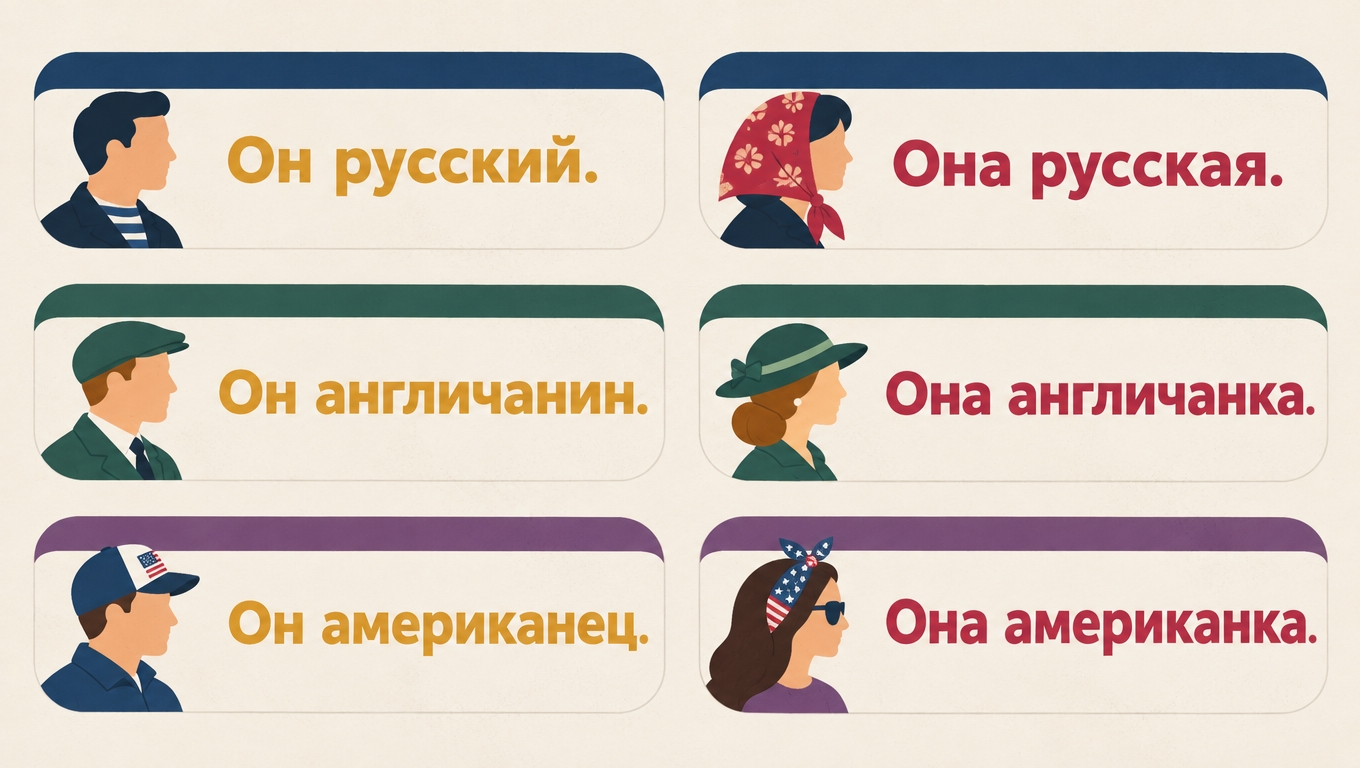
Introduce yourself properly: pick between ты and вы, ask and answer the name questions as fixed chunks, state a profession or a nationality with no verb at all, conjugate the class II -ить verbs, and make your first adjectives agree.
⏱ About 55 minutes26 phrases34 exercises
What you will learn
Ask and answer «Кактебязовут?» and «Каквасзовут?», and give your own name with «Менязовут…»
Decide whether the person in front of you takes ты or вы, and put the verb in the matching form
Conjugate the class II verbs говорить, любить and платить in the present tense, and handle the three that refuse the pattern: жить, смотреть and звать
State your profession and your nationality in the masculine or feminine form that fits, with no verb in the sentence
Make an adjective agree with its noun across all four nominative forms: большой, большая, большое, большие
Choose between и, а, но and или, and use а whenever you are contrasting two different people
Quick review
Say these aloud before you start. They come from earlier lessons.
Я студе́нт.I am a student.Listen in Russian:Slow in Russian:Я студе́нт.
Э́то Москва́.This is Moscow.Listen in Russian:Slow in Russian:Э́то Москва́.
Ты врач?Are you a doctor?Listen in Russian:Slow in Russian:Ты врач?
Я чита́ю кни́гу.I am reading a book.Listen in Russian:Slow in Russian:Я чита́ю кни́гу.
Он не рабо́тает.He does not work.Listen in Russian:Slow in Russian:Он не рабо́тает.
Вы понима́ете по-ру́сски?Do you understand Russian?Listen in Russian:Slow in Russian:Вы понима́ете по-ру́сски?
Theory
Conjugation II: the -ить verbs
Lesson 2 gave you one ending set: -ю, -ешь, -ет, -ем, -ете, -ют. Russian has a second one, and it is just as regular — -ю, -ишь, -ит, -им, -ите, -ят. Between them the two cover almost every verb in the language. Which set a verb takes is normally visible from the infinitive: verbs in -ить belong to the second, verbs in -ать, -ять and -овать to the first. The exceptions are few enough to memorise, and this lesson gives you the three that matter most.
The vowel inside the ending is the whole difference. Тычита́ешь but тыговори́шь. Онзна́ет but онговори́т. Они́чита́ют but они́говоря́т. Learn to hear that е against и and you can hear the two conjugations; learn to produce it and a Russian will follow you even when an ending slips.
Two things about the -ить verbs are worth fixing now, because they cause almost every mistake. The first is that the я-form is where the surprises live: a good many verbs change a stem consonant there and nowhere else — люби́ть gives ялюблю́, плати́ть gives яплачу́. The second is that stress is not predictable from the infinitive. говори́ть keeps it on the ending throughout (говорю́, говори́шь, говоря́т); люби́ть and плати́ть keep it on the stem everywhere except the я-form (лю́бишь, пла́тишь, but люблю́, плачу́). Learn the paradigm, not the dictionary headword.
Я говорю́ по-ру́сски.I speak Russian.Listen in Russian:Slow in Russian:Я говорю́ по-ру́сски.
Ты говори́шь хорошо́.You speak well.Listen in Russian:Slow in Russian:Ты говори́шь хорошо́.
Они́ говоря́т.They are speaking.Listen in Russian:Slow in Russian:Они́ говоря́т.
Мы лю́бим чита́ть.We love reading.Listen in Russian:Slow in Russian:Мы лю́бим чита́ть.
Sound focus
Three verbs that refuse the pattern: жить, смотреть and звать
жить ends in -ить, so you would expect something like *живишь. What you get is живу́, живёшь, живёт, живём, живёте, живу́т — class I endings, and -у and -ут rather than -ю and -ют. A small closed group behaves this way: жить, пить, бить, шить, лить, вить. Not one of them is rare, so learn the six as a list and stop trusting the infinitive.
смотре́ть does the opposite. It ends in -еть, which normally means class I, but it conjugates as class II: ясмотрю́, тысмо́тришь, они́смо́трят. It sits in the traditional list of eleven exceptions — гнать, держа́ть, смотре́ть, ви́деть, дыша́ть, слы́шать, ненави́деть, оби́деть, терпе́ть, зави́сеть, верте́ть — and you will genuinely use смотре́ть and ви́деть from your first week. звать is class I, but its stem alternates: зва- in the infinitive and the past, зов- in the present and the imperative. зову́, зовёшь, зову́т; зва́л, звала́, зва́ли.
Now listen to what the stress does in these three, because this is where the ear has to be trained. жить is stressed on the ending right through the present — живу́, живёшь, живёт — and the ё in four of those six forms is no coincidence: ё in Russian is always stressed, so seeing it tells you where the accent falls with no mark needed at all. That is why живёт, зовёт and актёр carry no acute anywhere in this lesson. In the past, жить does exactly what быть does: жил, жила́, жи́ло, жи́ли, with only the feminine dragging the stress to the end. And in the sentence you will use most — Меня́зову́тА́нна — hear the two vowels side by side: the first е of меня́ is unstressed and collapses to a thin [ɪ], while the о of зову́т keeps its full round [o] precisely because it carries the stress. That one short sentence is Russian vowel reduction at work.
Я живу́ здесь.I live here.Listen in Russian:Slow in Russian:Я живу́ здесь.
Он живёт там.He lives there.Listen in Russian:Slow in Russian:Он живёт там.
Она́ смо́трит, а я говорю́.She is watching and I am speaking.Listen in Russian:Slow in Russian:Она́ смо́трит, а я говорю́.
Меня́ зову́т Том.My name is Tom.Listen in Russian:Slow in Russian:Меня́ зову́т Том.
ты and вы: one social decision, no new grammar
Russian has two ways of saying "you", and getting it wrong is a social slip rather than a grammatical one. ты is singular and close: family, friends, children, classmates, people of your own age in an informal setting, colleagues once the ice has broken. вы is the plural of both, and the polite singular for adults you do not know, older people, officials, shop assistants, hotel staff, doctors, teachers — anyone you are dealing with professionally.
Unlike Italian Lei or German Sie, Russian вы is simply the second-person plural. There is no third-person trick and nothing new to conjugate: Тычита́ешь becomes Вычита́ете in exactly the same way it does when you are talking to two friends. The entire cost of the distinction is one judgement about the person in front of you.
If you are unsure, begin with вы. It is never offensive, whereas an unwelcome ты can be, and the offer to switch always comes from the older or more senior of the two — Дава́йтенаты. In this lesson the choice surfaces in one fixed pair: Кактебя́зову́т? and Каквасзову́т? Notice that зову́т is identical in both. It is the 3rd person plural of звать either way, so only the pronoun moves.
Как тебя́ зову́т?What is your name? (to a friend or a child)Listen in Russian:Slow in Russian:Как тебя́ зову́т?
Как вас зову́т?What is your name? (to someone you have just met)Listen in Russian:Slow in Russian:Как вас зову́т?
Ты говори́шь по-ру́сски.You speak Russian. (informal, one person)Listen in Russian:Slow in Russian:Ты говори́шь по-ру́сски.
Вы говори́те по-ру́сски.You speak Russian. (formal, or to a group)Listen in Russian:Slow in Russian:Вы говори́те по-ру́сски.
Who you are: no verb, two genders, one agreeing adjective
Everything you need to introduce yourself is now in place. Lesson 1 gave you the sentence with no verb in it — Ястуде́нт — and gender decided by the ending. This lesson fills that frame with content: professions, countries and nationalities. Онинжене́р. Она́журнали́стка. Яанглича́нин. There is no article to insert and no copula to conjugate; a noun in the nominative does the entire job.
Nationalities come in two shapes, and the difference matters. ру́сский is an adjective, so its feminine is simply the -ая form of the same word: онру́сский, она́ру́сская. англича́нин and англича́нка, италья́нец and италья́нка are nouns, so there are two separate words and you pick the one that matches the person in front of you. Both patterns are common and you will meet both constantly. Some professions have no feminine noun at all — инжене́р is the standard example — and then a woman says она́инжене́р, which is correct Russian rather than a shortcut.
The adjective is the last new piece and the easiest system in Russian grammar. In the nominative it has four forms and no more: большо́й, больша́я, большо́е, больши́е. The noun chooses and the adjective obeys, and the plural collapses all three genders into one form, so больши́е serves for дома́, кни́ги and города́ alike. Which masculine ending a given adjective takes is a matter of spelling rather than meaning: -ый after a hard consonant (но́вый), -ий after г, к, х and after ж, ш, щ, ч (ру́сский, хоро́ший), and -ой only where the ending itself is stressed (большо́й, молодо́й).
Он учи́тель, а она́ учи́тельница.He is a teacher and she is a teacher.Listen in Russian:Slow in Russian:Он учи́тель, а она́ учи́тельница.
Я инжене́р.I am an engineer.Listen in Russian:Slow in Russian:Я инжене́р.
Москва́ — большо́й го́род.Moscow is a big city.Listen in Russian:Slow in Russian:Москва́ — большо́й го́род.
Она́ ру́сская, а он италья́нец.She is Russian and he is Italian.Listen in Russian:Slow in Russian:Она́ ру́сская, а он италья́нец.
и, а, но, или: four words that hold a sentence together
Russian needs four connectors where English manages with three, and the extra one is the most useful of the four. и is plain "and". но is "but", in the sense of a genuine obstacle or contradiction. или is "or". а has no single English equivalent: it means "and, whereas", and you use it when the second half says something different about a different subject without contradicting the first. Ястуде́нт, аона́врач — "I am a student and she is a doctor". Using а where English would use "and" is one of the fastest audible signs that your Russian is real rather than translated.
The distinction worth drilling is и against а. When one subject does two things, use и: Ячита́юислу́шаю. When two subjects each do their own thing, use а: Ячита́ю, аона́слу́шает. English says "and" in both cases and the difference vanishes; Russian keeps it, and a native speaker hears immediately which one you chose.
Punctuation follows the meaning and is not optional in Russian writing. A comma always goes before а and before но. Before или in a plain choice question it does not: Тыстуде́нти́лиучи́тель? Before и the rule depends on what и is joining — two words or two verbs inside a single clause take no comma, while two whole clauses each with their own subject and verb do. Ячита́юкни́гуислу́шаюра́дио has none; Ячита́ю, иона́чита́ет has one.
Я студе́нт, а она́ врач.I am a student and she is a doctor.Listen in Russian:Slow in Russian:Я студе́нт, а она́ врач.
Я говорю́ по-ру́сски, но я не чита́ю.I speak Russian, but I do not read.Listen in Russian:Slow in Russian:Я говорю́ по-ру́сски, но я не чита́ю.
Ты студе́нт и́ли учи́тель?Are you a student or a teacher?Listen in Russian:Slow in Russian:Ты студе́нт и́ли учи́тель?
Я чита́ю, и она́ чита́ет.I read, and she reads.Listen in Russian:Slow in Russian:Я чита́ю, и она́ чита́ет.
Conjugation I and Conjugation II side by side (present tense)
Form
чита́ть — class I
говори́ть — class II
жить — class I despite -ить
смотре́ть — class II despite -еть
я
чита́ю
говорю́
живу́
смотрю́
ты
чита́ешь
говори́шь
живёшь
смо́тришь
он / она / оно
чита́ет
говори́т
живёт
смо́трит
мы
чита́ем
говори́м
живём
смо́трим
вы
чита́ете
говори́те
живёте
смо́трите
они
чита́ют
говоря́т
живу́т
смо́трят
Two ending sets cover almost every Russian verb: class I is -ю / -ешь / -ет / -ем / -ете / -ют, class II is -ю / -ишь / -ит / -им / -ите / -ят. The last two columns are the honest picture of the infinitive: -ить usually means class II, but жить belongs to class I, and смотреть belongs to class II even though it ends in -еть. Learn the infinitive together with the я-form and you will never have to guess.
Gender and agreement: one adjective, four forms
Form
большо́й
но́вый
ру́сский
он / дом / го́род — masculine
большо́й
но́вый
ру́сский
она́ / кни́га / Москва́ — feminine
больша́я
но́вая
ру́сская
оно́ / молоко́ — neuter
большо́е
но́вое
ру́сское
они́ / дома́, кни́ги, города́ — plural
больши́е
но́вые
ру́сские
The noun decides, the adjective follows. Look at the last row: Russian has one plural adjective form for all three genders, so больши́едома́, больши́екни́ги and больши́егорода́ all use the same word. The three columns also show the three masculine endings — -ой when the ending is stressed (большо́й), -ый after a hard consonant (но́вый), and -ий after гкхжшщч (ру́сский).
He and she: the masculine form and the feminine form
Form
Он …
Она́ …
teacher
учи́тель
учи́тельница
journalist
журнали́ст
журнали́стка
actor
актёр
актри́са
engineer
инжене́р
инжене́р
Russian
ру́сский
ру́сская
English
англича́нин
англича́нка
Italian
италья́нец
италья́нка
Two different mechanisms produce the same result. Russian is an adjective, so its feminine is simply the -ая ending of the same word. The others are nouns with feminine suffixes: -ница (учительница), -ка (журналистка, англичанка, итальянка), -иса (актриса). A few professions have no feminine noun at all — инжене́р is one — and then a woman says она́инжене́р, which is standard Russian and not a shortcut.
ты or вы: one social decision, no new grammar
Form
ты — one person you know
вы — polite singular, or any group
The name question
Кактебя́зову́т?
Каквасзову́т?
The greeting
Приве́т!
Здра́вствуйте!
чита́ть (class I)
Тычита́ешь
Вычита́ете
говори́ть (class II)
Тыговори́шь
Выговори́те
жить (class I)
Тыживёшь
Выживёте
Какдела́?
Какдела́?
Каква́шидела́?
вы is not a third-person form the way Italian Lei is — it is simply the second-person plural, so there is nothing new to conjugate, only a judgement to make. Use ты with family, friends, children and people who have offered it; use вы with adults you do not know, older people, officials and anyone you deal with professionally. When in doubt, begin with вы: it is never offensive, and an unwelcome ты can be.
Vocabulary
Learn each word with its stress mark and its pronunciation. Nouns are given with their gender, animacy and their full six-case declension; verbs are given with their aspect and, where one exists, their partner verb.
Russian
English
Gender / aspect
Pronunciation
Audio
говори́тьimperfective
to speak, to talk, to say
imperfective
/ɡəvɐˈrʲitʲ/guh-vuh-REET
Listen in Russian:Slow in Russian:говорить
житьimperfective
to live
imperfective
/ʐɨtʲ/ZHIHT
Listen in Russian:Slow in Russian:жить
смотре́тьimperfective
to look at, to watch
imperfective
/smɐˈtrʲetʲ/smuh-TRYET
Listen in Russian:Slow in Russian:смотреть
люби́тьimperfective
to love, to like
imperfective
/lʲʊˈbʲitʲ/lyoo-BEET
Listen in Russian:Slow in Russian:любить
плати́тьimperfective
to pay
imperfective
/plɐˈtʲitʲ/pluh-TEET
Listen in Russian:Slow in Russian:платить
зватьimperfective
to call; in the fixed formula Меня зовут… "my name is…"
imperfective
/zvatʲ/ZVYAT
Listen in Russian:Slow in Russian:звать
учи́тельmasculine · animate
teacher (male, or generic)
masculine · animate
/ʊˈtɕitʲɪlʲ/oo-CHIH-til
Listen in Russian:Slow in Russian:учитель
инжене́рmasculine · animate
engineer (male, or generic)
masculine · animate
/ɪnʐɨˈnʲer/in-zhih-NYER
Listen in Russian:Slow in Russian:инженер
программи́стmasculine · animate
programmer, software developer (male, or generic)
masculine · animate
/prəɡrɐˈmʲist/pruh-gruh-MEEST
Listen in Russian:Slow in Russian:программист
журнали́стmasculine · animate
journalist (male, or generic)
masculine · animate
/ʐʊrˈnalʲɪst/zhoo-rnuh-LEEST
Listen in Russian:Slow in Russian:журналист
продаве́цmasculine · animate
shop assistant, salesperson (male, or generic)
masculine · animate
/prədɐˈvʲets/pruh-duh-VYETS
Listen in Russian:Slow in Russian:продавец
актёрmasculine · animate
actor (male)
masculine · animate
/ɐˈktʲor/uk-TYOHR
Listen in Russian:Slow in Russian:актёр
учи́тельницаfeminine · animate
teacher (female)
feminine · animate
/ʊˈtɕitʲɪlʲnʲɪtsə/oo-CHIH-til-nih-tsih
Listen in Russian:Slow in Russian:учительница
журнали́сткаfeminine · animate
journalist (female)
feminine · animate
/ʐʊrˈnalʲɪstkə/zhoo-rnuh-LEEST-kuh
Listen in Russian:Slow in Russian:журналистка
актри́саfeminine · animate
actress
feminine · animate
/ɐˈktrʲisə/uk-TREE-suh
Listen in Russian:Slow in Russian:актриса
Росси́яfeminine · inanimate
Russia
feminine · inanimate
/rɐˈsʲijə/ruh-SEE-yuh
Listen in Russian:Slow in Russian:Россия
А́нглияfeminine · inanimate
England
feminine · inanimate
/ˈanɡlʲɪjə/AHN-glih-yuh
Listen in Russian:Slow in Russian:Англия
Ита́лияfeminine · inanimate
Italy
feminine · inanimate
/ɪˈtalʲɪjə/ih-TAH-lih-yuh
Listen in Russian:Slow in Russian:Италия
ру́сскийadjective
Russian; a Russian man
adjective
/ˈruskʲɪj/ROO-skiy
Listen in Russian:Slow in Russian:русский
англича́нинmasculine · animate
Englishman
masculine · animate
/ɐnɡlʲɪˈtɕanʲɪn/un-glih-CHAH-nin
Listen in Russian:Slow in Russian:англичанин
англича́нкаfeminine · animate
Englishwoman
feminine · animate
/ɐnɡlʲɪˈtɕankə/un-glih-CHAHN-kuh
Listen in Russian:Slow in Russian:англичанка
италья́нецmasculine · animate
Italian man
masculine · animate
/ɪtɐˈlʲjanʲɪts/ih-tuh-LYAH-nits
Listen in Russian:Slow in Russian:итальянец
италья́нкаfeminine · animate
Italian woman
feminine · animate
/ɪtɐˈlʲjankə/ih-tuh-LYAHN-kuh
Listen in Russian:Slow in Russian:итальянка
иconjunction
and
conjunction
/i/EE
Listen in Russian:Slow in Russian:и
аconjunction
and, whereas; but (mildly)
conjunction
/a/AH
Listen in Russian:Slow in Russian:а
ноconjunction
but
conjunction
/no/NOH
Listen in Russian:Slow in Russian:но
и́лиconjunction
or
conjunction
/ˈilʲɪ/EE-lih
Listen in Russian:Slow in Russian:или
большо́йadjective
big, large
adjective
/bɐlʲˈʂoj/bul-SHOY
Listen in Russian:Slow in Russian:большой
но́выйadjective
new
adjective
/ˈnovɨj/NOH-viy
Listen in Russian:Slow in Russian:новый
фами́лияfeminine · inanimate
surname, family name
feminine · inanimate
/fɐˈmʲilʲɪjə/fuh-MEE-lih-yuh
Listen in Russian:Slow in Russian:фамилия
студе́нтmasculine · animate
student (male, or generic)
masculine · animate
/stʊˈdʲent/stoo-DYENT
Listen in Russian:Slow in Russian:студент
врачmasculine · animate
doctor
masculine · animate
/vratɕ/VRAHCH
Listen in Russian:Slow in Russian:врач
выpronoun
you (plural, or formal singular)
pronoun
/vɨ/VIH
Listen in Russian:Slow in Russian:вы
по-ру́сскиadverb
in Russian
adverb
/pɐˈruskʲɪ/puh-ROO-skih
Listen in Russian:Slow in Russian:по-русски
Full six-case declension of the 19 nouns in this lesson
Each case is listed with the question word that selects it. Find the question you are answering and the ending follows.
Singular
Form
учи́тель (m)
инжене́р (m)
программи́ст (m)
журнали́ст (m)
продаве́ц (m)
актёр (m)
учи́тельница (f)
журнали́стка (f)
актри́са (f)
Росси́я (f)
А́нглия (f)
Ита́лия (f)
англича́нин (m)
англича́нка (f)
италья́нец (m)
италья́нка (f)
фами́лия (f)
студе́нт (m)
врач (m)
nom · Кто? Что?
учи́тель
инжене́р
программи́ст
журнали́ст
продаве́ц
актёр
учи́тельница
журнали́стка
актри́са
Росси́я
А́нглия
Ита́лия
англича́нин
англича́нка
италья́нец
италья́нка
фами́лия
студент
врач
gen · Кого? Чего?
учи́теля
инжене́ра
программи́ста
журнали́ста
продавца́
актёра
учи́тельницы
журнали́стки
актри́сы
Росси́и
А́нглии
Ита́лии
англича́нина
англича́нки
италья́нца
италья́нки
фами́лии
студента
врача
dat · Кому? Чему?
учи́телю
инжене́ру
программи́сту
журнали́сту
продавцу́
актёру
учи́тельнице
журнали́стке
актри́се
Росси́и
А́нглии
Ита́лии
англича́нину
англича́нке
италья́нцу
италья́нке
фами́лии
студенту
врачу
acc · Кого? Что?
учи́теля
инжене́ра
программи́ста
журнали́ста
продавца́
актёра
учи́тельницу
журнали́стку
актри́су
Росси́ю
А́нглию
Ита́лию
англича́нина
англича́нку
италья́нца
италья́нку
фами́лию
студента
врача
instr · Кем? Чем?
учи́телем
инжене́ром
программи́стом
журнали́стом
продавцо́
актёром
учи́тельницой
журнали́сткой
актри́сой
Росси́ей
А́нглией
Ита́лией
англича́нином
англича́нкой
италья́нцем
италья́нкой
фами́лией
студентом
врачом
prep · Оком? Очём?
учи́теле
инжене́ре
программи́сте
журнали́сте
продавце́
актёре
учи́тельнице
журнали́стке
актри́се
Росси́и
А́нглии
Ита́лии
англича́нине
англича́нке
италья́нце
италья́нке
фами́лии
студенте
враче
Plural
Form
учи́тель (m)
инжене́р (m)
программи́ст (m)
журнали́ст (m)
продаве́ц (m)
актёр (m)
учи́тельница (f)
журнали́стка (f)
актри́са (f)
Росси́я (f)
А́нглия (f)
Ита́лия (f)
англича́нин (m)
англича́нка (f)
италья́нец (m)
италья́нка (f)
фами́лия (f)
студе́нт (m)
врач (m)
nom · Кто? Что?
учи́тели
инжене́ры
программи́сты
журнали́сты
продавцы́
актёры
учи́тельницы
журнали́стки
актри́сы
—
—
—
англича́не
англича́нки
италья́нцы
италья́нки
фами́лии
студенты
врачи́
gen · Кого? Чего?
учи́телей
инжене́ров
программи́стов
журнали́стов
продавцо́в
актёров
учи́тельниц
журнали́сток
актри́с
—
—
—
англича́н
англича́нок
италья́нцев
италья́нок
фами́лий
студентов
враче́й
dat · Кому? Чему?
учи́телям
инжене́рам
программи́стам
журнали́стам
продавца́м
актёрам
учи́тельницам
журнали́сткам
актри́сам
—
—
—
англича́нам
англича́нкам
италья́нцам
италья́нкам
фами́лиям
студентам
врача́м
acc · Кого? Что?
учи́телей
инжене́ров
программи́стов
журнали́стов
продавцо́в
актёров
учи́тельниц
журнали́сток
актри́с
—
—
—
англича́н
англича́нок
италья́нцев
италья́нок
фами́лии
студентов
враче́й
instr · Кем? Чем?
учи́телями
инжене́рами
программи́стами
журнали́стами
продавца́ми
актёрами
учи́тельницами
журнали́стками
актри́сами
—
—
—
англича́нами
англича́нками
италья́нцами
италья́нками
фами́лиями
студентами
врача́ми
prep · Оком? Очём?
учи́телях
инжене́рах
программи́стах
журнали́стах
продавца́х
актёрах
учи́тельницах
журнали́стках
актри́сах
—
—
—
англича́нах
англича́нках
италья́нцах
италья́нках
фами́лиях
студентах
врача́х
Ready-to-use phrases
До́брое у́тро!
Good morning!
IPA/ˈdobrəjə ˈutrə/
Say itDOH-bruh-yuh OO-truh!
A set morning greeting, used with colleagues and strangers alike. Learn it whole: до́брое is the neuter form of до́брый "good", agreeing with у́тро.
neutralgreetings
Listen in Russian:Slow in Russian:Доброе утро!
До́брый день!
Good afternoon! (literally "good day")
IPA/ˈdobrɨj ˈdʲenʲ/
Say itDOH-briy DYEN!
The all-purpose daytime greeting, from late morning until early evening. день is masculine, so the adjective takes -ый.
neutralgreetings
Listen in Russian:Slow in Russian:Добрый день!
До́брый ве́чер!
Good evening!
IPA/ˈdobrɨj ˈvʲetɕɪr/
Say itDOH-briy VYEH-chihr!
The third member of the set. All three are neutral-polite and work with ты and with вы.
neutralgreetings
Listen in Russian:Slow in Russian:Добрый вечер!
До свида́ния!
Goodbye!
IPA/də svʲɪˈdanʲɪjə/
Say itduh svih-DAH-nih-yuh!
Literally "until the meeting". до is a preposition that takes the genitive, but nothing here needs analysing — learn the four syllables as one word.
neutralgreetings
Listen in Russian:Slow in Russian:До свидания!
Как тебя́ зову́т?
What is your name? (informal, to one person)
IPA/kak tʲɪˈbʲa zɐˈvut/
Say itKAHK tih-BYAH zuh-VOOT?
Literally "how do they call you?". тебя́ is the accusative of ты and зову́т is the 3rd person plural of звать, but learn the sentence as one unanalysed chunk — the case behind it is Lesson 6.
informalintroductionsquestionsregister
Listen in Russian:Slow in Russian:Как тебя зовут?
Как вас зову́т?
What is your name? (formal, or to more than one person)
IPA/kak vas zɐˈvut/
Say itKAHK VAHS zuh-VOOT?
One word different from the informal version, and it is the safe default with any adult you have just met.
formalintroductionsquestionsregisterpoliteness
Listen in Russian:Slow in Russian:Как вас зовут?
Меня́ зову́т А́нна.
My name is Anna. (literally "they call me Anna")
IPA/mʲɪˈnʲa zɐˈvut ˈanːə/
Say itmih-NYAH zuh-VOOT AH-nuh.
The only way Russians introduce themselves. Меня́зову́т plus your name; the verb never changes, whoever you are.
neutralintroductions
Listen in Russian:Slow in Russian:Меня зовут Анна.
О́чень прия́тно!
Pleased to meet you!
IPA/ˈotɕɪnʲ prʲɪˈjatnə/
Say itOH-chin prih-YAHT-nuh!
Said once, immediately after the names are exchanged. прия́тно on its own means "pleasant"; о́чень is the "very" you met in Lesson 2.
politeintroductionspoliteness
Listen in Russian:Slow in Russian:Очень приятно!
Как дела́?
How are things? How are you?
IPA/kak dʲɪˈla/
Say itKAHK dih-LAH?
A real question in Russian, not a phatic reflex: expect a short answer, and give one. The formal version is Каква́шидела́?
informalgreetingsquestions
Listen in Russian:Slow in Russian:Как дела?
Как ва́ша фами́лия?
What is your surname?
IPA/kak ˈvaʂə fɐˈmʲilʲɪjə/
Say itKAHK VAH-shih fuh-MEE-lih-yuh?
Used on forms and at desks. For the given name you ask Каквасзову́т?, not *Каквашеимя?
formalintroductionsquestions
Listen in Russian:Slow in Russian:Как ваша фамилия?
Вы говори́те по-ру́сски?
Do you speak Russian?
IPA/vɨ ɡəvɐˈrʲitʲe pɐˈruskʲɪ/
Say itVIH guh-vuh-REE-tyuh puh-ROO-skih?
говорить is conjugation II, so the вы-form is -ите, not the -ете of class I. The language is the adverb по-русски — no noun and no case.
formalquestionslanguagesregister
Listen in Russian:Slow in Russian:Вы говорите по-русски?
Я говорю́ по-ру́сски.
I speak Russian.
IPA/ja ɡəvɐˈrʲu pɐˈruskʲɪ/
Say itYAH guh-vuh-RYOO puh-ROO-skih.
The я-form of говорить keeps the plain stem: говорю́. Watch the stress — it never leaves the ending in this verb.
neutrallanguages
Listen in Russian:Slow in Russian:Я говорю по-русски.
Она́ учи́тельница.
She is a teacher.
IPA/ɐˈna ʊˈtɕitʲɪlʲnʲɪtsə/
Say ituh-NAH oo-CHIH-til-nih-tsih.
No verb, no article. The zero copula you met in Lesson 1 does all the work, and the feminine noun does the agreeing.
neutralprofessionswork
Listen in Russian:Slow in Russian:Она учительница.
Я инжене́р.
I am an engineer.
IPA/ja ɪnʐɨˈnʲer/
Say itYAH in-zhih-NYER.
Professions stay in the masculine form when a woman states her own job informally: она́инжене́р is normal Russian, not a shortcut.
neutralprofessionswork
Listen in Russian:Slow in Russian:Я инженер.
Он журна́лист, а она́ врач.
He is a journalist and she is a doctor.
IPA/on ʐʊrˈnalʲɪst a ɐˈna vratɕ/
Say itOHN zhoo-RNAH-list, AH uh-NAH VRAHCH.
The textbook use of а: two different subjects, two different facts, no contradiction. English has to use "and" here and loses the contrast.
neutralprofessionsconnectors
Listen in Russian:Slow in Russian:Он журналист, а она врач.
Я студе́нт, но я не рабо́таю.
I am a student, but I do not work.
IPA/ja stʊˈdʲent no ja nʲe rɐˈbotəjʊ/
Say itYAH stoo-DYENT, NOH YAH NYEH ruh-BOH-tuh-yoo.
но signals a real conflict between the two halves, so it is the right connector here and а would be wrong. The не of Lesson 2 sits directly before the verb.
neutralstudyconnectorsnegationwork
Listen in Russian:Slow in Russian:Я студент, но я не работаю.
Ты студе́нт и́ли учи́тель?
Are you a student or a teacher?
IPA/tɨ stʊˈdʲent ˈilʲɪ ʊˈtɕitʲɪlʲ/
Say itTIH stoo-DYENT EE-lih oo-CHIH-til?
A choice question keeps the word order of a statement; the voice rises on the first option and falls on the last. No comma goes before или.
informalquestionsstudyprofessions
Listen in Russian:Slow in Russian:Ты студент или учитель?
Он ру́сский.
He is Russian.
IPA/on ˈruskʲɪj/
Say itOHN ROO-skiy.
A masculine adjective standing alone as the predicate. No verb, no article.
neutrallanguagesgeography
Listen in Russian:Slow in Russian:Он русский.
Она́ ру́сская.
She is Russian.
IPA/ɐˈna ˈruskəjə/
Say ituh-NAH ROO-skuh-yuh.
Same word, feminine ending. The adjective agrees with она, and this is the whole of Russian agreement in the nominative.
neutrallanguagesgeography
Listen in Russian:Slow in Russian:Она русская.
Я англича́нин.
I am English (said by a man).
IPA/ja ɐnɡlʲɪˈtɕanʲɪn/
Say itYAH un-glih-CHAH-nin.
A woman says яанглича́нка. Unlike ру́сский, which is an adjective, these nationality words are nouns and have two separate forms.
neutralgeographyintroductions
Listen in Russian:Slow in Russian:Я англичанин.
Она́ италья́нка.
She is Italian.
IPA/ɐˈna ɪtɐˈlʲjankə/
Say ituh-NAH ih-tuh-LYAHN-kuh.
The man is италья́нец; the е of that suffix disappears in every other form.
neutralgeographyintroductions
Listen in Russian:Slow in Russian:Она итальянка.
Москва́ — большо́й го́род.
Moscow is a big city.
IPA/mɐˈskva bɐlʲˈʂoj ˈɡorət/
Say itmuh-SKVAH — bul-SHOY GOH-rut.
When both halves of a zero-copula sentence are nouns, Russian puts a dash where "is" would be. The adjective simply agrees with the masculine го́род.
neutralcityadjectivesgeography
Listen in Russian:Slow in Russian:Москва — большой город.
Я люблю́ чита́ть.
I love reading. (literally "I love to read")
IPA/ja lʲʊˈblʲu tɕɪˈtatʲ/
Say itYAH lyoo-BLYOO chih-TYAT.
любить plus an infinitive, with no connector and no case. The я-form is люблю́, with the б turned into бл.
neutralhobbiesfeelingsstudy
Listen in Russian:Slow in Russian:Я люблю читать.
Ско́лько вы пла́тите?
How much do you pay?
IPA/ˈskolʲkə vɨ ˈplatʲɪtʲe/
Say itSKOHL-kuh VIH PLAH-tih-tyuh?
сколько from Lesson 2 plus a class II verb. Add за plus the accusative when you say what for — that case is Lesson 6.
neutralshoppingquestionsnumbers
Listen in Russian:Slow in Russian:Сколько вы платите?
Он живёт здесь.
He lives here.
IPA/on ʐɨˈvʲot zdʲesʲ/
Say itOHN zhih-VYOHT ZDYES.
живёт carries no stress mark because ё is always stressed. The 3rd person singular of жить ends in -ёт, not in the -ит you would expect from an -ить verb.
neutralplace
Listen in Russian:Slow in Russian:Он живёт здесь.
Что вы смо́трите?
What are you watching?
IPA/ʂto vɨ ˈsmotrʲɪtʲe/
Say itSHTOH VIH SMOH-trih-tyuh?
The question word goes first and nothing else moves — the Lesson 2 rule. Note the stress: высмо́трите, but ясмотрю́.
neutralquestionshobbies
Listen in Russian:Slow in Russian:Что вы смотрите?
Dialogues
A first meeting at a conference in Moscow
Irina and David have just been introduced by a colleague. They are adults who do not know each other, so both use вы throughout.
Irina
Добрый день! Как вас зовут?
Good afternoon! What is your name?
Listen in Russian:Slow in Russian:Добрый день! Как вас зовут?
David
Добрый день! Меня зовут Дэвид. А вас?
Good afternoon! My name is David. And yours?
Listen in Russian:Slow in Russian:Добрый день! Меня зовут Дэвид. А вас?
Irina
Меня зовут Ирина. Очень приятно!
My name is Irina. Pleased to meet you!
Listen in Russian:Slow in Russian:Меня зовут Ирина. Очень приятно!
David
Очень приятно! Вы говорите по-русски?
Pleased to meet you! Do you speak Russian?
Listen in Russian:Slow in Russian:Очень приятно! Вы говорите по-русски?
Irina
Да, я говорю по-русски. Я русская. А вы кто?
Yes, I speak Russian. I am Russian. And who are you?
Listen in Russian:Slow in Russian:Да, я говорю по-русски. Я русская. А вы кто?
David
Я англичанин. Я студент.
I am English. I am a student.
Listen in Russian:Slow in Russian:Я англичанин. Я студент.
Irina
Вы студент? Вы не работаете?
You are a student? You do not work?
Listen in Russian:Slow in Russian:Вы студент? Вы не работаете?
David
Нет, я не работаю. А вы?
No, I do not work. And you?
Listen in Russian:Slow in Russian:Нет, я не работаю. А вы?
Irina
Я журналистка. До свидания, Дэвид!
I am a journalist. Goodbye, David!
Listen in Russian:Slow in Russian:Я журналистка. До свидания, Дэвид!
Two Italians at a party in Moscow
Marco and Nina are the same age and have just been introduced by a friend, so they use ты from the first sentence.
Marco
Привет! Как тебя зовут?
Hi! What is your name?
Listen in Russian:Slow in Russian:Привет! Как тебя зовут?
Nina
Меня зовут Нина. А тебя?
My name is Nina. And you?
Listen in Russian:Slow in Russian:Меня зовут Нина. А тебя?
Marco
А меня зовут Марко. Ты русская?
And my name is Marco. Are you Russian?
Listen in Russian:Slow in Russian:А меня зовут Марко. Ты русская?
Nina
Нет, я итальянка. А ты?
No, I am Italian. And you?
Listen in Russian:Slow in Russian:Нет, я итальянка. А ты?
Marco
Я тоже итальянец! Очень приятно.
I am Italian too! Pleased to meet you.
Listen in Russian:Slow in Russian:Я тоже итальянец! Очень приятно.
Nina
Очень приятно. Ты студент?
Pleased to meet you. Are you a student?
Listen in Russian:Slow in Russian:Очень приятно. Ты студент?
Marco
Нет, я не студент. Я актёр. А ты кто?
No, I am not a student. I am an actor. And what are you?
Listen in Russian:Slow in Russian:Нет, я не студент. Я актёр. А ты кто?
Nina
Я учительница. Я живу здесь.
I am a teacher. I live here.
Listen in Russian:Slow in Russian:Я учительница. Я живу здесь.
Marco
Хорошо! Я тоже живу здесь.
Good! I live here too.
Listen in Russian:Slow in Russian:Хорошо! Я тоже живу здесь.
A new colleague on the first morning
Mariya and Oleg both started at the same office this week and meet for the first time on Monday morning. Neither knows the other, so both use вы.
Mariya
Доброе утро! Вы Олег?
Good morning! Are you Oleg?
Listen in Russian:Slow in Russian:Доброе утро! Вы Олег?
Oleg
Да, я Олег. А вы Мария?
Yes, I am Oleg. And you are Mariya?
Listen in Russian:Slow in Russian:Да, я Олег. А вы Мария?
Mariya
Да. Очень приятно!
Yes. Pleased to meet you!
Listen in Russian:Slow in Russian:Да. Очень приятно!
Oleg
Очень приятно. Вы журналистка?
Pleased to meet you. Are you a journalist?
Listen in Russian:Slow in Russian:Очень приятно. Вы журналистка?
Mariya
Нет, я учительница. А вы кто?
No, I am a teacher. And what are you?
Listen in Russian:Slow in Russian:Нет, я учительница. А вы кто?
Oleg
Я инженер. Вы говорите по-русски?
I am an engineer. Do you speak Russian?
Listen in Russian:Slow in Russian:Я инженер. Вы говорите по-русски?
Mariya
Да, я русская. А вы?
Yes, I am Russian. And you?
Listen in Russian:Slow in Russian:Да, я русская. А вы?
Oleg
Я итальянец, но я говорю по-русски.
I am Italian, but I speak Russian.
Listen in Russian:Slow in Russian:Я итальянец, но я говорю по-русски.
Mariya
Очень хорошо! До свидания!
Very good! Goodbye!
Listen in Russian:Slow in Russian:Очень хорошо! До свидания!
Exercises
Answer actively — try to recall the Russian before you look at any hint.
ConjugationExercise 1
Give the present tense form for "вы".
говорить — вы
ConjugationExercise 2
Give the present tense form for "они".
жить — они
ConjugationExercise 3
Give the present tense form for "я".
смотреть — я
ConjugationExercise 4
Give the present tense form for "ты".
любить — ты
ConjugationExercise 5
Give the present tense form for "я".
платить — я
ConjugationExercise 6
Give the past tense form for a female subject.
жить — past, feminine
Translate To RussianExercise 7
Translate into Russian.
He is a teacher.
Translate To RussianExercise 8
Translate into Russian.
My name is Anna.
Translate To RussianExercise 9
Translate into Russian.
I speak Russian.
Translate To RussianExercise 10
Translate into Russian.
She is Russian.
Translate To RussianExercise 11
Translate into Russian.
He is a journalist and she is a doctor.
Translate To EnglishExercise 12
Translate into English.
Она́журна́листка.
Translate To EnglishExercise 13
Translate into English.
Меня́зову́тТом.
Translate To EnglishExercise 14
Translate into English.
Ониталья́нец, ноонговори́тпо-ру́сски.
Multiple ChoiceExercise 15
Choose the correct sentence.
You have just been introduced to a new colleague at work. Which question do you ask?
Multiple ChoiceExercise 16
Choose the correct word.
Which connector belongs in «Ястудент, … онаврач.»?
Multiple ChoiceExercise 17
Choose the correct form.
What is the feminine of учитель?
Fill GapExercise 18
Fill the gap with the right form of говорить: "She speaks Russian."
Она ___ по-русски.
Fill GapExercise 19
Fill the gap with the right form of жить: "I live here."
Я ___ здесь.
Fill GapExercise 20
Fill the gap with the right form of любить: "We love coffee."
Мы ___ кофе.
Fill GapExercise 21
Fill the gap so that the question is informal, asked of one friend.
Как ___ зовут?
Ending ChoiceExercise 22
Choose the form of новый that agrees with дом.
Это ___ дом.
Ending ChoiceExercise 23
Choose the form of большой that agrees with город.
Москва — ___ город.
Ending ChoiceExercise 24
Choose the form of русский that fits.
Анна ___.
Stress ChoiceExercise 25
Choose the correctly stressed form.
Where does the stress fall in «учитель»?
Stress ChoiceExercise 26
Choose the correctly stressed form.
Where does the stress fall in «продавец»?
True FalseExercise 27
Answer true or false.
The verb жить is conjugated with the endings of class I: живу, живёшь, живёт.
True FalseExercise 28
Answer true or false.
The adjective большой has a different plural form for masculine, feminine and neuter nouns.
Match PairsExercise 29
Pair the words.
Match each masculine form with its feminine partner.
Word OrderExercise 30
Put the words in order.
Build the question: "What is your name?" (informal)
Word OrderExercise 31
Put the words in order.
Build the sentence: "I speak Russian."
Sentence TransformExercise 32
Rewrite it so that the subject is a woman.
Rewrite this sentence for a female subject: «Онучитель.»
Listen And TypeExercise 33
Play the audio and type what you hear.
Listen and type the sentence.
Flashcard Self RatingExercise 34
Recall the English meaning, then rate how well you knew it.
О́ченьприя́тно!
Speak now
Say each line aloud three times: slowly, at normal speed, then from memory. Then swap in your own name, your own profession and your own nationality — the point of this lesson is that the frame never changes and only the words do.
Меня́ зову́т А́нна. Я ру́сская.My name is Anna. I am Russian.Listen in Russian:Slow in Russian:Меня́ зову́т А́нна. Я ру́сская.
Как вас зову́т? О́чень прия́тно!What is your name? Pleased to meet you!Listen in Russian:Slow in Russian:Как вас зову́т? О́чень прия́тно!
Он журна́лист, а она́ учи́тельница.He is a journalist and she is a teacher.Listen in Russian:Slow in Russian:Он журна́лист, а она́ учи́тельница.
Я говорю́ по-ру́сски, но я не понима́ю.I speak Russian, but I do not understand.Listen in Russian:Slow in Russian:Я говорю́ по-ру́сски, но я не понима́ю.
Москва́ — большо́й го́род.Moscow is a big city.Listen in Russian:Slow in Russian:Москва́ — большо́й го́род.
Ты студе́нт и́ли учи́тель?Are you a student or a teacher?Listen in Russian:Slow in Russian:Ты студе́нт и́ли учи́тель?
Lesson checkpoint
Before you move on, make sure you can do all of this without looking:
Say your own introduction out loud: Менязовут…, then ask it back both ways — Кактебязовут? and Каквасзовут?
Run говорить through all six present-tense forms from memory, then do the same for жить and notice how different the endings are
Give the я-form of любить, платить and смотреть — the consonant change and the stress move both happen there and nowhere else
Say your profession and your nationality in Russian, in the form that matches your own gender, then say your partner's
Put большой, новый and русский against a masculine, a feminine, a neuter and a plural noun from Lesson 1
Join two of your own sentences with а, two with но, and say out loud why you chose each one
Remember this
Conjugation II is -ю, -ишь, -ит, -им, -ите, -ят: яговорю, тыговоришь, ониговорят. The vowel in the ending is what separates it from class I, and the я-form is where the surprises live — люблю (б becomes бл), плачу (т becomes ч), смотрю (the stress moves onto the ending).
жить and пить end in -ить but conjugate as class I — живу, живёшь, живут. смотреть ends in -еть but conjugates as class II — смотрю, смотришь. The infinitive alone never decides.
Professions and nationalities need no verb and no article: Онинженер. Онарусская. Яангличанин. Russian is an adjective, so it agrees; the others are nouns, so there are two words.
A nominative adjective has exactly four forms — большой, большая, большое, большие — and the plural form is the same for all three genders.
и joins like with like; а switches to something different about a different subject; но contradicts; или offers a choice. A comma always goes before а and но.
вы is the safe default with any adult you do not know. It is simply the second-person plural, so the verb takes the plural ending and nothing else changes.