Order a meal from the menu to the bill, complain politely when it goes wrong, and describe what hurts at the doctor's and in the pharmacy: the three ordering frames, the portion genitive (чашкакофе, тарелкасупа), food preferences, and the health frame «Уменяболитголова», with the aspect pairs заказывать/заказать and болеть/заболеть.
⏱ About 55 minutes26 phrases34 exercises
What you will learn
Order food and drink with three frames — «Ябуду…», «Мне …, пожалуйста» and «Можномне …?» — keeping the thing you want in the accusative
Build portion phrases in which the container governs the genitive: чашкакофе, тарелкасупа, кусокхлеба, бутылкаводы, пачкачая
Say what you eat and like with the right case after each verb: «Янееммясо» (accusative), «Ялюблюрыбу», «Мненравитсясуп» (nominative subject)
Describe pain with «Уменяболит …», agreeing the verb with the body part in the present and the past, and add «Уменятемпература» and «Язаболел»
Get through a restaurant visit and a trip to the doctor or pharmacist: menu, order, bill, a polite complaint, a prescription, and «аллергияна + accusative»
Use the aspect pairs заказывать / заказать and болеть / заболеть to tell the process from the single completed result
Quick review
Say these aloud before you start. They come from earlier lessons.
Мне нравится эта музыка.I like this music.Listen in Russian:Slow in Russian:Мне нравится эта музыка.
У меня есть брат.I have a brother.Listen in Russian:Slow in Russian:У меня есть брат.
Я хочу пить.I'm thirsty. (I want to drink.)Listen in Russian:Slow in Russian:Я хочу пить.
Сколько это стоит?How much is this?Listen in Russian:Slow in Russian:Сколько это стоит?
Дайте, пожалуйста, книгу.Give me the book, please.Listen in Russian:Slow in Russian:Дайте, пожалуйста, книгу.
Я болею.I am ill.Listen in Russian:Slow in Russian:Я болею.
Theory
Ordering: three frames, one case
A Russian café gives you three comfortable ways to order, and all three put the thing you want in the same case — the accusative. «Ябудусуп» is literally "I shall be [having] the soup": the compound future of Lesson 2 with a noun standing where the infinitive usually goes. «Мнетарелкуборща, пожалуйста» drops the verb altogether and lets a dative «мне» do the polite work. «Можномнеменю?» is the permission frame of Lesson 4 turned into a question. Pick any of the three and you will be understood; natives mix them freely.
The waiter answers in kind. «Чтовыбудетезаказывать?» — "what will you be ordering?" — uses the imperfective, because you are still in the middle of choosing. The whole exchange runs on «вы»: you and the waiter are adult strangers, so the polite plural is automatic, exactly as it was in Lesson 3. Register is not decoration here — «дай» instead of «дайте» would sound rude.
None of this is new grammar; it is the accusative, the dative and the future you already have, aimed at a plate. What is new is the vocabulary you load into the frames, and one construction — the portion genitive — that comes next.
Я буду суп.I'll have the soup.Listen in Russian:Slow in Russian:Я буду суп.
Мне тарелку борща, пожалуйста.A plate of borscht for me, please.Listen in Russian:Slow in Russian:Мне тарелку борща, пожалуйста.
Можно мне меню?May I have the menu?Listen in Russian:Slow in Russian:Можно мне меню?
Что вы будете заказывать?What will you be ordering?Listen in Russian:Slow in Russian:Что вы будете заказывать?
The portion genitive: чашкакофе, тарелкасупа
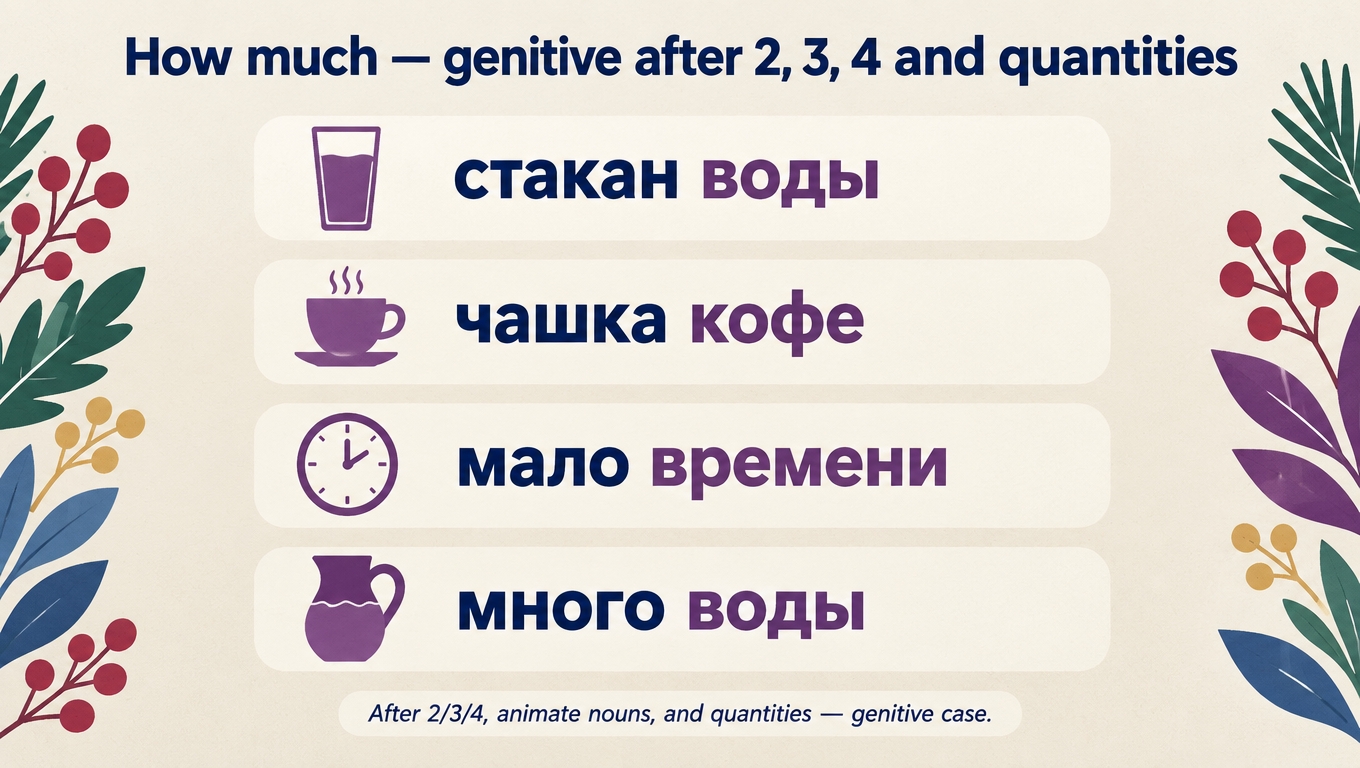
Russian measures food and drink by the container, and the container governs the thing inside it: the measure word stays in whatever case the sentence needs, while the contents go into the genitive. «Чашкакофе», «тарелкасупа», «кусокхлеба», «бутылкаводы», «пачкачая» — in each, the second noun is genitive. This is the same genitive you met after «нет» in Lesson 8, now doing its measuring job. It is one of the places where this A2-expansion block builds a little beyond the beginner minimum, but the pattern is regular enough to learn as a single move.
Two details are worth fixing now. First, «кофе» and «меню» are indeclinable, so «чашкакофе» looks identical in every case — only the words around it change. Second, the genitive of «вода» moves the stress onto the ending: the nominative stresses the final -а, the genitive the -ы. The matrix and the phrase list mark those two forms for you — that mobile stress is the one genuinely tricky cell of the whole pattern.
When you actually order, the container slides into the accusative because it is the thing being handed over — «Мнетарелкуборща» — while the contents stay genitive (борща). So a single order can carry two cases at once, and the genitive of the food never changes: тарелкасупа, тарелкусупа, отарелкесупа.
чашка кофеa cup of coffeeListen in Russian:Slow in Russian:чашка кофе
тарелка супаa plate of soupListen in Russian:Slow in Russian:тарелка супа
кусок хлебаa piece of breadListen in Russian:Slow in Russian:кусок хлеба
бутылка водыa bottle of waterListen in Russian:Slow in Russian:бутылка воды
What you eat and what you like
Three verbs cover almost everything you will say about food, and each takes a different case. «Есть» (to eat) and «любить» (to like/love) govern the accusative: «Янееммясо», «Ялюблюрыбу». For an inanimate masculine or neuter noun the accusative looks just like the nominative, so «мясо» and «рыбу» are the only visible clues.
«Нравиться» works backwards and trips up every learner once. The thing you like is the grammatical SUBJECT (nominative), and YOU are the indirect object in the dative: «Мненравитсясуп» is literally "to me the soup is pleasing". The verb agrees with the thing, not with you — «мненравитсясуп» but «мненравятсяторты». You met this in Lesson 4; here it carries the whole menu.
There is one refinement worth naming rather than hiding: with a negative, «есть» can take either the accusative or the genitive. «Янееммясо» (accusative) is the neutral default; «Янееммяса» (genitive) sounds a shade more categorical, "I eat no meat at all". Both are correct — start with the accusative and treat the genitive as a nuance you will recognise when you hear it.
Я не ем мясо.I don't eat meat.Listen in Russian:Slow in Russian:Я не ем мясо.
Я люблю рыбу.I like fish. (I love fish.)Listen in Russian:Slow in Russian:Я люблю рыбу.
Мне нравится этот суп.I like this soup.Listen in Russian:Slow in Russian:Мне нравится этот суп.
Мне нравятся торты.I like (whole) cakes.Listen in Russian:Slow in Russian:Мне нравятся торты.
At the doctor’s: Уменяболитголова
Russian reports pain with the possession frame you already know — «уменя» — plus the verb «болит». But the grammar is the reverse of the English: the body part is the SUBJECT, in the nominative, and the verb agrees with it, not with you. «Уменяболитголова» is literally "at me aches the head", where «голова» is nominative. Say «уменяболитголову» and you have put the subject into the wrong case.
Because the body part is the subject, the verb follows it in number and, in the past, in gender. «Уменяболитгорло» but «уменяболятзубы»; «вчерауменяболелаголова» (feminine), «болелогорло» (neuter), «болелзуб» (masculine), «болелизубы» (plural). This is the ordinary past-tense agreement of Lesson 2, applied to a sentence whose subject happens to sit at the end.
Around this frame sit the fixed phrases of the clinic: «Уменятемпература» (a bare noun, no verb, no adjective), «Язаболел» (a woman says «язаболела»), «Мнеплохо», and «Уменяаллергиянарыбу». That last one governs «на + accusative» — never «нарыбе» — which is the directed-at «на» of Lesson 6. Naming these government patterns explicitly is exactly the A2 step this block is for.
У меня болит горло.My throat hurts.Listen in Russian:Slow in Russian:У меня болит горло.
У меня болят зубы.My teeth hurt.Listen in Russian:Slow in Russian:У меня болят зубы.
Вчера у меня болела голова.Yesterday I had a headache.Listen in Russian:Slow in Russian:Вчера у меня болела голова.
У меня аллергия на рыбу.I'm allergic to fish.Listen in Russian:Slow in Russian:У меня аллергия на рыбу.
Process or result: заказывать / заказать, болеть / заболеть
This lesson leans on two aspect pairs, and both follow the rule Lesson 13 installed. The imperfective names the process or the habit; the perfective names one completed act. «Заказывать» is what you are doing while you study the menu; «заказать» is the moment the order is placed. «Болеть» is the state of being ill; «заболеть» is falling ill, the instant it begins.
The structural consequence is the one you have seen before: the perfective has no present tense. Its present-shaped forms ARE its future — «язакажуборщ», «оназаболеет». So «Чтовызаказываете?» (imperfective, present) asks what you are choosing now, while «Язакажуборщ» (perfective, future) states a single decided order.
One sound change is worth memorising with the pair: «заказать» alternates к → ж in the «я» form — «закажу» — and the stress leaps onto the ending there, then back onto the root for everyone else («закажешь», «закажут»). It is a twin of «сказать → скажу» from Lesson 13, so if that one is comfortable, this one is free.
Что вы заказываете?What are you ordering? (in the process)Listen in Russian:Slow in Russian:Что вы заказываете?
Я закажу борщ.I'll order the borscht. (one decided act)Listen in Russian:Slow in Russian:Я закажу борщ.
Он болеет.He is ill. (the state)Listen in Russian:Slow in Russian:Он болеет.
Он заболел вчера.He fell ill yesterday. (the event)Listen in Russian:Slow in Russian:Он заболел вчера.
The portion genitive — the container governs the contents
Form
ко́фе (m, indeclinable)
суп (m)
вода́ (f)
хлеб (m)
Именительный — the thing itself
ко́фе
суп
вода́
хлеб
Родительный — after a measure word (чашка / тарелка / бутылка / кусок …)
ко́фе
су́па
воды́
хле́ба
After a measure word the contents go into the genitive: ча́шкако́фе, таре́лкасу́па, буты́лкаводы́, кусо́кхле́ба. Indeclinable ко́фе looks the same in every case, so only the others visibly change. вода́ → воды́ moves the stress onto the ending; хлеб → хле́ба keeps it on the root.
Уменяболит … — the body part is the subject
Form
голова́ (f)
го́рло (n)
зуб (m)
зу́бы (pl)
настоящее — what aches now
боли́т
боли́т
боли́т
боля́т
прошедшее — yesterday
боле́ла
боле́ло
боле́л
боле́ли
The verb agrees with the BODY PART (the nominative subject), never with you: «Уменя́боли́тголова́», but «уменя́боля́тзу́бы». In the past it also takes gender: голова́боле́ла, го́рлоболе́ло, зубболе́л, зу́быболе́ли.
Two aspect pairs at the table and in the clinic
Form
зака́зывать (НСВ)
заказа́ть (СВ)
боле́ть (НСВ)
заболе́ть (СВ)
я — present (НСВ) / future (СВ)
зака́зываю
закажу́
боле́ю
заболе́ю
он — past
зака́зывал
заказа́л
боле́л
заболе́л
она — past
зака́зывала
заказа́ла
боле́ла
заболе́ла
инфинитив
зака́зывать
заказа́ть
боле́ть
заболе́ть
The imperfective has a present tense (the process or habit); the perfective has none — its present-shaped forms ARE its future (закажу́, заболе́ю), the single completed act. This is the Lesson 13 choice applied to ordering and falling ill. Note the к → ж leap in закажу́ and the ending stress there.
Vocabulary
Learn each word with its stress mark and its pronunciation. Nouns are given with their gender, animacy and their full six-case declension; verbs are given with their aspect and, where one exists, their partner verb.
Russian
English
Gender / aspect
Pronunciation
Audio
за́втракmasculine · inanimate
breakfast
masculine · inanimate
/ˈzaftrək/ZAHF-truk
Listen in Russian:Slow in Russian:завтрак
о́бедmasculine · inanimate
dinner, lunch — the main meal of the day, eaten in the early afternoon
masculine · inanimate
/ɐˈbʲet/OH-bit
Listen in Russian:Slow in Russian:обед
у́жинmasculine · inanimate
supper, evening meal
masculine · inanimate
/ˈuʐɨn/OO-zhin
Listen in Russian:Slow in Russian:ужин
меню́neuter · inanimate
menu
neuter · inanimate
/mʲɪˈnʲu/mih-NYOO
Listen in Russian:Slow in Russian:меню
счётmasculine · inanimate
the bill, the check; an account
masculine · inanimate
/ɕːot/SHCHOHT
Listen in Russian:Slow in Russian:счёт
официа́нтmasculine · animate
waiter
masculine · animate
/ɐfʲɪtsɨˈant/uh-fih-tsih-AHNT
Listen in Russian:Slow in Russian:официант
блю́доneuter · inanimate
dish, course; a large shallow serving dish
neuter · inanimate
/ˈblʲudə/BLYOO-duh
Listen in Russian:Slow in Russian:блюдо
по́рцияfeminine · inanimate
portion, serving, helping
feminine · inanimate
/ˈportsɨjə/POH-rtsih-yuh
Listen in Russian:Slow in Russian:порция
кусо́кmasculine · inanimate
piece, slice, chunk
masculine · inanimate
/kʊˈsok/koo-SOHK
Listen in Russian:Slow in Russian:кусок
буты́лкаfeminine · inanimate
bottle
feminine · inanimate
/bʊˈtɨlkə/boo-TIHL-kuh
Listen in Russian:Slow in Russian:бутылка
па́чкаfeminine · inanimate
packet, pack, carton
feminine · inanimate
/ˈpatɕkə/PAH-chkuh
Listen in Russian:Slow in Russian:пачка
супmasculine · inanimate
soup
masculine · inanimate
/sup/SOOP
Listen in Russian:Slow in Russian:суп
борщmasculine · inanimate
borscht — beetroot soup with meat and cabbage
masculine · inanimate
/borɕː/BOHRSHCH
Listen in Russian:Slow in Russian:борщ
сала́тmasculine · inanimate
salad
masculine · inanimate
/sɐˈlat/suh-LAHT
Listen in Russian:Slow in Russian:салат
ку́рицаfeminine · animate
chicken (the bird and the meat)
feminine · animate
/ˈkurʲɪtsə/KOO-rih-tsih
Listen in Russian:Slow in Russian:курица
са́харmasculine · inanimate
sugar
masculine · inanimate
/ˈsaxər/SAH-khuhr
Listen in Russian:Slow in Russian:сахар
тортmasculine · inanimate
gateau, fancy cake (a whole one)
masculine · inanimate
/tort/TOHRT
Listen in Russian:Slow in Russian:торт
вку́сныйadjective
tasty, delicious; (of food) good
adjective
/ˈfkusnɨj/FKOO-sniy
Listen in Russian:Slow in Russian:вкусный
живо́тmasculine · inanimate
stomach, belly; (archaic) life
masculine · inanimate
/ʐɨˈvot/zhih-VOHT
Listen in Russian:Slow in Russian:живот
зубmasculine · inanimate
tooth
masculine · inanimate
/zup/ZOOP
Listen in Russian:Slow in Russian:зуб
температу́раfeminine · inanimate
temperature — a fever; the reading on a thermometer
Full six-case declension of the 29 nouns in this lesson
Each case is listed with the question word that selects it. Find the question you are answering and the ending follows.
Singular
Form
за́втрак (m)
о́бед (m)
у́жин (m)
меню́ (n)
счёт (m)
официа́нт (m)
блю́до (n)
по́рция (f)
кусо́к (m)
буты́лка (f)
па́чка (f)
суп (m)
борщ (m)
сала́т (m)
ку́рица (f)
са́хар (m)
торт (m)
живо́т (m)
зуб (m)
температу́ра (f)
лека́рство (n)
табле́тка (f)
реце́пт (m)
алле́ргия (f)
ча́шка (f)
таре́лка (f)
голова́ (f)
го́рло (n)
апте́ка (f)
nom · Кто? Что?
за́втрак
о́бед
у́жин
меню́
счёт
официа́нт
блю́до
по́рция
кусо́к
буты́лка
па́чка
суп
борщ
сала́т
ку́рица
са́хар
торт
живо́т
зуб
температу́ра
лека́рство
табле́тка
реце́пт
алле́ргия
ча́шка
таре́лка
голова́
го́рло
аптека
gen · Кого? Чего?
за́втрака
о́беда
у́жина
меню́
счёта
официа́нта
блю́да
по́рции
кусока́
буты́лки
па́чки
су́па
борща́
сала́та
ку́рицы
са́хара
то́рта
живота́
зуба́
температу́ры
лека́рства
табле́тки
реце́пта
алле́ргии
ча́шки
таре́лки
го́ловы
го́рла
аптеки
dat · Кому? Чему?
за́втраку
о́беду
у́жину
меню́
счёту
официа́нту
блю́ду
по́рции
кусоку́
буты́лке
па́чке
су́пу
борщу́
сала́ту
ку́рице
са́хару
то́рту
животу́
зубу́
температу́ре
лека́рству
табле́тке
реце́пту
алле́ргии
ча́шке
таре́лке
го́лове
го́рлу
аптеке
acc · Кого? Что?
за́втрак
о́бед
у́жин
меню́
счёт
официа́нта
блю́до
по́рцию
кусо́к
буты́лку
па́чку
суп
борщ
сала́т
ку́рицу
са́хар
торт
живо́т
зуб
температу́ру
лека́рство
табле́тку
реце́пт
алле́ргию
ча́шку
таре́лку
го́лову
го́рло
аптеку
instr · Кем? Чем?
за́втраком
о́бедом
у́жином
меню́
счётом
официа́нтом
блю́дом
по́рцией
кусоко́м
буты́лкой
па́чкой
су́пом
борщо́м
сала́том
ку́рицой
са́харом
то́ртом
живото́м
зубо́м
температу́рой
лека́рством
табле́ткой
реце́птом
алле́ргией
ча́шкой
таре́лкой
голо́вой
го́рлом
аптекой
prep · Оком? Очём?
за́втраке
о́беде
у́жине
меню́
счёте
официа́нте
блю́де
по́рции
кусоке́
буты́лке
па́чке
су́пе
борще́
сала́те
ку́рице
са́харе
то́рте
животе́
зубе́
температу́ре
лека́рстве
табле́тке
реце́пте
алле́ргии
ча́шке
таре́лке
го́лове
го́рле
аптеке
Plural
Form
за́втрак (m)
о́бед (m)
у́жин (m)
меню́ (n)
счёт (m)
официа́нт (m)
блю́до (n)
по́рция (f)
кусо́к (m)
буты́лка (f)
па́чка (f)
суп (m)
борщ (m)
сала́т (m)
ку́рица (f)
са́хар (m)
торт (m)
живо́т (m)
зуб (m)
температу́ра (f)
лека́рство (n)
табле́тка (f)
реце́пт (m)
алле́ргия (f)
ча́шка (f)
таре́лка (f)
голова́ (f)
го́рло (n)
апте́ка (f)
nom · Кто? Что?
за́втраки
о́беды
у́жины
—
—
официа́нты
блю́да
по́рции
куски́
буты́лки
па́чки
супы́
борщи́
сала́ты
ку́рицы
—
то́рты
животы́
зу́бы
температу́ры
лека́рства
табле́тки
реце́пты
алле́ргии
ча́шки
таре́лки
го́ловы
го́рла
аптеки
gen · Кого? Чего?
за́втраков
о́бедов
у́жинов
—
—
официа́нтов
блюд
по́рций
кусо́в
буты́лок
па́чек
супо́в
борще́й
сала́тов
ку́риц
—
то́ртов
живото́в
зубо́в
температу́р
лека́рств
табле́ток
реце́птов
алле́ргий
ча́шек
таре́лок
голо́в
горл
аптек
dat · Кому? Чему?
за́втракам
о́бедам
у́жинам
—
—
официа́нтам
блю́дам
по́рциям
куска́м
буты́лкам
па́чкам
супа́м
борща́м
сала́там
ку́рицам
—
то́ртам
живота́м
зуба́м
температу́рам
лека́рствам
табле́ткам
реце́птам
алле́ргиям
ча́шкам
таре́лкам
голова́м
го́рлам
аптекам
acc · Кого? Что?
за́втраки
о́беды
у́жины
—
—
официа́нтов
блю́да
по́рции
куски́
буты́лки
па́чки
супы́
борщи́
сала́ты
ку́риц
—
то́рты
животы́
зу́бы
температу́ры
лека́рства
табле́тки
реце́пты
алле́ргии
ча́шки
таре́лки
го́ловы
го́рла
аптеки
instr · Кем? Чем?
за́втраками
о́бедами
у́жинами
—
—
официа́нтами
блю́дами
по́рциями
куска́ми
буты́лками
па́чками
супа́ми
борща́ми
сала́тами
ку́рицами
—
то́ртами
живота́ми
зуба́ми
температу́рами
лека́рствами
табле́тками
реце́птами
алле́ргиями
ча́шками
таре́лками
голова́ми
го́рлами
аптеками
prep · Оком? Очём?
за́втраках
о́бедах
у́жинах
—
—
официа́нтах
блю́дах
по́рциях
куска́х
буты́лках
па́чках
супа́х
борща́х
сала́тах
ку́рицах
—
то́ртах
живота́х
зуба́х
температу́рах
лека́рствах
табле́тках
реце́птах
алле́ргиях
ча́шках
таре́лках
голова́х
го́рлах
аптеках
A dash means the form does not exist. Plural-only nouns such as де́ньги and су́тки have no singular, and indeclinable nouns such as ко́фе and метро́ keep one form in all six cases.
Ready-to-use phrases
Я бу́ду суп, пожа́луйста.
I'll have the soup, please.
IPA/ja ˈbudu sup pɐˈʐalujstə/
Say itYAH BOO-doo SOOP, puh-ZHAH-luy-stuh.
The order formula, and the one to make your default. «Ябуду» is the compound future of Lesson 2 used with no infinitive after it at all — literally "I shall be [having] the soup". The thing ordered is in the accusative, and because суп is masculine and inanimate that accusative looks exactly like the nominative. You have had this sentence since Lesson 16; here it becomes a pattern you can load with anything.
restaurantrestaurantfoodfuturepoliteness
Listen in Russian:Slow in Russian:Я буду суп, пожалуйста.
Мне таре́лку борща́, пожа́луйста.
A plate of borscht for me, please.
IPA/mnʲe tɐˈrʲelkʊ bɐrˈɕa pɐˈʐalujstə/
Say itmuh-NYEH tuh-RYEL-koo buhr-SHCHAH, puh-ZHAH-luy-stuh.
Literally "to me a plate of borscht, please" — no verb at all. The dative мне does the politeness work (Lesson 9), the container word тарелка is in the accusative because it is the thing being handed over, and the thing it holds is in the genitive: борща. This elliptical frame is what a Russian actually says at a counter.
restaurantrestaurantgenitivefoodpoliteness
Listen in Russian:Slow in Russian:Мне тарелку борща, пожалуйста.
Мо́жно мне меню́?
May I have the menu?
IPA/ˈmoʐnə mnʲe mʲɪˈnʲu/
Say itMOHZH-nuh muh-NYEH mih-NYOO?
«Можно» plus a dative person plus the thing wanted is the all-purpose permission-and-request frame from Lesson 4, and it never needs a verb. меню is indeclinable, so it stays меню in the accusative as in every other case — only «можномне» tells you the sentence is a request. Intonation is ИК-3, the sharp rise on «мож-», exactly as in any yes/no question.
restaurantrestaurantpolitenessquestionsfood
Listen in Russian:Slow in Russian:Можно мне меню?
Что вы бу́дете зака́зывать?
What will you be ordering?
IPA/ʂto vɨ ˈbudʲɪtʲə zɐˈkazɨvətʲ/
Say itSHTOH VIH BOO-dih-tyuh zuh-KAH-zih-vyut?
What a waiter asks. Two sounds to listen for: «что» is pronounced [ʂto], with the ч hardening to ш before the т, and the -ывать suffix of заказывать keeps both its ы and the stress, just like показывать. The imperfective is right here because the question is about the process of choosing, not about one completed act.
restaurantrestaurantfuturequestionsfood
Listen in Russian:Slow in Russian:Что вы будете заказывать?
Да́йте, пожа́луйста, счёт.
The bill, please.
IPA/ˈdajtʲə pɐˈʐalujstə ɕːot/
Say itDAY-tyuh, puh-ZHAH-luy-stuh, SHCHOHT.
The вы imperative of дать — a request that needs no «можно» and no dative — plus a one-syllable noun spelled with four consonants. сч is read as a single long soft sound [ɕː], the sound of щ, so счёт is heard as "shchot". пожалуйста can sit in the middle of a Russian sentence without sounding fussy — that is its natural home in a request like this one.
restaurantrestaurantshoppingimperativepoliteness
Listen in Russian:Slow in Russian:Дайте, пожалуйста, счёт.
Э́то о́чень вку́сно.
This is very tasty.
IPA/ˈɛtə ˈotɕɪnʲ ˈfkusnə/
Say itEH-tuh OH-chin FKOO-snuh.
The short neuter form of вкусный, used on its own as a predicate with no subject at all — the same trick as «мнехолодно» from Lesson 4. Say it after a good meal and you have made your host or your waiter happy. Note that the stress of «вкусно» is where the adjective has it, on the root; the -о ending is never stressed in this form.
restaurantrestaurantfoodfeelingsimpersonal
Listen in Russian:Slow in Russian:Это очень вкусно.
Прия́тного аппети́та!
Enjoy your meal! (literally: of a pleasant appetite)
IPA/prʲɪˈjatnəvə ɐpʲɪˈtʲitə/
Say itprih-YAHT-nuh-vuh uh-pih-TEE-tuh!
Learned whole, like «спасибо». Both words are in the genitive, because the sentence is an elliptical wish — literally "(I wish you) of a pleasant appetite" — and Russian expresses a wish that way rather than with a verb. Listen for the -ого ending: it is pronounced [əvə], never [-ovo], so «приятного» sounds like "prih-YAHT-nuh-vuh". You say it to the people you are eating with, and they say it back.
restaurantrestaurantpolitenessfoodgreetings
Listen in Russian:Slow in Russian:Приятного аппетита!
Чай без са́хара, пожа́луйста.
Tea without sugar, please.
IPA/tɕaj bʲes ˈsaxərə pɐˈʐalujstə/
Say itCHAY bis SAH-khuh-ruh, puh-ZHAH-luy-stuh.
без + genitive, the preposition from Lesson 8, and the standard way to specify a drink: «безсахара», «безмолока», «сольдом». Two sound changes run together here — the з of «без» devoices to [s] in front of the с of «сахара», and the unstressed а after that с reduces to [ə], so the middle of the phrase is one blurred [ˈsaxərə].
restaurantrestaurantdrinksgenitivefood
Listen in Russian:Slow in Russian:Чай без сахара, пожалуйста.
Ча́шка ко́фе и кусо́к то́рта.
A cup of coffee and a slice of cake.
IPA/ˈtɕaʂkə ˈkofʲe ɪ kʊˈsok ˈtortə/
Say itCHAH-shkuh KOH-fyuh EE koo-SOHK TOHR-tuh.
Two portion frames side by side, and they behave differently in one respect. «Чашкакофе» shows кофе not moving at all, because it is indeclinable; «кусокторта» shows a real genitive, то́рта. In both, the container is the grammatical subject and the contents are genitive — and remember that торт keeps its stress on the root in every form, while кусок moves it to the ending as soon as it declines (куска́).
restaurantrestaurantfoodgenitivedrinks
Listen in Russian:Slow in Russian:Чашка кофе и кусок торта.
Буты́лку воды́, пожа́луйста.
A bottle of water, please.
IPA/bʊˈtɨlkʊ vɐˈdɨ pɐˈʐalujstə/
Say itboo-TIHL-koo vuh-DIH, puh-ZHAH-luy-stuh.
The elliptical order: "(give me) a bottle of water, please". The container is accusative — буты́лку — because it is the thing being handed over, exactly like таре́лку in «Мнетарелкуборща»; the contents stay genitive. And here is the mobile stress of вода at work: вода́ in the nominative, but воды́ in the genitive after a portion word. Lesson 1 gave you «во́ды» for the plural nominative; this is the same spelling with the stress in the other place, and only the frame tells you which one you are looking at. Naming the bottle rather than ordering it — «вотбутылкаводы» — keeps it nominative.
restaurantrestaurantgenitiveaccusativedrinksfood
Listen in Russian:Slow in Russian:Бутылку воды, пожалуйста.
У вас есть сала́т?
Do you have any salad? (lit. at you there is salad?)
IPA/u vas jesʲtʲ sɐˈlat/
Say itoo VAHS YEST suh-LAHT?
The existence frame «у + genitive + есть» from Lesson 4, aimed at a shop or a restaurant. The thing that exists stays in the NOMINATIVE — «естьсалат», not *супа — which is the difference between this sentence and the portion frame. In the negative the noun flips to the genitive: «Унаснетсалата».
restaurantrestaurantquestionsfoodgenitive
Listen in Russian:Slow in Russian:У вас есть салат?
Извини́те, я не зака́зывал сала́т.
Excuse me, I didn't order the salad.
IPA/ɪzˈvʲinʲɪtʲə ja nʲe zɐˈkazɨvəl sɐˈlat/
Say itih-zvih-NEE-tyuh, YAH NYEH zuh-KAH-zih-vul suh-LAHT.
The polite complaint, and the model for every problem you report in a restaurant. «Извините» (Lesson 19) softens the opening; the imperfective past «янезаказывал» states the fact of your order, which is exactly what the imperfective is for (Lesson 13) — the perfective «незаказал» would suggest one particular salad you declined. A woman says «янезаказывала». The follow-up is the same shape: «Язаказывалчайбезсахара» — I ordered tea without sugar.
restaurantrestaurantpolitenessnegationpastfood
Listen in Russian:Slow in Russian:Извините, я не заказывал салат.
Две табле́тки в день.
Two tablets a day.
IPA/dvʲe tɐˈblʲetkɪ v ˈdʲenʲ/
Say itDVYEH tuh-BLYET-kih v DYEN.
The dosage answer, and a neat piece of numeral government: таблетка is feminine, so "two" is две and not два, and the noun after two, three or four goes into the genitive singular — табле́тки, not таблеткы and not таблеток. «Вдень» is literally "into the day" and means "a day, per day", the same в + accusative that gives «вдвачаса».
neutralhealthnumberstimeagreement
Listen in Russian:Slow in Russian:Две таблетки в день.
Я не ем мя́со.
I don't eat meat.
IPA/ja nʲe jem ˈmʲasə/
Say itYAH NYEH YEM MYAH-suh.
The sentence a vegetarian learns first. ем is the irregular "я" form of есть "to eat" from Lesson 6, and мясо is accusative — which for a neuter inanimate noun is identical to the nominative, so nothing here shows the case except the grammar. With не the object can also go into the genitive, «янееммяса», which sounds a shade more categorical; the accusative is the neutral default.
neutralfoodaccusativenegation
Listen in Russian:Slow in Russian:Я не ем мясо.
Мне нра́вится э́тот суп.
I like this soup.
IPA/mnʲe ˈnravʲɪtsə ˈɛtət sup/
Say itmuh-NYEH NRAH-vih-tsyuh EH-tut SOOP.
The other way to say you like something, and the one that catches people out. With нравиться YOU are in the dative (мне) and the THING you like is the grammatical subject, so it stands in the nominative: «мненравитсясуп», «мненравитсякурица», «мненравятсяторты». The verb agrees with the thing, never with you.
neutralfoodnominativedativefeelings
Listen in Russian:Slow in Russian:Мне нравится этот суп.
У меня́ боли́т живо́т.
My stomach aches. (lit. at me the stomach aches)
IPA/u mʲɪˈna bɐˈlʲit ʐɨˈvot/
Say itoo mih-NYAH buh-LEET zhih-VOHT.
The health frame of this lesson. «Уменя» is the possession frame you know from «уменяестьбрат», but what follows is not «есть» — it is болит, and the thing that aches is its SUBJECT, so живот stands in the nominative. Read it literally as "at me aches the stomach" and the case stops being a mystery.
neutralhealthnominativebodyimpersonal
Listen in Russian:Slow in Russian:У меня болит живот.
У меня́ боля́т зу́бы.
My teeth ache.
IPA/u mʲɪˈna bɐˈlʲat ˈzubɨ/
Say itoo mih-NYAH buh-LYAHT ZOO-bih.
The same frame in the plural, and two things happen at once: the verb becomes болят, agreeing with the plural subject, and зуб becomes зу́бы with the stress pulled back onto the root. That stress is the single exception in an otherwise end-stressed paradigm — зуба́, зубо́в, зуба́м, but зу́бы.
neutralhealthpluralagreementbody
Listen in Russian:Slow in Russian:У меня болят зубы.
Вчера́ у меня́ боле́ла голова́.
Yesterday I had a headache.
IPA/fˈtɕorə u mʲɪˈna bɐˈlʲelə ɡəlɐˈva/
Say itfuh-chih-RAH oo mih-NYAH buh-LYEH-luh guh-luh-VAH.
The past tense of this frame agrees in GENDER and number with the body part, never with you: голова is feminine, so болит becomes болела. «Уменяболелогорло» (neuter), «уменяболелзуб» (masculine), «уменяболелизубы» (plural). This is the same rule the ordinary past tense follows (Lesson 2), applied to a sentence where the subject sits at the end.
neutralhealthpastbodyagreement
Listen in Russian:Slow in Russian:Вчера у меня болела голова.
У меня́ температу́ра.
I have a temperature.
IPA/u mʲɪˈna tʲɪmpʲɪrɐˈturə/
Say itoo mih-NYAH tim-pih-ruh-TOO-ruh.
No verb, no adjective, no «есть» — just the possession frame and a bare noun in the nominative, and it means "I have a fever". Russian leaves out the copula in the present tense, so the noun alone carries the diagnosis. The word is long and the stress is late: everything before it reduces.
neutralhealthzero-copula
Listen in Russian:Slow in Russian:У меня температура.
Я заболе́л.
I have fallen ill.
IPA/ja zəbɐˈlʲel/
Say itYAH zuh-buh-LYEL.
The perfective partner of болеть, and the aspect choice from Lesson 13 in one word: «язаболел» is the moment it started, «яболею» is the state you are still in. A woman says «язаболела»; the past tense agrees in gender, not in person. The prefix за- here adds its core idea of beginning — the same за- that turns motion into setting off (Lesson 15).
neutralhealthaspectpast
Listen in Russian:Slow in Russian:Я заболел.
У меня́ алле́ргия на ры́бу.
I am allergic to fish. (lit. I have an allergy to fish)
IPA/u mʲɪˈna ɐˈlʲerɡʲɪjə nɐ ˈrɨbə/
Say itoo mih-NYAH uh-LYER-gih-yuh nuh RIH-boo.
The government to remember: аллергияНА + accusative. «Нарыбу», not *нарыбе and not *нарыбы. It is the directed-at «на» of Lesson 6, the same preposition and case as in «ясмотрюнателевизор». This is the sentence to have ready in a restaurant, and it is worth learning with the specific food you actually react to.
neutralhealthaccusativefoodgovernment
Listen in Russian:Slow in Russian:У меня аллергия на рыбу.
Что у вас боли́т?
What aches? / Where does it hurt?
IPA/ʂto u vas bɐˈlʲit/
Say itSHTOH oo VAHS buh-LEET?
The doctor's opening question. «Что» is the subject here and it is in the nominative, which is why the verb is the default third-person singular болит even though the answer may be plural: «Чтоувасболит?» — «Уменяболятзубы». Note «что» pronounced [ʂto], the standard reading of this word in every context.
politehealthquestionspolitenessbody
Listen in Russian:Slow in Russian:Что у вас болит?
Что с ва́ми?
What is the matter with you?
IPA/ʂto s ˈvamʲɪ/
Say itSHTOH s VAH-mih?
«С» + instrumental, the case from Lesson 10, in its "what has happened to" sense. The informal version is «чтостобой?». It is broader than the health question above — it covers anything visibly wrong with somebody — and it is the phrase to reach for when somebody looks unwell or upset.
politehealthquestionsinstrumentalpoliteness
Listen in Russian:Slow in Russian:Что с вами?
У вас есть реце́пт?
Have you got a prescription?
IPA/u vas jesʲtʲ rʲɪˈtsept/
Say itoo VAHS YEST rih-TSEPT?
What the pharmacist asks. The existence frame again, with рецепт in the nominative. One word covers both a doctor's prescription and a cooking recipe in Russian, and the setting decides which you are being offered.
politehealthquestionsshopping
Listen in Russian:Slow in Russian:У вас есть рецепт?
У меня́ нет реце́пта.
I haven't got a prescription.
IPA/u mʲɪˈna nʲet rʲɪˈtseptə/
Say itoo mih-NYAH NYET rih-TSEP-tuh.
нет + genitive, the rule from Lesson 8 that never has an exception: whatever «есть» held in the nominative, «нет» puts in the genitive. So «уменяестьрецепт» but «уменянетрецепта». The stress does not move — реце́пт, реце́пта — and the final т of the genitive reduces to a schwa.
neutralhealthgenitivenegation
Listen in Russian:Slow in Russian:У меня нет рецепта.
Ско́лько сто́ит э́то лека́рство?
How much is this medicine?
IPA/ˈskolʲkə ˈstoit ˈɛtə lʲɪˈkarstvə/
Say itSKOHL-kuh STOH-it EH-tuh lih-KAHR-stvuh?
The price question of Lesson 11 with the new noun dropped in. стоить keeps its stress on the root in every form — сто́ит, сто́ят — and never behaves like its near-homophone звони́т. «Лекарство» is the substance; if you want to price one countable unit, ask «сколькостоитэтатаблетка».
neutralhealthshoppingnumbersquestions
Listen in Russian:Slow in Russian:Сколько стоит это лекарство?
Dialogues
Dinner in a restaurant in Kazan
Mark eats alone in a restaurant. The waiter does not know him, so both of them use вы and the polite imperative throughout.
Waiter
Добрый вечер! Вот меню. Что вы будете заказывать?
Good evening! Here is the menu. What will you be ordering?
Listen in Russian:Slow in Russian:Добрый вечер! Вот меню. Что вы будете заказывать?
Mark
Можно мне тарелку борща, пожалуйста?
May I have a plate of borscht, please?
Listen in Russian:Slow in Russian:Можно мне тарелку борща, пожалуйста?
Waiter
Хорошо. А что вы будете пить?
All right. And what will you drink?
Listen in Russian:Slow in Russian:Хорошо. А что вы будете пить?
Mark
Я буду чай без сахара. И кусок торта.
I'll have tea without sugar. And a slice of cake.
Listen in Russian:Slow in Russian:Я буду чай без сахара. И кусок торта.
Waiter
Очень хорошо. Борщ, чай без сахара и кусок торта.
Very good. Borscht, tea without sugar and a slice of cake.
Listen in Russian:Slow in Russian:Очень хорошо. Борщ, чай без сахара и кусок торта.
Mark
А ещё салат, пожалуйста.
And a salad as well, please.
Listen in Russian:Slow in Russian:А ещё салат, пожалуйста.
Waiter
Хорошо. Вот ваш борщ и ваш салат. Приятного аппетита!
Right. Here is your borscht and your salad. Enjoy your meal!
Listen in Russian:Slow in Russian:Хорошо. Вот ваш борщ и ваш салат. Приятного аппетита!
Mark
Спасибо! Это очень вкусно. Можно мне счёт, пожалуйста?
Thank you! This is very tasty. May I have the bill, please?
Listen in Russian:Slow in Russian:Спасибо! Это очень вкусно. Можно мне счёт, пожалуйста?
Waiter
Вот ваш счёт. Триста пятьдесят рублей.
Here is your bill. Three hundred and fifty roubles.
Listen in Russian:Slow in Russian:Вот ваш счёт. Триста пятьдесят рублей.
At the doctor’s
David feels ill and goes to the clinic. He and the doctor are strangers, so both use вы. Note that everything David says about his body puts the body part in the nominative.
Doctor
Здравствуйте. Что у вас болит?
Hello. What aches?
Listen in Russian:Slow in Russian:Здравствуйте. Что у вас болит?
David
У меня болит горло и болит голова. Мне очень плохо.
My throat aches and my head aches. I feel awful.
Listen in Russian:Slow in Russian:У меня болит горло и болит голова. Мне очень плохо.
Doctor
У вас температура?
Do you have a temperature?
Listen in Russian:Slow in Russian:У вас температура?
David
Да, у меня температура. Я заболел вчера.
Yes, I have a temperature. I fell ill yesterday.
Listen in Russian:Slow in Russian:Да, у меня температура. Я заболел вчера.
Doctor
У вас аллергия?
Do you have any allergies?
Listen in Russian:Slow in Russian:У вас аллергия?
David
Да, у меня аллергия на рыбу.
Yes, I am allergic to fish.
Listen in Russian:Slow in Russian:Да, у меня аллергия на рыбу.
Doctor
Хорошо. Вот рецепт и вот лекарство. Одна таблетка утром и одна вечером.
Right. Here is a prescription and here is the medicine. One tablet in the morning and one in the evening.
Listen in Russian:Slow in Russian:Хорошо. Вот рецепт и вот лекарство. Одна таблетка утром и одна вечером.
David
Спасибо большое. Сколько стоит это лекарство?
Thank you very much. How much is this medicine?
Listen in Russian:Slow in Russian:Спасибо большое. Сколько стоит это лекарство?
Doctor
Спросите в аптеке. Аптека рядом.
Ask at the pharmacy. The pharmacy is close by.
Listen in Russian:Slow in Russian:Спросите в аптеке. Аптека рядом.
At the pharmacy
Nina has a headache and goes to the pharmacy next door. She and the pharmacist are strangers, so both use вы. The genitive does two jobs in nine lines: after нет, and after the numerals.
Nina
Здравствуйте! У меня болит голова.
Hello! I have got a headache.
Listen in Russian:Slow in Russian:Здравствуйте! У меня болит голова.
Pharmacist
У вас есть рецепт?
Have you got a prescription?
Listen in Russian:Slow in Russian:У вас есть рецепт?
Nina
Нет, у меня нет рецепта.
No, I haven't got a prescription.
Listen in Russian:Slow in Russian:Нет, у меня нет рецепта.
Pharmacist
Хорошо. Вот лекарство. Две таблетки в день, утром и вечером.
Right. Here is the medicine. Two tablets a day, in the morning and in the evening.
Listen in Russian:Slow in Russian:Хорошо. Вот лекарство. Две таблетки в день, утром и вечером.
Nina
Спасибо. А у вас есть вода?
Thank you. And do you have any water?
Listen in Russian:Slow in Russian:Спасибо. А у вас есть вода?
Pharmacist
Да, вот бутылка воды. Пятьдесят рублей.
Yes, here is a bottle of water. Fifty roubles.
Listen in Russian:Slow in Russian:Да, вот бутылка воды. Пятьдесят рублей.
Nina
А сколько стоит лекарство?
And how much is the medicine?
Listen in Russian:Slow in Russian:А сколько стоит лекарство?
Pharmacist
Сто двадцать рублей. С водой сто семьдесят.
A hundred and twenty roubles. With the water, a hundred and seventy.
Listen in Russian:Slow in Russian:Сто двадцать рублей. С водой сто семьдесят.
Nina
Хорошо. Я плачу картой.
Right. I'm paying by card.
Listen in Russian:Slow in Russian:Хорошо. Я плачу картой.
Exercises
Answer actively — try to recall the Russian before you look at any hint.
Fill GapExercise 1
Fill the gap with the right form of болеть.
Уменя ___ голова. (it aches)
Fill GapExercise 2
Fill the gap with the right form of болеть.
Уменя ___ зубы. (they ache)
Case ChoiceExercise 3
Choose the genitive of суп after the measure word.
тарелка ___ (a plate of soup)
Case ChoiceExercise 4
Choose the genitive of вода after the measure word.
бутылка ___ (a bottle of water)
Ending ChoiceExercise 5
Choose the genitive singular ending of хлеб.
кусокхлеб___ (a piece of bread)
Stress ChoiceExercise 6
Choose the correctly stressed genitive form.
бутылка ___ (genitive of вода)
Stress ChoiceExercise 7
Choose the correctly stressed plural nominative.
Уменяболят ___ (plural of зуб)
Stress ChoiceExercise 8
Choose the correctly stressed plural nominative.
Настолестоят ___ (plural of торт)
Translate To RussianExercise 9
Translate into Russian.
My throat hurts.
Translate To RussianExercise 10
Translate into Russian.
I don't eat meat.
Translate To RussianExercise 11
Translate into Russian.
A cup of coffee, please. (ordering)
Translate To EnglishExercise 12
Translate into English.
Мнетарелкуборща, пожалуйста.
Translate To EnglishExercise 13
Translate into English.
Уменятемпература.
Multiple ChoiceExercise 14
Choose the right meaning.
What does «счёт» mean in a restaurant?
Multiple ChoiceExercise 15
Choose the correct portion phrase.
Which phrase means "a plate of soup"?
ConjugationExercise 16
Give the future-tense form for "я".
заказать — я (future)
ConjugationExercise 17
Give the present-tense form for "они".
заказывать — они (present)
ConjugationExercise 18
Give the future-tense form for "он".
заболеть — он (future)
Word OrderExercise 19
Put the words in order.
Build the request: "May I have the menu?"
Word OrderExercise 20
Put the words in order.
Build the order: "I'll have tea without sugar."
Sentence TransformExercise 21
Rewrite with the perfective partner in the future.
«Язаказываюборщ.» — say it as one decided order in the future (perfective).
Sentence TransformExercise 22
Rewrite in the past tense.
«Уменяболитголова.» — put it in the past with «вчера».
The waiter asks what you are choosing right now: «Чтовы ___?»
Pronoun ChoiceExercise 25
Choose the right form of the pronoun.
___ нравитсяэтотсуп.
Pronoun ChoiceExercise 26
Choose the right form of the pronoun.
У ___ аллергиянарыбу.
Numeral AgreementExercise 27
Choose the right form after the numeral.
Две ___ вдень. (таблетка)
Numeral AgreementExercise 28
Choose the right form after the numeral.
Купитепять ___ . (таблетка)
Listen And TypeExercise 29
Play the audio and type what you hear.
Listen and type the sentence.
Listen And ChooseExercise 30
Play the audio and choose the meaning.
What does the waiter wish you?
True FalseExercise 31
True or false?
The word «меню» changes its ending depending on its case.
Match PairsExercise 32
Pair the two halves of each portion phrase.
Match each container with what it usually holds.
Flashcard Self RatingExercise 33
Say both aloud, then rate your recall.
Say "My head hurts" and "My teeth hurt" in Russian.
Multiple ChoiceExercise 34
Choose the right preposition.
Complete: «Уменяаллергия ___ рыбу.»
Speak now
Say each line aloud three times: slowly, at normal speed, then from memory. Then swap in your own food or your own symptom and say the new version. Ordering and describing how you feel are things you do with your mouth, not on paper, so rehearse them out loud until the case endings come without thinking.
Я буду борщ и чай без сахара.I'll have borscht and tea without sugar.Listen in Russian:Slow in Russian:Я буду борщ и чай без сахара.
Мне тарелку супа и кусок торта, пожалуйста.A plate of soup and a slice of cake for me, please.Listen in Russian:Slow in Russian:Мне тарелку супа и кусок торта, пожалуйста.
Можно мне меню?May I have the menu?Listen in Russian:Slow in Russian:Можно мне меню?
У меня болит горло и у меня температура.My throat hurts and I have a temperature.Listen in Russian:Slow in Russian:У меня болит горло и у меня температура.
У меня аллергия на рыбу.I'm allergic to fish.Listen in Russian:Slow in Russian:У меня аллергия на рыбу.
Сколько стоит это лекарство?How much is this medicine?Listen in Russian:Slow in Russian:Сколько стоит это лекарство?
Lesson checkpoint
Before you move on, make sure you can do all of this without looking:
Order three items three different ways — «Ябуду…», «Мне …, пожалуйста», «Можномне …?» — and say aloud why the thing you want is accusative in all three
Build five portion phrases — чашкакофе, тарелкасупа, кусокхлеба, бутылкаводы, пачкачая — and name the case of the second word in each
Say what hurts for a head, a throat, a stomach and teeth, then put all four into the past and make the verb agree in gender and number
Run заказывать and заболеть through present, past and future, and say which of the two columns has no present tense and why
Ask for the bill and complain politely about a wrong order, using «Извините, янезаказывал …»
Describe an allergy and a fever to a pharmacist, then ask the price and say you will pay by card
Remember this
Three frames order anything — «Ябудусуп», «Мнетарелкуборща, пожалуйста», «Можномнеменю?» — and all three put the thing wanted in the accusative. The «мне» frame needs no verb at all.
A measure word governs the genitive: чашкакофе, тарелкасупа, кусокхлеба, бутылкаводы, пачкачая. Indeclinable кофе and меню never change; вода → воды moves the stress onto the ending.
Likes: любить and есть take the accusative («ялюблюрыбу», «янееммясо»); нравиться puts YOU in the dative and the THING in the nominative, and the verb agrees with the thing — «мненравитсясуп», «мненравятсяторты».
In «Уменяболитголова» the body part is the subject: nominative, with the verb agreeing with it — болитзуб, болятзубы, болелаголова, болелогорло, болелизубы.
заказывать / заказать and болеть / заболеть are aspect pairs of the Lesson 13 kind: the imperfective has a present (the process), the perfective's present-shaped forms are its future (закажу, заболею) — the single completed act.
Two fixed government patterns carry the clinic: аллергияНА + accusative (нарыбу) and нет + genitive (нетрецепта); and the bill is «Счёт, пожалуйста».