
Voglio un caffè.
I want a coffee.
IPA /ˈvɔʎʎo um kafˈfɛ/
Say it VOH-lyoh oon kahf-FEH
With strangers, the polite version is Vorrei un caffè (Lesson 15).
Listen in Italian:
Slow in Italian:
Voglio un caffè.
Say what you want, what you know and what you like. The verbs volere, sapere and the mi piace pattern open the door to real opinions.
Say these aloud before you start. They come from earlier lessons.
Volere (to want) is your key to polite and direct requests. When you know a person, voglio + infinitive is natural: Voglio un caffè. With strangers, prefer vorrei (Lesson 15), but understand voglio first.
The pattern is simple: voglio/vuoi/vuole + verb infinitive. Voglio imparare l'italiano. Notice the -ere and -ire verbs are unchanged: scrivere, leggere, dormire.
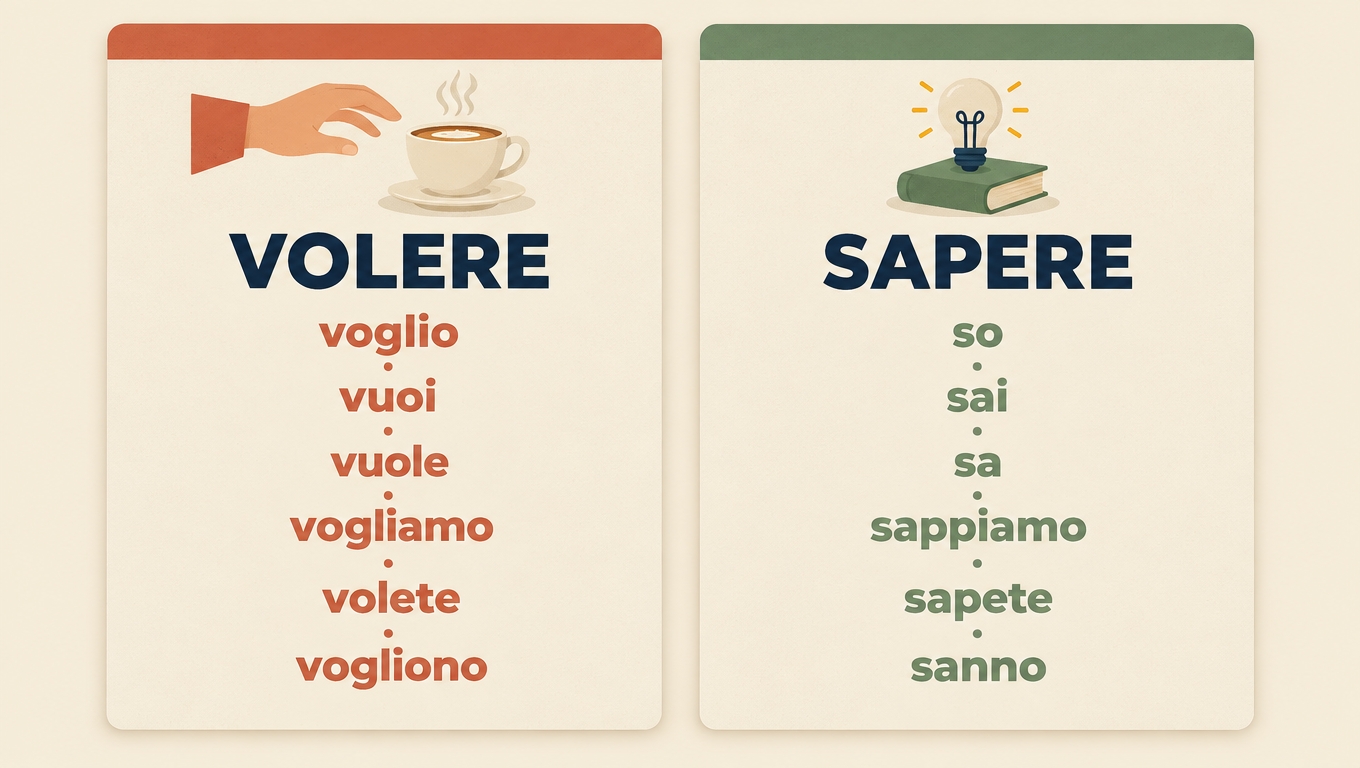
Sapere means both 'to know a fact' and 'to know how to do something'. For skills, follow it with an infinitive: So guidare (I can drive, I know how to drive).
Unlike voglio, sapere changes in the io and loro forms: so, sai, sa, sappiamo, sapete, sanno. Learn the io form first — So parlare inglese is a sentence you will say constantly.
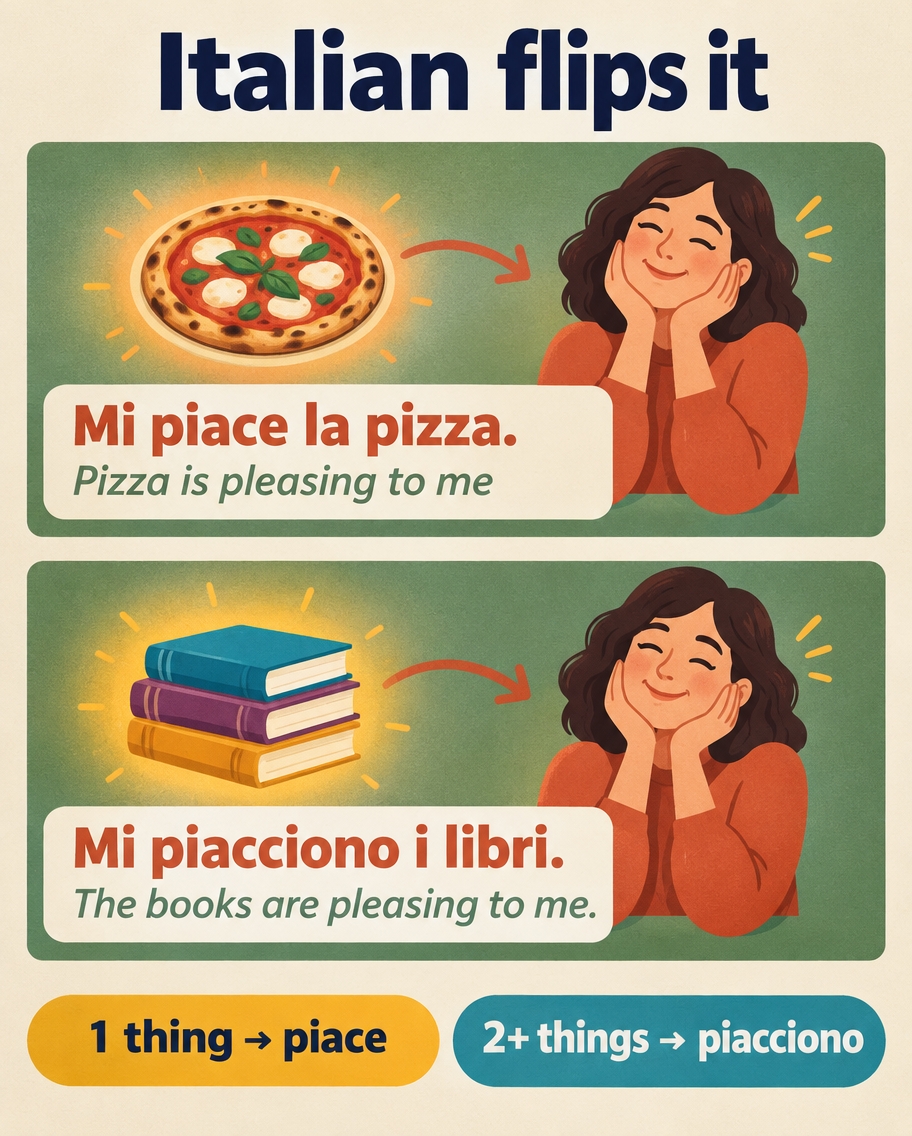
Italian builds 'I like' backwards: mi piace means 'it is pleasing to me'. Mi piace il caffè. When what you like is plural, the verb changes: mi piacciono (they are pleasing to me). Mi piacciono i libri.
So the verb agrees with the thing liked, not with you. One book: mi piace. Two books: mi piacciono. This is the most common beginner mistake in Italian — drill it hard.
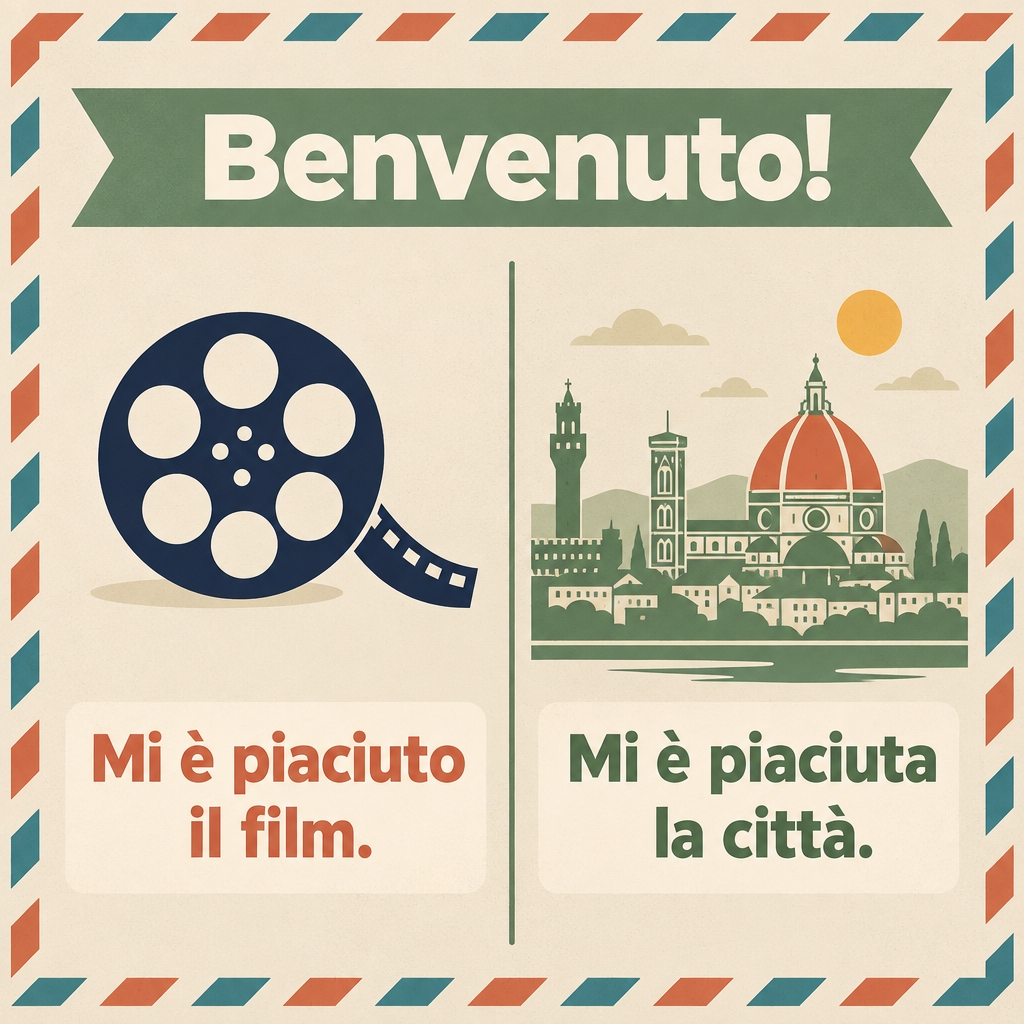
Every Italian noun is masculine or feminine, and the article shows it: il/lo for masculine singular, la for feminine. Lo is used before s+consonant and z: lo studente, lo zaino.
Basic plural: most nouns change -o to -i (il libro → i libri) and -a to -e (la casa → le case). Always learn a noun with its article — the gender is invisible otherwise.
| Form | volere | sapere |
|---|---|---|
| io | voglio | so |
| tu | vuoi | sai |
| lui / lei | vuole | sa |
| noi | vogliamo | sappiamo |
| voi | volete | sapete |
| loro | vogliono | sanno |
Both are followed directly by an infinitive: Voglio partire. So nuotare.
| Form | singular | plural |
|---|---|---|
| io | Mi piace il caffè. | Mi piacciono i caffè. |
| tu | Ti piace la pizza? | Ti piacciono le pizze? |
| noi | Ci piace il film. | Ci piacciono i film. |
The verb follows the number of the thing liked, not the person.
| Italian | English | Pronunciation | Audio |
|---|---|---|---|
| volere | to want | /voˈlere/ voh-LEH-reh | Listen in Italian: Slow in Italian: volere |
| sapere | to know (facts, skills) | /saˈpere/ sah-PEH-reh | Listen in Italian: Slow in Italian: sapere |
| vivere | to live | /ˈvivere/ VEE-veh-reh | Listen in Italian: Slow in Italian: vivere |
| leggere | to read | /ˈlɛddʒere/ LEHJ-jeh-reh | Listen in Italian: Slow in Italian: leggere |
| scrivere | to write | /ˈskrivere/ SKREE-veh-reh | Listen in Italian: Slow in Italian: scrivere |
| dormire | to sleep | /dorˈmire/ dor-MEE-reh | Listen in Italian: Slow in Italian: dormire |
| capire | to understand | /kaˈpire/ kah-PEE-reh | Listen in Italian: Slow in Italian: capire |
| cercare | to look for | /tʃerˈkare/ chehr-KAH-reh | Listen in Italian: Slow in Italian: cercare |
| trovare | to find | /troˈvare/ troh-VAH-reh | Listen in Italian: Slow in Italian: trovare |
| pensare | to think | /penˈsare/ pehn-SAH-reh | Listen in Italian: Slow in Italian: pensare |
| provare | to try | /proˈvare/ proh-VAH-reh | Listen in Italian: Slow in Italian: provare |
| aiutare | to help | /ajuˈtare/ ah-yoo-TAH-reh | Listen in Italian: Slow in Italian: aiutare |
| il libro | book | /ˈlibro/ LEE-broh | Listen in Italian: Slow in Italian: il libro |
| il film | film | /ˈfilm/ FEELM | Listen in Italian: Slow in Italian: il film |
| la musica | music | /ˈmuzika/ MOO-zee-kah | Listen in Italian: Slow in Italian: la musica |
| il caffè | coffee | /kafˈfɛ/ kahf-FEH | Listen in Italian: Slow in Italian: il caffè |
| la pizza | pizza | /ˈpittsa/ PEET-tsah | Listen in Italian: Slow in Italian: la pizza |
| il vino | wine | /ˈvino/ VEE-noh | Listen in Italian: Slow in Italian: il vino |
| la lingua | language, tongue | /ˈliŋɡwa/ LEEN-gwah | Listen in Italian: Slow in Italian: la lingua |
| la parola | word | /paˈrɔla/ pah-ROH-lah | Listen in Italian: Slow in Italian: la parola |
| la casa | house, home | /ˈkasa/ KAH-zah | Listen in Italian: Slow in Italian: la casa |
| lo zaino | backpack | /ˈdzaino/ DZY-noh | Listen in Italian: Slow in Italian: lo zaino |
| un po' | a little, a bit | /um ˈpɔ/ oon POH | Listen in Italian: Slow in Italian: un po' |
| sempre | always | /ˈsɛmpre/ SEHM-preh | Listen in Italian: Slow in Italian: sempre |
| curioso | curious | /kuˈrjɔzo/ koo-RYOH-zoh | Listen in Italian: Slow in Italian: curioso |
| onesto | honest | /oˈnɛsto/ oh-NEHS-toh | Listen in Italian: Slow in Italian: onesto |
| generoso | generous | /dʒeneˈrozo/ jeh-neh-ROH-zoh | Listen in Italian: Slow in Italian: generoso |
Voglio un caffè.
I want a coffee.
IPA /ˈvɔʎʎo um kafˈfɛ/
Say it VOH-lyoh oon kahf-FEH
With strangers, the polite version is Vorrei un caffè (Lesson 15).
Che cosa vuoi?
What do you want?
IPA /ke ˈkɔza ˈvwɔi/
Say it keh KOH-zah VWOY
Vuoi un caffè?
Do you want a coffee?
IPA /ˈvwɔi um kafˈfɛ/
Say it VWOY oon kahf-FEH
Voglio imparare l'italiano.
I want to learn Italian.
IPA /ˈvɔʎʎo im paˈrare litaˈljano/
Say it VOH-lyoh eem-pah-RAH-reh lee-tah-LYAH-noh
So parlare inglese.
I can speak English.
IPA /so parˈlare iŋˈɡleze/
Say it soh par-LAH-reh een-GLEH-zeh
So + infinitive means 'I know how to'.
Non so nuotare.
I cannot swim.
IPA /non so nwoˈtare/
Say it nohn soh nwoh-TAH-reh
Sai guidare?
Can you drive?
IPA /sai ɡwiˈdare/
Say it SY gwee-DAH-reh
Mi piace la musica.
I like music.
IPA /mi ˈpjatʃe la ˈmuzika/
Say it mee PYAH-cheh lah MOO-zee-kah
Mi piacciono i film italiani.
I like Italian films.
IPA /mi ˈpjatʃono i ˈfilm itaˈljani/
Say it mee PYAH-choh-noh ee FEELM ee-tah-LYAH-nee
Plural thing → mi piacciono.
Ti piace la pizza?
Do you like pizza?
IPA /ti ˈpjatʃe la ˈpittsa/
Say it tee PYAH-cheh lah PEET-tsah
Non mi piace il vino.
I do not like wine.
IPA /non mi ˈpjatʃe il ˈvino/
Say it nohn mee PYAH-cheh eel VEE-noh
non comes before mi piace.
Leggo un libro ogni sera.
I read a book every evening.
IPA /ˈlɛɡɡo um ˈlibro ˈoɲɲi ˈsera/
Say it LEH-goh oon LEE-broh OH-nyee SEH-rah
Scrivo un'email.
I am writing an email.
IPA /ˈskrivo un eˈmail/
Say it SKREE-voh oon ee-MAYL
Capisco un po' d'italiano.
I understand a little Italian.
IPA /kaˈpisko um pɔ ditaˈljano/
Say it kah-PEES-koh oon POH dee-tah-LYAH-noh
capire uses -isc in io: capisco.
Non capisco.
I do not understand.
IPA /non kaˈpisko/
Say it nohn kah-PEES-koh
Learn this one on day one — you will need it constantly.
Cerco il mio libro.
I am looking for my book.
IPA /ˈtʃerko il ˈmio ˈlibro/
Say it CHEHR-koh eel MEE-oh LEE-broh
Ho trovato il ristorante!
I found the restaurant!
IPA /o troˈvato il ristoˈrante/
Say it oh troh-VAH-toh eel rees-toh-RAHN-teh
Penso che sia buono.
I think it is good.
IPA /ˈpɛnso ke ˈsia ˈbwɔno/
Say it PEHN-soh keh SEE-ah BWOH-noh
A handy phrase; the che-clause is simplified here for beginners.
Puoi aiutarmi?
Can you help me?
IPA /ˈpwɔi ajuˈtarmi/
Say it PWOY ah-yoo-TAHR-mee
Sono d'accordo.
I agree.
IPA /ˈsono dakˈkordo/
Say it SOH-noh dahk-KOR-doh
Vivo a Firenze da tre anni.
I have lived in Florence for three years.
IPA /ˈvivo a fiˈrɛntse da tre ˈanni/
Say it VEE-voh ah fee-REHN-tseh dah treh AH-nee
Dove dormi quando viaggi?
Where do you sleep when you travel?
IPA /ˈdove ˈdormi ˈkwando ˈvjaddʒi/
Say it DOH-veh DOR-mee KWAHN-doh VYAH-jee
Tom wants to buy a book and asks for help.
Buongiorno, cerco un libro in italiano.
Good morning, I am looking for a book in Italian.
Listen in Italian: Slow in Italian: Buongiorno, cerco un libro in italiano.Buongiorno! Che tipo di libro vuole?
Good morning! What kind of book would you like?
Listen in Italian: Slow in Italian: Buongiorno! Che tipo di libro vuole?Un libro facile. Voglio leggere e capire bene.
An easy book. I want to read and understand well.
Listen in Italian: Slow in Italian: Un libro facile. Voglio leggere e capire bene.Questo è perfetto per chi impara. Mi piace molto.
This one is perfect for learners. I like it a lot.
Listen in Italian: Slow in Italian: Questo è perfetto per chi impara. Mi piace molto.Quanto costa?
How much does it cost?
Listen in Italian: Slow in Italian: Quanto costa?Dodici euro. Lo prendo? Sappiamo che le piace leggere!
Twelve euros. Shall I wrap it? We can see you like reading!
Listen in Italian: Slow in Italian: Dodici euro. Lo prendo? Sappiamo che le piace leggere!Sara and Leo decide what to do this evening.
Vuoi guardare un film stasera?
Do you want to watch a film tonight?
Listen in Italian: Slow in Italian: Vuoi guardare un film stasera?Sì, mi piacciono i film italiani. Che film?
Yes, I like Italian films. Which film?
Listen in Italian: Slow in Italian: Sì, mi piacciono i film italiani. Che film?Non so. Sai consigliare qualcosa?
I do not know. Can you recommend something?
Listen in Italian: Slow in Italian: Non so. Sai consigliare qualcosa?Mi piace La grande bellezza, ma è un po' lungo.
I like La grande bellezza, but it is a bit long.
Listen in Italian: Slow in Italian: Mi piace La grande bellezza, ma è un po' lungo.Non importa. Voglio provare qualcosa di nuovo!
Never mind. I want to try something new!
Listen in Italian: Slow in Italian: Non importa. Voglio provare qualcosa di nuovo!Perfetto, sono d'accordo!
Perfect, I agree!
Listen in Italian: Slow in Italian: Perfetto, sono d'accordo!Choose the correct form of volere.
Choose the correct form of sapere.
Write the correct form.
Write the correct form.
Write the correct form.
Write the correct form.
Fill the gap with the correct form of piacere.
Fill the gap with the correct form of piacere.
Translate into Italian.
Translate into Italian.
Translate into Italian.
Translate into Italian (informal).
Translate into English.
Translate into English.
Choose the correct article.
Choose the correct article.
Tap the words in the correct order.
Tap the words in the correct order.
Tap a verb, then its io form.
True or false?
True or false?
Play the audio, then type exactly what you hear.
Play the audio, then pick the sentence.
Remove the negation.
Say the sentence aloud, then reveal and rate yourself.
Say three true sentences about yourself using each pattern: voglio + infinitive, so + infinitive, and mi piace/mi piacciono. Then ask a partner two questions from this lesson.
Before you move on, make sure you can do all of this without looking:
Go deeper: Modal verbs · Noun gender · Plurals · Present tense · Questions