
Parlo inglese.
I speak English.
IPA /ˈparlo iŋˈɡleze/
Say it PAR-loh een-GLEH-zeh
Listen in Italian:
Slow in Italian:
Parlo inglese.
Learn the single most powerful pattern in Italian: the present-tense verb matrix. Say what you do, what you do not do, ask questions and talk about the past — from your very first lesson.
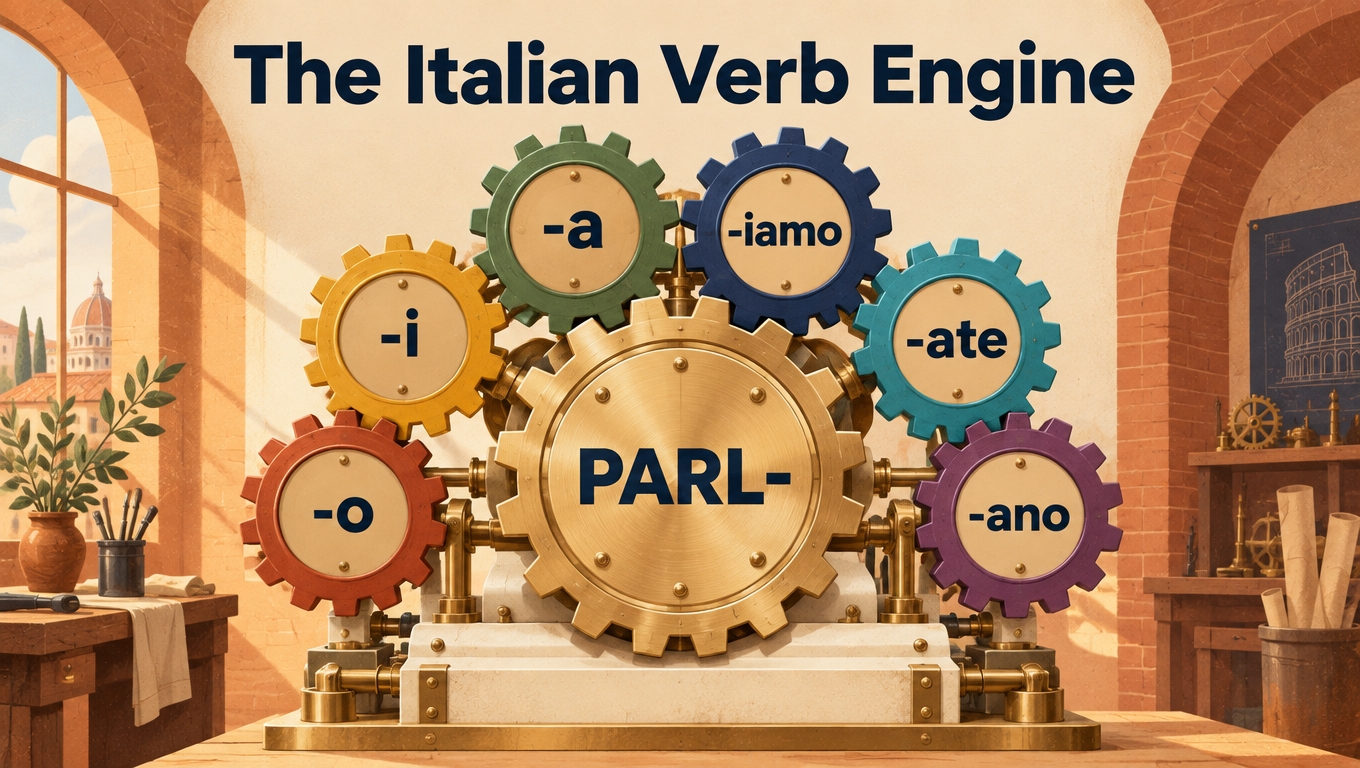
Italian verbs change their ending depending on who is acting. This sounds like extra work, but it is actually a gift: learn six endings and you unlock every regular -are verb in the language.
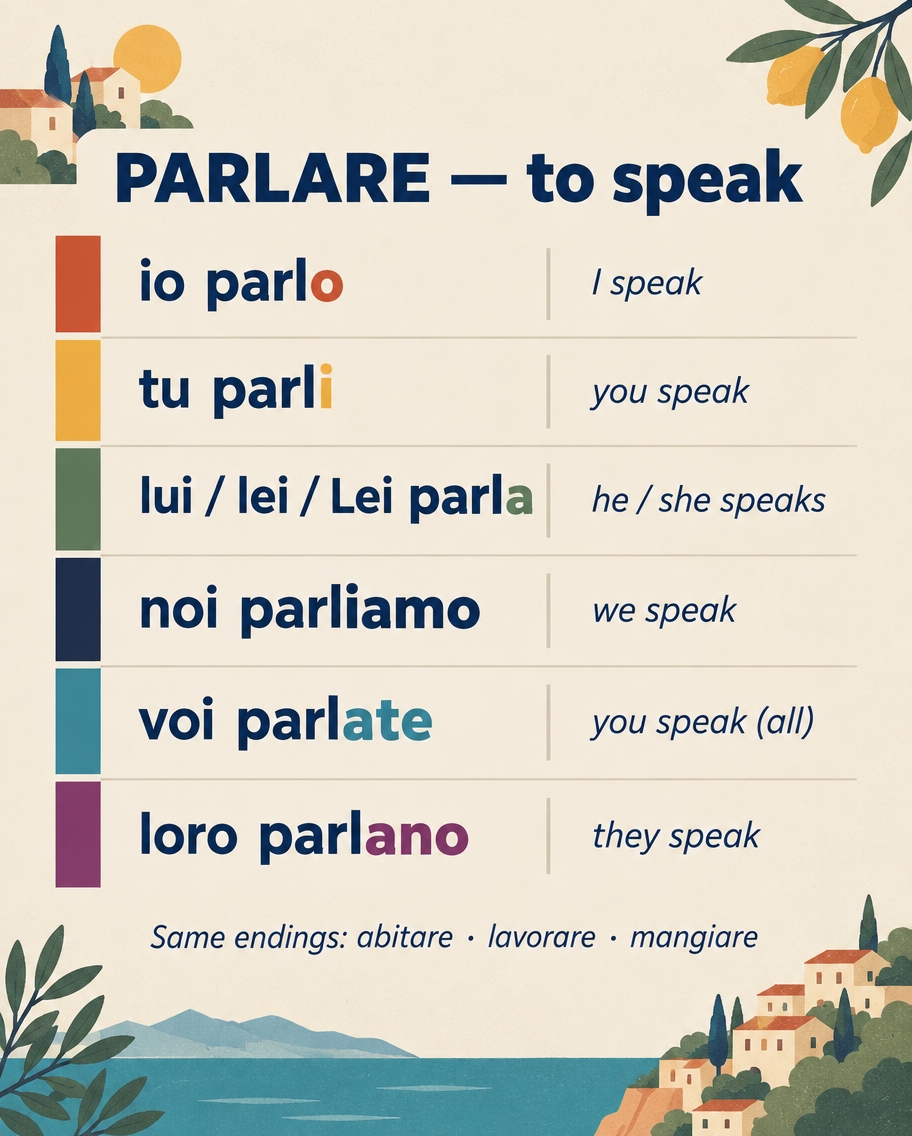
Look at the matrix for parlare (to speak). The stem parl- never changes; only the ending does. The same endings work for abitare, lavorare, mangiare and thousands more.
To say what you do not do, place non directly before the verb. That is the whole rule.
This tiny word doubles your speaking power immediately: every affirmative sentence you know becomes a negative one.
In Italian a yes-or-no question uses exactly the same word order as a statement — only the intonation rises at the end. Parli inglese. (statement) becomes Parli inglese? (question).
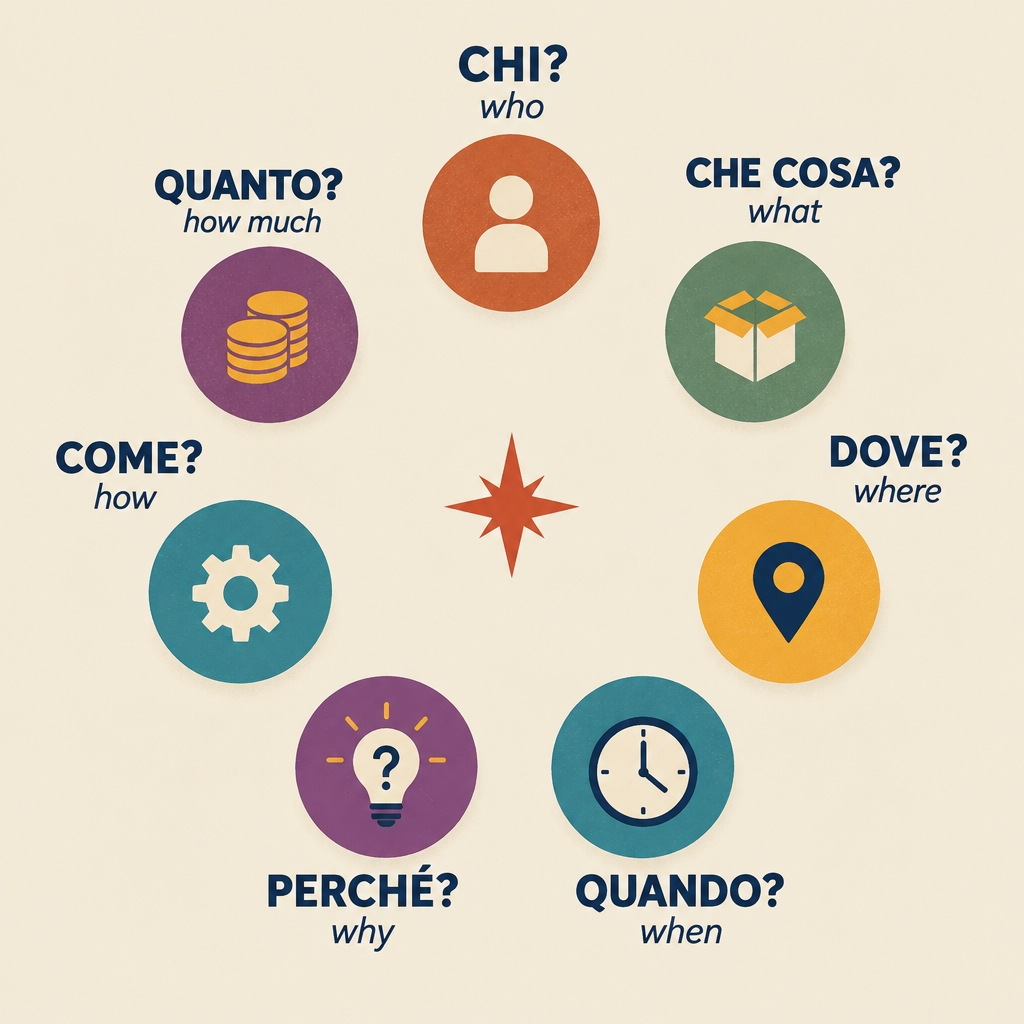
For information questions, put the question word first: Dove abiti? (Where do you live?). Learn the seven core question words in this lesson and you can ask about almost anything.
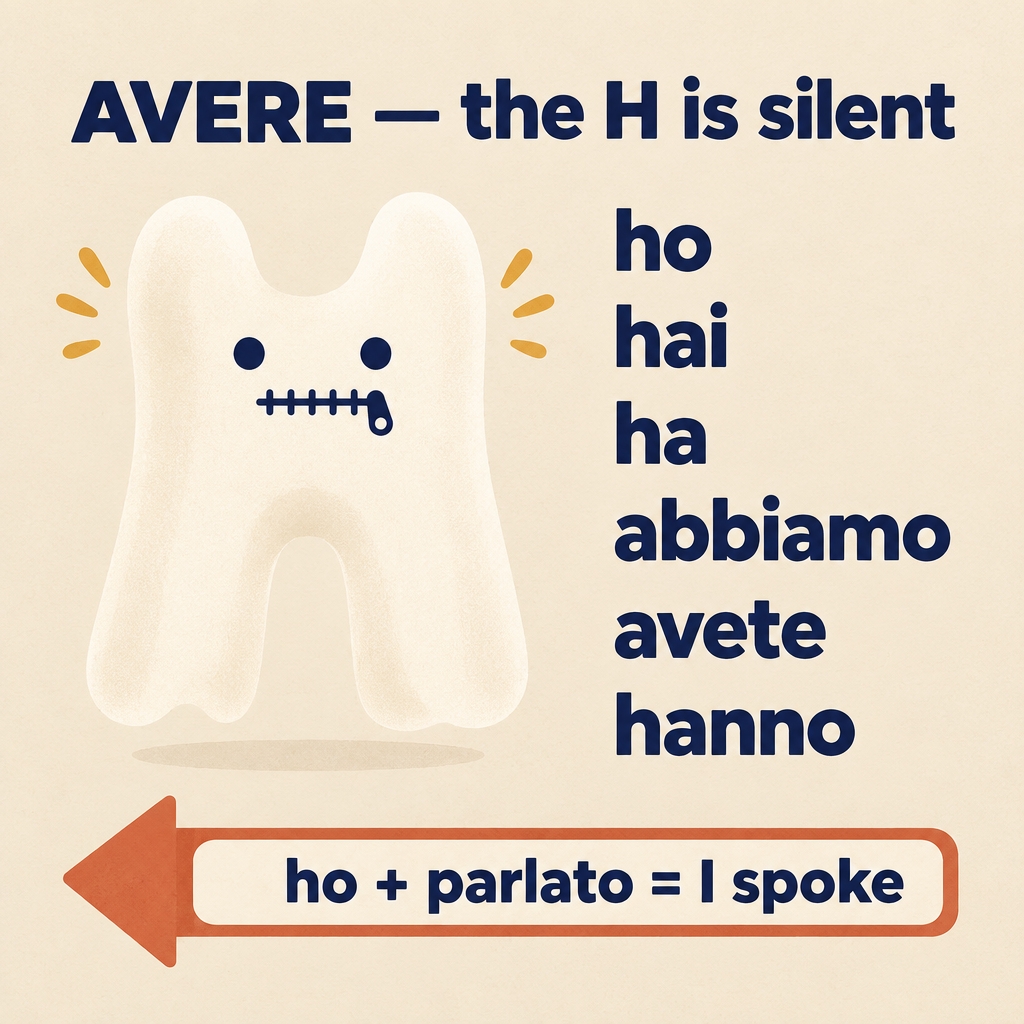
Avere is irregular, so learn its forms as a set: ho, hai, ha, abbiamo, avete, hanno.
Avere also builds the most common past tense. Put ho + a past participle: parlare becomes parlato, mangiare becomes mangiato. Ho parlato means both I spoke and I have spoken. Regular -are verbs all form this participle with -ato.
| Form | parlare | mangiare | abitare |
|---|---|---|---|
| io | parlo | mangio | abito |
| tu | parli | mangi | abiti |
| lui / lei | parla | mangia | abita |
| noi | parliamo | mangiamo | abitiamo |
| voi | parlate | mangiate | abitate |
| loro | parlano | mangiano | abitano |
All regular -are verbs follow these six endings: -o, -i, -a, -iamo, -ate, -ano.
| Form | avere |
|---|---|
| io | ho |
| tu | hai |
| lui / lei | ha |
| noi | abbiamo |
| voi | avete |
| loro | hanno |
The h is never pronounced: ho sounds like o, hai like eye.
| Form | present | past (passato prossimo) |
|---|---|---|
| io | parlo | ho parlato |
| tu | mangi | hai mangiato |
| lui / lei | lavora | ha lavorato |
| noi | ascoltiamo | abbiamo ascoltato |
-are verbs form the participle with -ato: parlare → parlato, mangiare → mangiato.
| Italian | English | Pronunciation | Audio |
|---|---|---|---|
| parlare | to speak | /parˈlare/ par-LAH-reh | Listen in Italian: Slow in Italian: parlare |
| abitare | to live (reside) | /abiˈtare/ ah-bee-TAH-reh | Listen in Italian: Slow in Italian: abitare |
| lavorare | to work | /lavoˈrare/ lah-voh-RAH-reh | Listen in Italian: Slow in Italian: lavorare |
| ascoltare | to listen | /askolˈtare/ ah-skohl-TAH-reh | Listen in Italian: Slow in Italian: ascoltare |
| guardare | to watch, to look at | /ɡwarˈdare/ gwahr-DAH-reh | Listen in Italian: Slow in Italian: guardare |
| mangiare | to eat | /manˈdʒare/ mahn-JAH-reh | Listen in Italian: Slow in Italian: mangiare |
| amare | to love | /aˈmare/ ah-MAH-reh | Listen in Italian: Slow in Italian: amare |
| imparare | to learn | /impaˈrare/ eem-pah-RAH-reh | Listen in Italian: Slow in Italian: imparare |
| giocare | to play | /dʒoˈkare/ joh-KAH-reh | Listen in Italian: Slow in Italian: giocare |
| avere | to have | /aˈvere/ ah-VEH-reh | Listen in Italian: Slow in Italian: avere |
| io | I | /ˈio/ EE-oh | Listen in Italian: Slow in Italian: io |
| tu | you (informal singular) | /ˈtu/ TOO | Listen in Italian: Slow in Italian: tu |
| lui | he | /ˈlui/ LOO-ee | Listen in Italian: Slow in Italian: lui |
| lei | she | /ˈlɛi/ LAY | Listen in Italian: Slow in Italian: lei |
| noi | we | /ˈnɔi/ NOY | Listen in Italian: Slow in Italian: noi |
| voi | you (plural) | /ˈvɔi/ VOY | Listen in Italian: Slow in Italian: voi |
| loro | they | /ˈloro/ LOH-roh | Listen in Italian: Slow in Italian: loro |
| non | not | /ˈnon/ NOHN | Listen in Italian: Slow in Italian: non |
| chi | who | /ˈki/ KEE | Listen in Italian: Slow in Italian: chi |
| che cosa / cosa | what | /ke ˈkɔza/ keh KOH-zah | Listen in Italian: Slow in Italian: che cosa / cosa |
| dove | where | /ˈdove/ DOH-veh | Listen in Italian: Slow in Italian: dove |
| quando | when | /ˈkwando/ KWAHN-doh | Listen in Italian: Slow in Italian: quando |
| perché | why, because | /perˈke/ pehr-KEH | Listen in Italian: Slow in Italian: perché |
| come | how | /ˈkome/ KOH-meh | Listen in Italian: Slow in Italian: come |
| quanto | how much | /ˈkwanto/ KWAHN-toh | Listen in Italian: Slow in Italian: quanto |
| molto | very, a lot | /ˈmolto/ MOHL-toh | Listen in Italian: Slow in Italian: molto |
| bene | well | /ˈbɛne/ BEH-neh | Listen in Italian: Slow in Italian: bene |
| adesso | now | /aˈdesso/ ah-DEHS-soh | Listen in Italian: Slow in Italian: adesso |
| qui | here | /ˈkwi/ KWEE | Listen in Italian: Slow in Italian: qui |
Parlo inglese.
I speak English.
IPA /ˈparlo iŋˈɡleze/
Say it PAR-loh een-GLEH-zeh
Non parlo bene l'italiano.
I do not speak Italian well.
IPA /non ˈparlo ˈbɛne litaˈljano/
Say it nohn PAR-loh BEH-neh lee-tah-LYAH-noh
Parli italiano?
Do you speak Italian?
IPA /ˈparli itaˈljano/
Say it PAR-lee ee-tah-LYAH-noh
Same word order as the statement — your voice does the work.
Dove abiti?
Where do you live?
IPA /ˈdove ˈabiti/
Say it DOH-veh AH-bee-tee
Abito a Londra.
I live in London.
IPA /ˈabito a ˈlondra/
Say it AH-bee-toh ah LOHN-drah
Use a with cities: a Roma, a Londra, a Milano.
Dove lavori?
Where do you work?
IPA /ˈdove laˈvori/
Say it DOH-veh lah-VOH-ree
Lavoro a Roma.
I work in Rome.
IPA /laˈvoro a ˈroma/
Say it lah-VOH-roh ah ROH-mah
Che cosa mangi?
What are you eating?
IPA /ke ˈkɔza ˈmandʒi/
Say it keh KOH-zah MAHN-jee
Cosa alone is just as common: Cosa mangi?
Ascolto la musica.
I listen to music.
IPA /aˈskolto la ˈmuzika/
Say it ah-SKOHL-toh lah MOO-zee-kah
Guardo un film.
I am watching a film.
IPA /ˈɡwardo um ˈfilm/
Say it GWAHR-doh oon FEELM
Ho una domanda.
I have a question.
IPA /o ˈuna doˈmanda/
Say it oh OO-nah doh-MAHN-dah
The h in ho is silent.
Hai tempo adesso?
Do you have time now?
IPA /ai ˈtempo aˈdesso/
Say it eye TEHM-poh ah-DEHS-soh
Quanto costa?
How much does it cost?
IPA /ˈkwanto ˈkɔsta/
Say it KWAHN-toh KOH-stah
One of the most useful travel sentences.
Perché studi italiano?
Why are you studying Italian?
IPA /perˈke ˈstudi itaˈljano/
Say it pehr-KEH STOO-dee ee-tah-LYAH-noh
Imparo l'italiano adesso.
I am learning Italian now.
IPA /imˈparo litaˈljano aˈdesso/
Say it eem-PAH-roh lee-tah-LYAH-noh ah-DEHS-soh
Giochiamo a calcio.
We play football.
IPA /dʒoˈkjamo a ˈkaltʃo/
Say it joh-KYAH-moh ah KAHL-choh
Giocare a + game or sport.
Non lavoro qui.
I do not work here.
IPA /non laˈvoro ˈkwi/
Say it nohn lah-VOH-roh KWEE
Chi parla inglese?
Who speaks English?
IPA /ˈki ˈparla iŋˈɡleze/
Say it KEE PAR-lah een-GLEH-zeh
Ho parlato con il direttore.
I spoke with the manager.
IPA /o parˈlato kon il diretˈtore/
Say it oh par-LAH-toh kohn eel dee-reht-TOH-reh
Your first past-tense pattern: ho + parlato.
Abbiamo mangiato molto bene.
We ate very well.
IPA /abˈbjamo manˈdʒato ˈmolto ˈbɛne/
Say it ahb-BYAH-moh mahn-JAH-toh MOHL-toh BEH-neh
Quando lavorate?
When do you (all) work?
IPA /ˈkwando lavoˈrate/
Say it KWAHN-doh lah-voh-RAH-teh
Amiamo questa città.
We love this city.
IPA /aˈmjamo ˈkwesta tʃitˈta/
Say it ah-MYAH-moh KWEH-stah cheet-TAH
Anna meets Tom at an evening language exchange in Turin.
Ciao! Parli italiano?
Hi! Do you speak Italian?
Listen in Italian: Slow in Italian: Ciao! Parli italiano?Un po'. Parlo inglese e imparo l'italiano adesso.
A little. I speak English and I am learning Italian now.
Listen in Italian: Slow in Italian: Un po'. Parlo inglese e imparo l'italiano adesso.Dove abiti?
Where do you live?
Listen in Italian: Slow in Italian: Dove abiti?Abito a Torino adesso. E tu?
I live in Turin now. And you?
Listen in Italian: Slow in Italian: Abito a Torino adesso. E tu?Abito a Milano, ma lavoro qui.
I live in Milan, but I work here.
Listen in Italian: Slow in Italian: Abito a Milano, ma lavoro qui.Interessante! Perché lavori qui?
Interesting! Why do you work here?
Listen in Italian: Slow in Italian: Interessante! Perché lavori qui?Perché amo questa città.
Because I love this city.
Listen in Italian: Slow in Italian: Perché amo questa città.Two classmates talk after their first Italian lesson.
Hai una domanda?
Do you have a question?
Listen in Italian: Slow in Italian: Hai una domanda?Sì. Quando studiamo il passato?
Yes. When do we study the past?
Listen in Italian: Slow in Italian: Sì. Quando studiamo il passato?Adesso! Guarda: ho parlato, hai mangiato.
Now! Look: I spoke, you ate.
Listen in Italian: Slow in Italian: Adesso! Guarda: ho parlato, hai mangiato.Ah, ho capito. Non è difficile.
Ah, I understand. It is not difficult.
Listen in Italian: Slow in Italian: Ah, ho capito. Non è difficile.No! E cosa hai mangiato ieri?
No! And what did you eat yesterday?
Listen in Italian: Slow in Italian: No! E cosa hai mangiato ieri?Ho mangiato una pizza. Molto bene!
I ate a pizza. Very good!
Listen in Italian: Slow in Italian: Ho mangiato una pizza. Molto bene!Choose the correct form of parlare.
Choose the correct form of abitare.
Choose the correct form of ascoltare.
Choose the correct form of giocare.
Write the correct form.
Write the correct form.
Write the correct form.
Write the correct form of avere.
Write the correct form of avere.
Write the correct form of avere.
Translate into Italian.
Translate into Italian (informal you).
Translate into Italian. (meat = la carne)
Translate into Italian.
Translate into Italian.
Translate into English.
Translate into English.
Fill the gap with the correct form.
Fill the gap with the correct question word.
Fill the gap with the past participle.
Tap the words in the correct order.
Tap the words in the correct order.
Tap a pronoun, then tap its verb form.
True or false?
True or false?
Play the audio, then type exactly what you hear.
Say the sentence aloud, then show the meaning and rate yourself.
Say each sentence aloud three times: once slowly, once at normal speed, once from memory. Then change one word and say your own version.
Before you move on, make sure you can do all of this without looking:
Go deeper: Present tense · -are verbs · avere · Negation · Questions · Passato prossimo