
Cosa fai domani?
What are you doing tomorrow?
IPA /ˈkɔza ˈfai doˈmani/
Say it KOH-zah FYE doh-MAH-nee
Present tense for a settled plan — very natural in Italian.
Listen in Italian:
Slow in Italian:
Cosa fai domani?
Learn the futuro semplice: one set of endings for every verb, eight irregular stems to learn by heart, and the time markers that let you talk about tomorrow, next week and next year — plans, promises, predictions and meetings.
Say these aloud before you start. They come from earlier lessons.
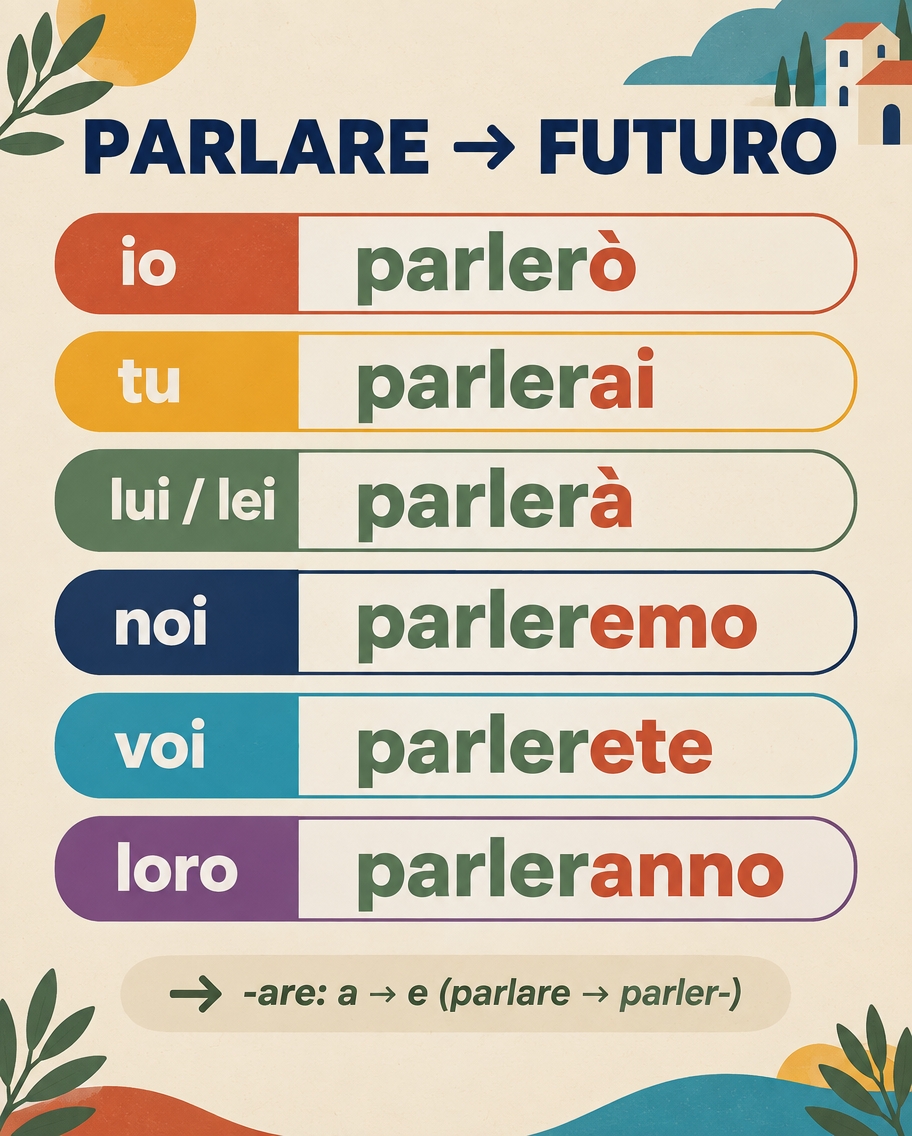
Good news: the Italian future (futuro semplice) uses a single set of endings for all three verb families. Take the infinitive, drop the final -e, and add: -erò, -erai, -erà, -eremo, -erete, -eranno. Credere becomes crederò, partire becomes partirò.
There is one small adjustment for -are verbs: the -a- of the infinitive becomes -e-. So parlare gives parlerò, not parlarò. Once you know that, the pattern is identical everywhere: io parlerò, tu parlerai, lui/lei parlerà, noi parleremo, voi parlerete, loro parleranno. Notice the stress always falls on the ending — that accent mark is the sound of the future.
Two tiny spelling rules keep the pronunciation intact. Verbs in -care and -gare add an h, because c and g would otherwise soften before e: dimenticare → dimenticherò, pagare → pagherò.
Verbs in -ciare and -giare do the opposite: they drop the i, which is no longer needed: cominciare → comincerò, mangiare → mangerò. The sound stays the same; only the spelling adjusts.
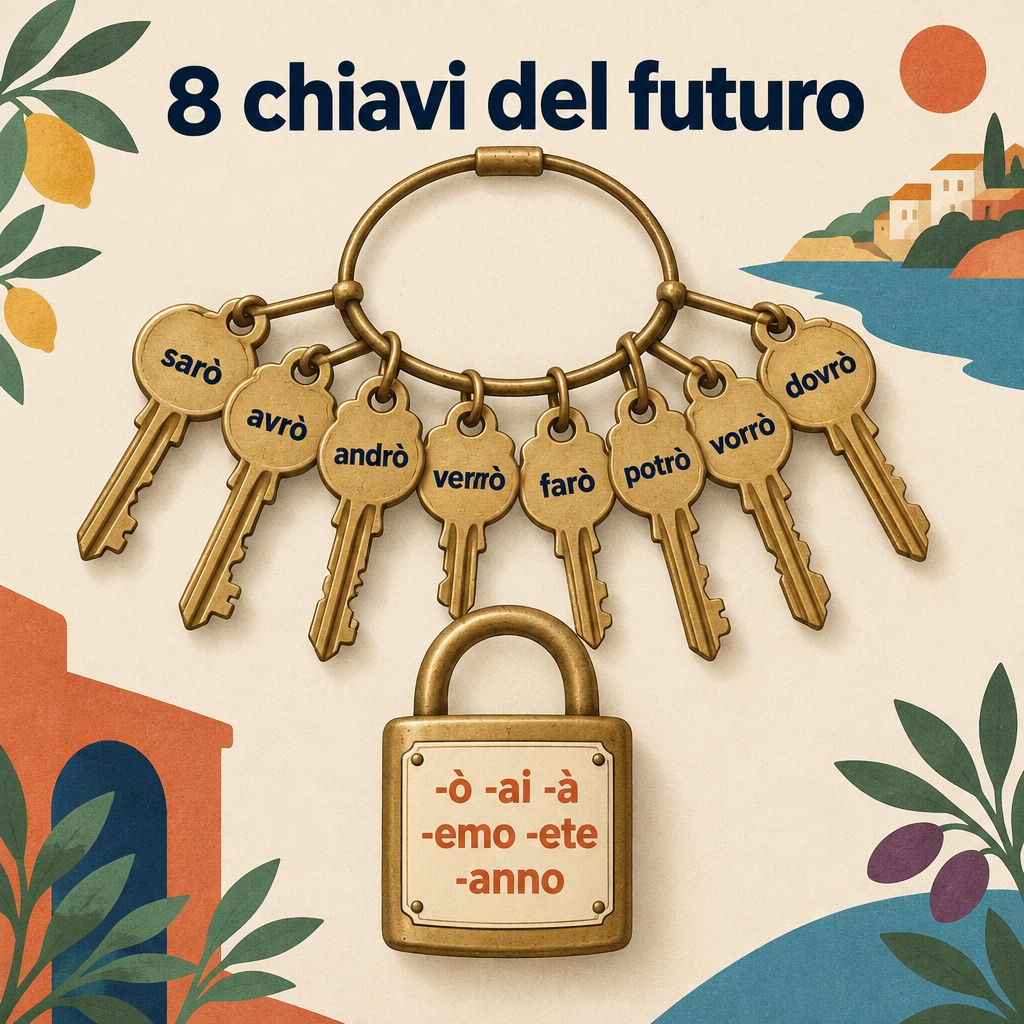
Eight high-frequency verbs change their stem in the future, but they keep the same six endings. Essere → sarò, avere → avrò, andare → andrò, venire → verrò, fare → farò, potere → potrò, volere → vorrò, dovere → dovrò.
These verbs appear constantly in everyday plans, so learn the io form first and the rest follows: andrò, andrai, andrà, andremo, andrete, andranno. The endings never change — only the stem does.
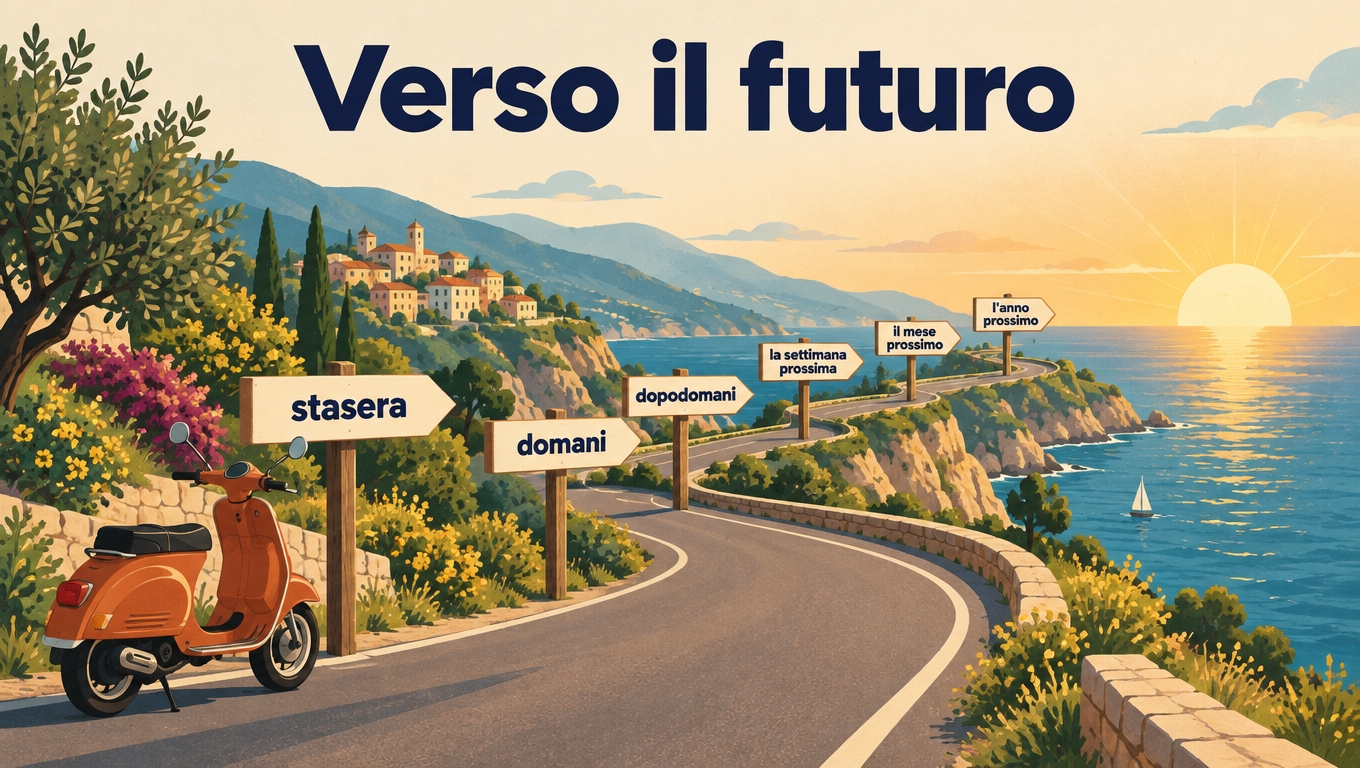
Future sentences love time markers: domani (tomorrow), dopodomani (the day after tomorrow), stasera (this evening), presto (soon), la settimana prossima (next week), il mese prossimo (next month), l'anno prossimo (next year). Prossimo agrees with the noun: prossima with settimana, prossimo with mese and anno.
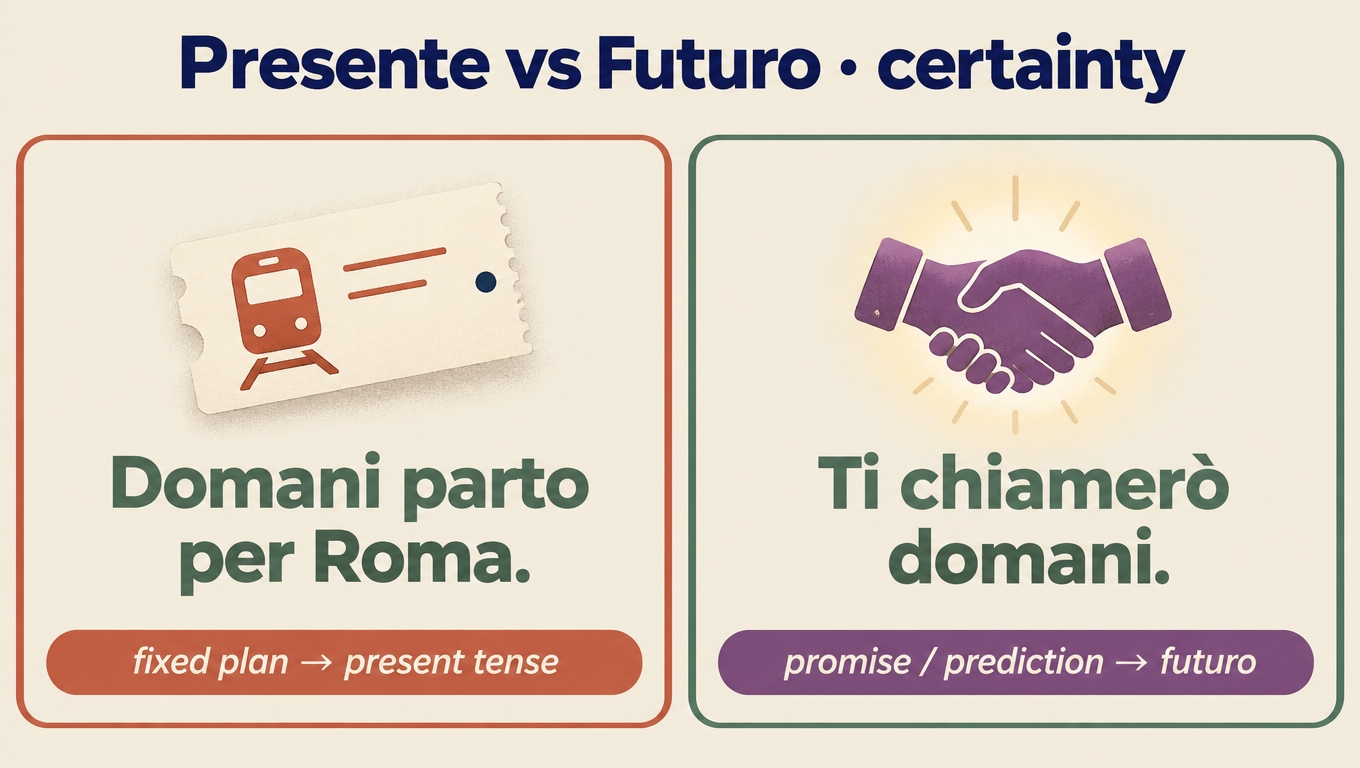
Here is the native secret: for fixed, near-certain plans Italians very often use the present tense — Domani parto alle otto (I leave at eight tomorrow). Reach for the true future when you promise (Ti aiuterò io), predict (Domani farà caldo) or simply want to sound clear and deliberate. Both are correct; the present sounds more settled, the future more open or emphatic.
| Form | parlare | credere | partire |
|---|---|---|---|
| io | parlerò | crederò | partirò |
| tu | parlerai | crederai | partirai |
| lui / lei | parlerà | crederà | partirà |
| noi | parleremo | crederemo | partiremo |
| voi | parlerete | crederete | partirete |
| loro | parleranno | crederanno | partiranno |
One set of endings for all verbs: -erò, -erai, -erà, -eremo, -erete, -eranno. Only -are verbs change -a- to -e-: parlare → parlerò.
| Form | dimenticare | pagare | cominciare |
|---|---|---|---|
| io | dimenticherò | pagherò | comincerò |
| tu | dimenticherai | pagherai | comincerai |
| lui / lei | dimenticherà | pagherà | comincerà |
| loro | dimenticheranno | pagheranno | cominceranno |
-care and -gare add h to keep the hard sound (dimenticherò, pagherò); -ciare and -giare drop the i (comincerò, mangerò).
| Form | essere | avere | andare | fare |
|---|---|---|---|---|
| io | sarò | avrò | andrò | farò |
| tu | sarai | avrai | andrai | farai |
| lui / lei | sarà | avrà | andrà | farà |
| noi | saremo | avremo | andremo | faremo |
| voi | sarete | avrete | andrete | farete |
| loro | saranno | avranno | andranno | faranno |
Same endings, new stems. Also: venire → verrò, potere → potrò, volere → vorrò, dovere → dovrò.
| Italian | English | Pronunciation | Audio |
|---|---|---|---|
| dimenticare | to forget | /dimenˈtikare/ dee-mehn-tee-KAH-reh | Listen in Italian: Slow in Italian: dimenticare |
| pagare | to pay | /paˈɡare/ pah-GAH-reh | Listen in Italian: Slow in Italian: pagare |
| cominciare | to begin, to start | /koˈmintʃare/ koh-meen-CHAH-reh | Listen in Italian: Slow in Italian: cominciare |
| prenotare | to book, to reserve | /prenoˈtare/ preh-noh-TAH-reh | Listen in Italian: Slow in Italian: prenotare |
| partire | to leave, to depart | /parˈtire/ par-TEE-reh | Listen in Italian: Slow in Italian: partire |
| tornare | to return, to come back | /torˈnare/ tor-NAH-reh | Listen in Italian: Slow in Italian: tornare |
| organizzare | to organise | /orɡanidˈdzare/ or-gah-need-DZAH-reh | Listen in Italian: Slow in Italian: organizzare |
| promettere | to promise | /proˈmettere/ proh-MEHT-teh-reh | Listen in Italian: Slow in Italian: promettere |
| decidere | to decide | /deˈtʃidere/ deh-CHEE-deh-reh | Listen in Italian: Slow in Italian: decidere |
| incontrare | to meet | /inkonˈtrare/ een-kohn-TRAH-reh | Listen in Italian: Slow in Italian: incontrare |
| visitare | to visit | /viziˈtare/ vee-zee-TAH-reh | Listen in Italian: Slow in Italian: visitare |
| cambiare | to change | /kamˈbjare/ kahm-BYAH-reh | Listen in Italian: Slow in Italian: cambiare |
| il futuro | the future | /il fuˈturo/ eel foo-TOO-roh | Listen in Italian: Slow in Italian: il futuro |
| il piano | the plan | /il ˈpjano/ eel PYAH-noh | Listen in Italian: Slow in Italian: il piano |
| il viaggio | the journey, the trip | /il ˈvjaddʒo/ eel VYAHD-joh | Listen in Italian: Slow in Italian: il viaggio |
| la promessa | the promise | /la proˈmessa/ lah proh-MEHS-sah | Listen in Italian: Slow in Italian: la promessa |
| la prenotazione | the booking, the reservation | /la prenotatˈtsjone/ lah preh-noh-tah-TSYOH-neh | Listen in Italian: Slow in Italian: la prenotazione |
| il biglietto | the ticket | /il biʎˈʎetto/ eel bee-LYEHT-toh | Listen in Italian: Slow in Italian: il biglietto |
| l'albergo | the hotel | /l alˈbɛrɡo/ lahl-BEHR-goh | Listen in Italian: Slow in Italian: l'albergo |
| la riunione | the meeting | /la riˈnjone/ lah ree-oo-NYOH-neh | Listen in Italian: Slow in Italian: la riunione |
| domani | tomorrow | /doˈmani/ doh-MAH-nee | Listen in Italian: Slow in Italian: domani |
| dopodomani | the day after tomorrow | /dopoˈdomani/ doh-poh-doh-MAH-nee | Listen in Italian: Slow in Italian: dopodomani |
| stasera | this evening, tonight | /staˈsera/ stah-SEH-rah | Listen in Italian: Slow in Italian: stasera |
| presto | early, soon | /ˈprɛsto/ PREH-stoh | Listen in Italian: Slow in Italian: presto |
| prossimo | next | /ˈprɔssimo/ PROHS-see-moh | Listen in Italian: Slow in Italian: prossimo |
| insieme | together | /inˈsjɛme/ een-SYEH-meh | Listen in Italian: Slow in Italian: insieme |
Cosa fai domani?
What are you doing tomorrow?
IPA /ˈkɔza ˈfai doˈmani/
Say it KOH-zah FYE doh-MAH-nee
Present tense for a settled plan — very natural in Italian.
Domani lavoro da casa.
Tomorrow I am working from home.
IPA /doˈmani laˈvoro da ˈkaza/
Say it doh-MAH-nee lah-VOH-roh dah KAH-zah
Another near-certain plan in the present tense.
Domani partirò per Roma.
Tomorrow I will leave for Rome.
IPA /doˈmani partiˈrɔ per ˈroma/
Say it doh-MAH-nee par-tee-ROH pehr ROH-mah
The true future: partire → partirò.
La settimana prossima visiteremo Firenze.
Next week we will visit Florence.
IPA /la settiˈmana ˈprɔssima visiteˈrɛmo fiˈrɛntse/
Say it lah seht-tee-MAH-nah PROHS-see-mah vee-see-teh-REH-moh fee-REHN-tseh
Prossima agrees with la settimana.
L'anno prossimo andrò in Italia.
Next year I will go to Italy.
IPA /ˈlanno ˈprɔssimo anˈdrɔ in iˈtalja/
Say it LAHN-noh PROHS-see-moh ahn-DROH een ee-TAH-lyah
Andare has an irregular stem: andrò.
Ti aiuterò io.
I will help you.
IPA /ti ajuteˈrɔ ˈio/
Say it tee ah-yoo-teh-ROH EE-oh
Io at the end adds emphasis: I will be the one to help.
Non dimenticherò il tuo compleanno.
I will not forget your birthday.
IPA /non dimentikeˈrɔ il ˈtuo kompleˈanno/
Say it nohn dee-mehn-tee-keh-ROH eel TOO-oh kohm-pleh-AHN-noh
-care verbs add h in the future: dimenticherò.
Ti prometto che ti scriverò.
I promise I will write to you.
IPA /ti proˈmetto ke ti skriveˈrɔ/
Say it tee proh-MEHT-toh keh tee skree-veh-ROH
Promettere + che + future: the classic promise pattern.
Vedrai, andrà tutto bene.
You will see, everything will be fine.
IPA /veˈdrai anˈdra ˈtutto ˈbɛne/
Say it veh-DRYE ahn-DRAH TOOT-toh BEH-neh
A very common way to reassure someone.
Domani farà caldo.
It will be hot tomorrow.
IPA /doˈmani faˈra ˈkaldo/
Say it doh-MAH-nee fah-RAH KAHL-doh
Fare for weather, as in fa caldo — here in the future.
Ci vedremo presto.
We will see each other soon.
IPA /tʃi veˈdrɛmo ˈprɛsto/
Say it chee veh-DREH-moh PREH-stoh
Vedersi in the future keeps the reflexive ci.
Quando comincerà il film?
When will the film start?
IPA /ˈkwando komintʃeˈra il ˈfilm/
Say it KWAHN-doh koh-meen-cheh-RAH eel FEELM
Cominciare drops the i: comincerà.
Ci incontreremo davanti all'albergo.
We will meet in front of the hotel.
IPA /tʃi inkontreˈremo daˈvanti alˈlalbɛrɡo/
Say it chee een-kohn-treh-REH-moh dah-VAHN-tee ahl-lahl-BEHR-goh
Davanti a + il becomes davanti all' before a vowel.
Prenoterò due biglietti stasera.
I will book two tickets this evening.
IPA /prenoteˈrɔ ˈdue biʎˈʎetti staˈsera/
Say it preh-noh-teh-ROH DOO-eh bee-LYEHT-tee stah-SEH-rah
La riunione comincerà alle nove.
The meeting will start at nine.
IPA /la riˈnjone komintʃeˈra ˈalle ˈnɔve/
Say it lah ree-oo-NYOH-neh koh-meen-cheh-RAH AHL-leh NOH-veh
Potrò venire alla festa.
I will be able to come to the party.
IPA /poˈtrɔ veˈnire ˈalla ˈfɛsta/
Say it poh-TROH veh-NEE-reh AHL-lah FEH-stah
Potere → potrò + infinitive.
Dovrò lavorare sabato.
I will have to work on Saturday.
IPA /doˈvrɔ lavoˈrare ˈsabato/
Say it doh-VROH lah-voh-RAH-reh SAH-bah-toh
Dovere → dovrò + infinitive.
Sarà una bella giornata.
It will be a lovely day.
IPA /saˈra ˈuna ˈbɛlla dʒorˈnata/
Say it sah-RAH OO-nah BEHL-lah jor-NAH-tah
Essere → sarà, the lui/lei form.
A che ora ci vediamo domani?
What time shall we meet tomorrow?
IPA /a ke ˈora tʃi veˈdjamo doˈmani/
Say it ah keh OH-rah chee veh-DYAH-moh doh-MAH-nee
Ci vediamo in the present arranges the meeting.
Fra una settimana saremo al mare.
In a week we will be at the seaside.
IPA /fra ˈuna settiˈmana saˈremo al ˈmare/
Say it frah OO-nah seht-tee-MAH-nah sah-REH-moh ahl MAH-reh
Fra (or tra) + time means in that amount of time.
Il treno arriverà alle dieci.
The train will arrive at ten.
IPA /il ˈtreno arriveˈra ˈalle ˈdjɛtʃi/
Say it eel TREH-noh ar-ree-veh-RAH AHL-leh DYEH-chee
Common in announcements about timetables.
Pagherò io stasera.
I will pay tonight.
IPA /paɡeˈrɔ ˈio staˈsera/
Say it pah-geh-ROH EE-oh stah-SEH-rah
-gare verbs add h: pagherò.
Tornerò presto.
I will be back soon.
IPA /torneˈrɔ ˈprɛsto/
Say it tor-neh-ROH PREH-stoh
Dopodomani avremo i risultati.
The day after tomorrow we will have the results.
IPA /dopoˈdomani aˈvrɛmo i rizulˈtati/
Say it doh-poh-doh-MAH-nee ah-VREH-moh ee ree-zool-TAH-tee
Avere → avremo.
Le telefonerò domani.
I will phone you tomorrow.
IPA /le telefoneˈrɔ doˈmani/
Say it leh teh-leh-foh-neh-ROH doh-MAH-nee
Le (capital L) is the formal to you — useful with clients.
Giulia and Marco plan a weekend trip over a coffee on Thursday afternoon.
Cosa facciamo il prossimo fine settimana?
What shall we do next weekend?
Listen in Italian: Slow in Italian: Cosa facciamo il prossimo fine settimana?Andremo a Firenze! Ho già prenotato l'albergo.
We will go to Florence! I have already booked the hotel.
Listen in Italian: Slow in Italian: Andremo a Firenze! Ho già prenotato l'albergo.Fantastico! Quando partiremo?
Fantastic! When will we leave?
Listen in Italian: Slow in Italian: Fantastico! Quando partiremo?Partiremo venerdì sera e torneremo domenica.
We will leave on Friday evening and come back on Sunday.
Listen in Italian: Slow in Italian: Partiremo venerdì sera e torneremo domenica.E cosa visiteremo?
And what will we visit?
Listen in Italian: Slow in Italian: E cosa visiteremo?Sabato visiteremo gli Uffizi e mangeremo bene.
On Saturday we will visit the Uffizi and eat well.
Listen in Italian: Slow in Italian: Sabato visiteremo gli Uffizi e mangeremo bene.E domenica?
And on Sunday?
Listen in Italian: Slow in Italian: E domenica?Domenica ci riposeremo. Sarà un bel viaggio!
On Sunday we will rest. It will be a lovely trip!
Listen in Italian: Slow in Italian: Domenica ci riposeremo. Sarà un bel viaggio!Elena and Davide, two colleagues, finalise tomorrow's arrangements at the office.
Elena, hai un minuto?
Elena, have you got a minute?
Listen in Italian: Slow in Italian: Elena, hai un minuto?Sì, dimmi.
Yes, tell me.
Listen in Italian: Slow in Italian: Sì, dimmi.Domani ci sarà la riunione con i clienti. Potrai venire?
Tomorrow there will be the meeting with the clients. Will you be able to come?
Listen in Italian: Slow in Italian: Domani ci sarà la riunione con i clienti. Potrai venire?Sì, ci sarò. A che ora comincerà?
Yes, I will be there. What time will it start?
Listen in Italian: Slow in Italian: Sì, ci sarò. A che ora comincerà?Alle dieci. Non dimenticare i documenti!
At ten. Don't forget the documents!
Listen in Italian: Slow in Italian: Alle dieci. Non dimenticare i documenti!Non li dimenticherò, promesso!
I will not forget them, promise!
Listen in Italian: Slow in Italian: Non li dimenticherò, promesso!Bene. Dopo la riunione organizzeremo il prossimo progetto.
Good. After the meeting we will organise the next project.
Listen in Italian: Slow in Italian: Bene. Dopo la riunione organizzeremo il prossimo progetto.Perfetto. Ci vediamo domani!
Perfect. See you tomorrow!
Listen in Italian: Slow in Italian: Perfetto. Ci vediamo domani!Choose the correct future form.
Choose the correct future form.
Choose the correct future form.
Choose the correct future form.
Choose the correct future form.
Write the correct future form.
Write the correct future form.
Write the correct future form.
Write the correct future form.
Write the correct future form.
Write the correct future form.
Fill the gap with the correct future form.
Fill the gap with the correct noun.
Fill the gap with the correct future form.
Translate into Italian (a promise to a friend).
Translate into Italian.
Translate into Italian (informal you).
Translate into Italian.
Translate into English.
Translate into English.
Tap the words in the correct order.
Tap the words in the correct order.
Tap an infinitive, then tap its future form.
True or false?
True or false?
Play the audio, then type exactly what you hear.
Play the audio, then choose the matching sentence.
Rewrite the sentence in the futuro semplice.
Choose the correct article.
Say the sentence aloud, then show the meaning and rate yourself.
Say each sentence aloud three times: once slowly, once at normal speed, once from memory. Then change the time marker or the verb and say your own version.
Before you move on, make sure you can do all of this without looking:
Go deeper: Present tense · Modal verbs · essere · avere · fare