Lesson 15 of 16

Polite Italian and Real-Life Problem Solving

Ask politely and fix problems in Italian: vorrei, mi piacerebbe and potrebbe, formal and informal requests, and the survival patterns you need in restaurants, hotels, stations, airports and pharmacies.

⏱ About 55 minutes 28 phrases 32 exercises

What you will learn

  • Use vorrei, mi piacerebbe and potrei to ask for things politely
  • Make formal requests with the pattern Potrebbe + infinitive
  • Choose the right imperative: scusami or mi scusi, dimmi or mi dica
  • Order food and drink politely in a restaurant
  • Report a simple problem with Non funziona and C'è un problema con
  • Understand common replies in hotels, stations and shops

Quick review

Say these aloud before you start. They come from earlier lessons.

  • Quanto costa? How much does it cost? Listen in Italian: Slow in Italian: Quanto costa?
  • C'è un bagno qui? Is there a bathroom here? Listen in Italian: Slow in Italian: C'è un bagno qui?
  • Si può pagare con la carta? Can you pay by card? Listen in Italian: Slow in Italian: Si può pagare con la carta?
  • Voglio un caffè. I want a coffee. Listen in Italian: Slow in Italian: Voglio un caffè.
  • Mi dica, per favore. Tell me, please. (formal) Listen in Italian: Slow in Italian: Mi dica, per favore.
  • Dimmi dov'è la stazione. Tell me where the station is. (informal) Listen in Italian: Slow in Italian: Dimmi dov'è la stazione.

Theory

Vorrei, potrei, dovrei: the polite conditional

The conditional is the tense of politeness. It uses the same stem as the future (Lesson 14) plus the endings -ei, -esti, -ebbe, -emmo, -este, -ebbero. So volere becomes vorrei (I would like), potere becomes potrei (I could) and dovere becomes dovrei (I should).

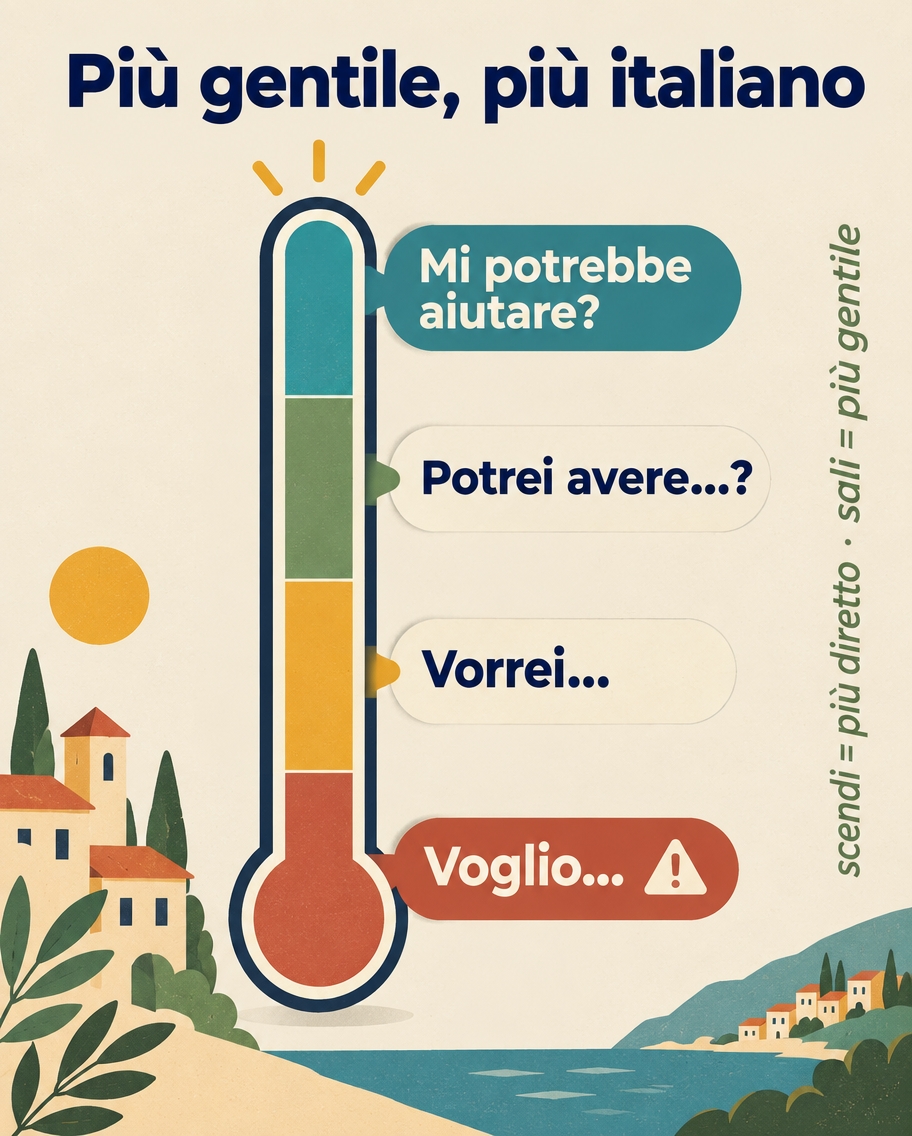
One change transforms how people hear you. Voglio un caffè (I want a coffee) can sound demanding with strangers; Vorrei un caffè is warm and polite. Use vorrei whenever you order, book or ask for something, and add per favore to finish the job.

  • Vorrei un caffè, per favore. I would like a coffee, please. Listen in Italian: Slow in Italian: Vorrei un caffè, per favore.
  • Potrei pagare con la carta? Could I pay by card? Listen in Italian: Slow in Italian: Potrei pagare con la carta?
  • Dovrei prenotare il treno. I should book the train. Listen in Italian: Slow in Italian: Dovrei prenotare il treno.
Politeness thermometer from the blunt voglio up through vorrei and potrei avere to mi potrebbe aiutare?
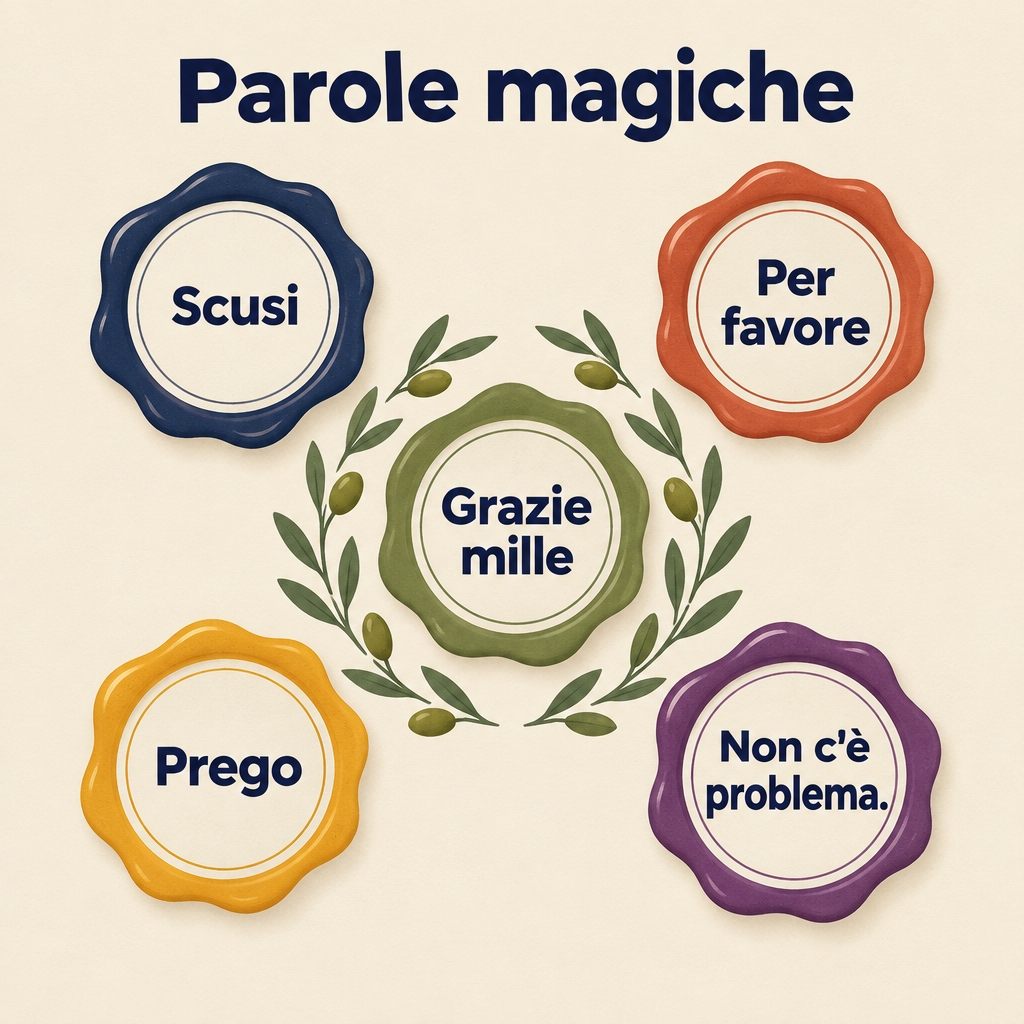
Five wax seals with the magic words scusi, per favore, grazie mille, prego and non c'è problema.

Mi piacerebbe: how to say what you would love

Piacere works backwards from English: the thing you like is the subject, so the verb agrees with it, not with you. Mi piace Roma means literally Rome is pleasing to me.

In the conditional this gives you a gentle way to talk about wishes: mi piacerebbe + infinitive means I would like to... Use mi piacerebbero when the thing is plural: mi piacerebbero due biglietti (I would like two tickets). To ask a friend, say ti piacerebbe...?

  • Mi piacerebbe visitare il centro storico. I would like to visit the historic centre. Listen in Italian: Slow in Italian: Mi piacerebbe visitare il centro storico.
  • Ti piacerebbe un caffè? Would you like a coffee? Listen in Italian: Slow in Italian: Ti piacerebbe un caffè?
  • Mi piacerebbero due biglietti per Roma. I would like two tickets to Rome. Listen in Italian: Slow in Italian: Mi piacerebbero due biglietti per Roma.

Two ways to ask: tu and Lei

With strangers, in shops and at reception desks, Italian uses the formal Lei — grammatically the third person. Potrebbe aiutarmi? (Could you help me?) is the most useful formal question you will ever learn: potrebbe plus any infinitive, with mi attached to the end of that infinitive. Informally, to a friend: Potresti aiutarmi?

Imperatives follow the same split. To a friend: scusami (excuse me), dimmi (tell me), dammi (give me) — the pronoun glues itself to the end. To a stranger: mi scusi, mi dica, mi dia — the pronoun comes before the verb. Same meaning, different door.

  • Potrebbe ripetere, per favore? Could you repeat that, please? Listen in Italian: Slow in Italian: Potrebbe ripetere, per favore?
  • Mi scusi, dov'è il binario sei? Excuse me, where is platform six? Listen in Italian: Slow in Italian: Mi scusi, dov'è il binario sei?
  • Scusami, sono in ritardo. Sorry, I am late. Listen in Italian: Slow in Italian: Scusami, sono in ritardo.
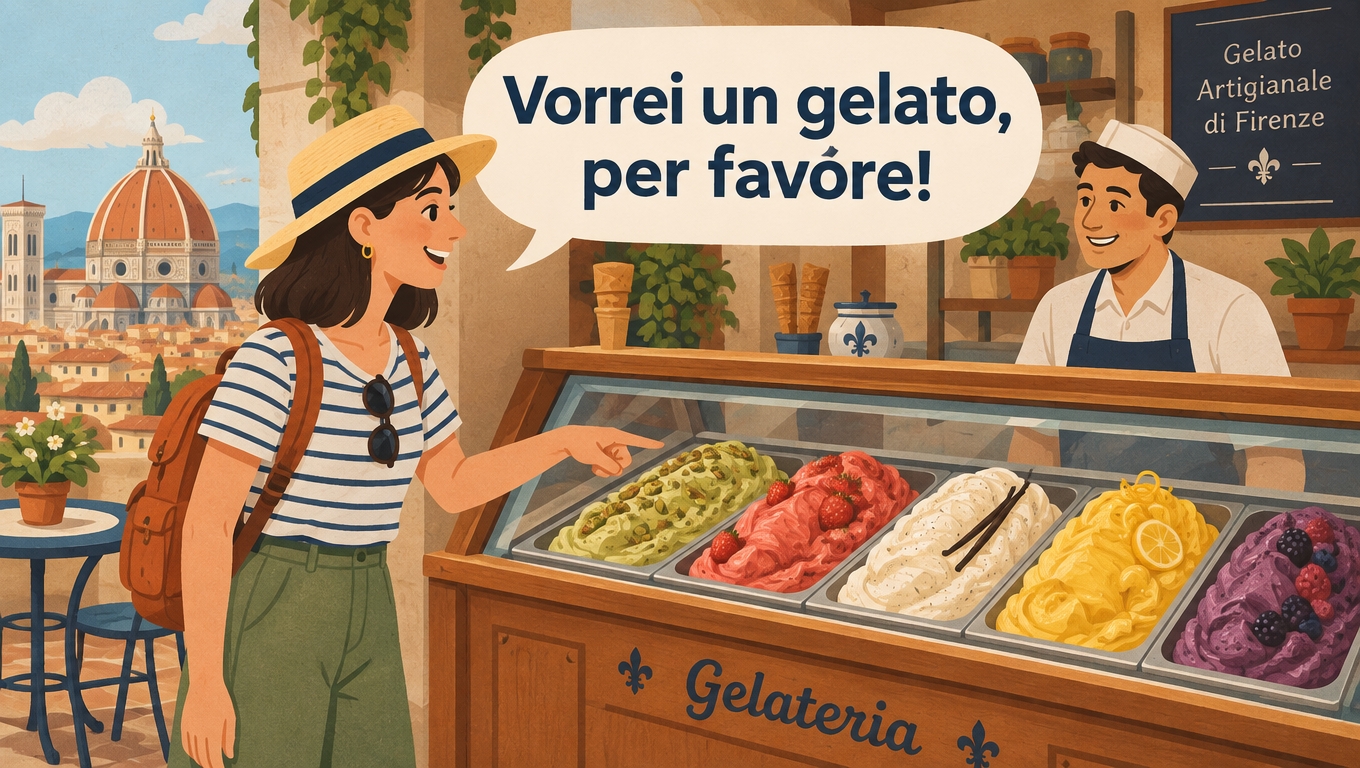
A tourist asking at a Florentine gelateria: Vorrei un gelato, per favore!

When something goes wrong

Two patterns solve most everyday problems. First: Non funziona + the thing, for anything that does not work — remember the verb agrees, so non funzionano le luci for plurals. Second: C'è un problema con + the thing, for everything else.

Then say what you need with vorrei or mi serve (I need), and listen for the common replies: Subito (right away), Mi dispiace (I am sorry), Un momento (one moment). Calm, polite and clear wins every time.

  • Non funziona la doccia. The shower is not working. Listen in Italian: Slow in Italian: Non funziona la doccia.
  • C'è un problema con la prenotazione. There is a problem with the booking. Listen in Italian: Slow in Italian: C'è un problema con la prenotazione.
  • Non ho ordinato questo. I did not order this. Listen in Italian: Slow in Italian: Non ho ordinato questo.
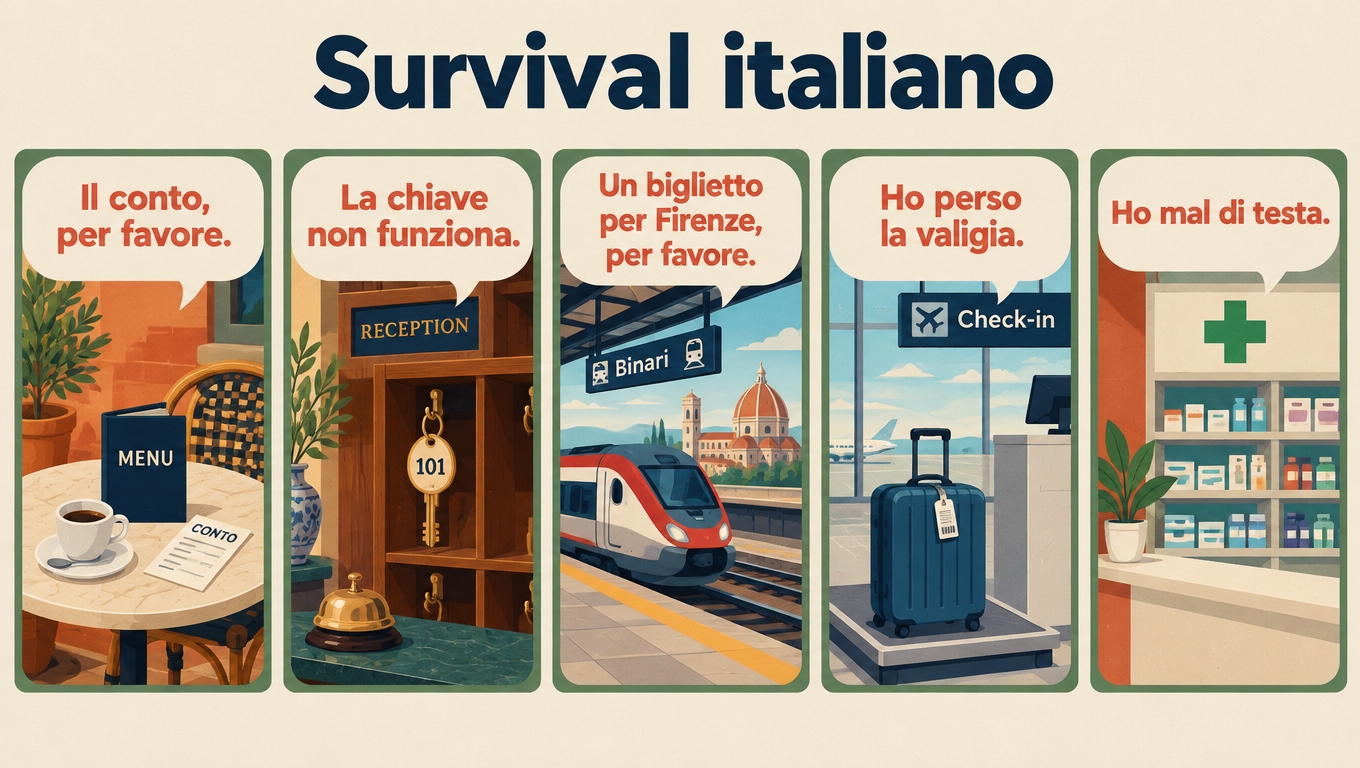
Five survival panels: il conto, per favore; la chiave non funziona; un biglietto per Firenze; ho perso la valigia; ho mal di testa.
The polite conditional: volere, potere, dovere
Form volere (to want) potere (can) dovere (must)
io vorrei potrei dovrei
tu vorresti potresti dovresti
lui / lei / Lei vorrebbe potrebbe dovrebbe
noi vorremmo potremmo dovremmo
voi vorreste potreste dovreste
loro vorrebbero potrebbero dovrebbero

Future stem + -ei, -esti, -ebbe, -emmo, -este, -ebbero. Vorrei is the polite replacement for voglio; potrebbe is the formal could you.

piacere in the conditional: what you would like
Form one thing / an action plural things
a me mi piacerebbe mi piacerebbero
a te ti piacerebbe ti piacerebbero
a Lei (formal) Le piacerebbe Le piacerebbero
a noi ci piacerebbe ci piacerebbero

The thing liked is the subject: mi piacerebbe un caffè, but mi piacerebbero due biglietti.

Getting attention: tu and Lei imperatives
Form informal (tu) formal (Lei)
scusare (to excuse) scusami mi scusi
dire (to tell) dimmi mi dica
dare (to give) dammi mi dia
aiutare (to help) aiutami mi aiuti

With tu the pronoun attaches to the end of the verb; with Lei it stands before the verb. Choose the column before you speak.

Vocabulary

Italian English Pronunciation Audio
volere to want /voˈlere/ voh-LEH-reh Listen in Italian: Slow in Italian: volere
potere to be able to, can, may /poˈtere/ poh-TEH-reh Listen in Italian: Slow in Italian: potere
dovere to have to, must /doˈvere/ doh-VEH-reh Listen in Italian: Slow in Italian: dovere
il piacere pleasure; nice to meet you /pjaˈtʃere/ pyah-CHEH-reh Listen in Italian: Slow in Italian: il piacere
aiutare to help /ajuˈtare/ ah-yoo-TAH-reh Listen in Italian: Slow in Italian: aiutare
prenotare to book, to reserve /prenoˈtare/ preh-noh-TAH-reh Listen in Italian: Slow in Italian: prenotare
ordinare to order (food and drink) /ordiˈnare/ or-dee-NAH-reh Listen in Italian: Slow in Italian: ordinare
funzionare to work, to function /funtsjoˈnare/ foon-tsyoh-NAH-reh Listen in Italian: Slow in Italian: funzionare
pagare to pay /paˈɡare/ pah-GAH-reh Listen in Italian: Slow in Italian: pagare
cambiare to change /kamˈbjare/ kahm-BYAH-reh Listen in Italian: Slow in Italian: cambiare
la stazione the station /la statˈtsjone/ lah staht-TSYOH-neh Listen in Italian: Slow in Italian: la stazione
il biglietto the ticket /il biʎˈʎetto/ eel bee-LYEHT-toh Listen in Italian: Slow in Italian: il biglietto
il binario the platform /il biˈnarjo/ eel bee-NAH-ryoh Listen in Italian: Slow in Italian: il binario
l'albergo the hotel /l alˈbɛrɡo/ lahl-BEHR-goh Listen in Italian: Slow in Italian: l'albergo
la camera the room /la ˈkamera/ lah KAH-meh-rah Listen in Italian: Slow in Italian: la camera
la chiave key /ˈkjave/ KYAH-veh Listen in Italian: Slow in Italian: la chiave
la farmacia the pharmacy /la farmaˈtʃia/ lah far-mah-CHEE-ah Listen in Italian: Slow in Italian: la farmacia
la medicina the medicine /la mediˈtʃina/ lah meh-dee-CHEE-nah Listen in Italian: Slow in Italian: la medicina
il conto the bill /il ˈkonto/ eel KOHN-toh Listen in Italian: Slow in Italian: il conto
il menù the menu /il meˈnu/ eel meh-NOO Listen in Italian: Slow in Italian: il menù
il problema the problem /il proˈblema/ eel proh-BLEH-mah Listen in Italian: Slow in Italian: il problema
l'aeroporto the airport /laeroˈpɔrto/ lah-eh-roh-POR-toh Listen in Italian: Slow in Italian: l'aeroporto
il volo the flight /il ˈvolo/ eel VOH-loh Listen in Italian: Slow in Italian: il volo
la valigia the suitcase /la vaˈlidʒa/ lah vah-LEE-jah Listen in Italian: Slow in Italian: la valigia
il resto the change (money) /il ˈrɛsto/ eel REH-stoh Listen in Italian: Slow in Italian: il resto
l'aiuto help /laˈjuto/ lah-YOO-toh Listen in Italian: Slow in Italian: l'aiuto
subito straight away, immediately /ˈsubito/ SOO-bee-toh Listen in Italian: Slow in Italian: subito
purtroppo unfortunately /purˈtrɔppo/ poor-TROHP-poh Listen in Italian: Slow in Italian: purtroppo
gentile kind, polite /dʒenˈtile/ jehn-TEE-leh Listen in Italian: Slow in Italian: gentile
rotto broken /ˈrɔtto/ ROHT-toh Listen in Italian: Slow in Italian: rotto

Ready-to-use phrases

Vorrei un caffè, per favore.

I would like a coffee, please.

IPA /vorˈrɛi un kafˈfɛ per faˈvore/

Say it vor-RAY oon kaf-FEH pehr fah-VOH-reh

The polite way to order — always better than voglio with strangers.

polite restaurant courtesy
Listen in Italian: Slow in Italian: Vorrei un caffè, per favore.

Vorrei prenotare un tavolo per due persone.

I would like to book a table for two people.

IPA /vorˈrɛi prenoˈtare un ˈtavolo per ˈdue perˈsone/

Say it vor-RAY preh-noh-TAH-reh oon TAH-voh-loh pehr DOO-eh pehr-SOH-neh

Vorrei + infinitive works for any request.

restaurant restaurant booking
Listen in Italian: Slow in Italian: Vorrei prenotare un tavolo per due persone.

Mi piacerebbe visitare il centro storico.

I would like to visit the historic centre.

IPA /mi pjatʃeˈrɛbbe vizitaˈre il ˈtʃentro ˈstɔriko/

Say it mee pyah-cheh-REHB-beh vee-zee-TAH-reh eel CHEN-troh STOH-ree-koh

Mi piacerebbe + infinitive expresses a wish.

polite travel wishes
Listen in Italian: Slow in Italian: Mi piacerebbe visitare il centro storico.

Potrebbe aiutarmi, per favore?

Could you help me, please?

IPA /poˈtrebbe ajuˈtarmi per faˈvore/

Say it poh-TREHB-beh ah-yoo-TAR-mee pehr fah-VOH-reh

Potrebbe + infinitive + mi is the key formal request pattern.

formal requests help
Listen in Italian: Slow in Italian: Potrebbe aiutarmi, per favore?

Potrebbe ripetere, per favore?

Could you repeat that, please?

IPA /poˈtrebbe riˈpetere per faˈvore/

Say it poh-TREHB-beh ree-PEH-teh-reh pehr fah-VOH-reh

A lifesaver when you do not catch something.

formal requests communication
Listen in Italian: Slow in Italian: Potrebbe ripetere, per favore?

Potrebbe parlare più lentamente?

Could you speak more slowly?

IPA /poˈtrebbe parˈlare pju lentaˈmente/

Say it poh-TREHB-beh par-LAH-reh pyoo lehn-tah-MEHN-teh

Più lentamente — more slowly.

formal requests communication
Listen in Italian: Slow in Italian: Potrebbe parlare più lentamente?

Potrei avere il menù, per favore?

Could I have the menu, please?

IPA /poˈtrɛi aˈvere il meˈnu per faˈvore/

Say it poh-TRAY ah-VEH-reh eel meh-NOO pehr fah-VOH-reh

Potrei is the io form of potere in the conditional.

restaurant restaurant requests
Listen in Italian: Slow in Italian: Potrei avere il menù, per favore?

Potrei pagare con la carta?

Could I pay by card?

IPA /poˈtrɛi paˈɡare kon la ˈkarta/

Say it poh-TRAY pah-GAH-reh kohn lah KAR-tah

La carta here means the payment card.

polite shopping money
Listen in Italian: Slow in Italian: Potrei pagare con la carta?

Dovrei confermare la prenotazione.

I should confirm the booking.

IPA /doˈvrɛi konferˈmare la prenotatsiˈone/

Say it doh-VRAY kohn-fehr-MAH-reh lah preh-noh-tah-TSYOH-neh

Dovrei is the conditional of dovere: should.

neutral travel hotel
Listen in Italian: Slow in Italian: Dovrei confermare la prenotazione.

Mi scusi, dov'è il bagno?

Excuse me, where is the bathroom?

IPA /mi ˈskuzi doˈvɛ il ˈbaɲɲo/

Say it mee SKOO-zee doh-VEH eel BAH-nyoh

Formal imperative of scusare — use with strangers.

formal courtesy questions
Listen in Italian: Slow in Italian: Mi scusi, dov'è il bagno?

Scusami, ho perso il treno.

Sorry, I have missed the train.

IPA /skuˈzami o ˈperso il ˈtreno/

Say it skoo-ZAH-mee oh PEHR-soh eel TREH-noh

Informal — the pronoun attaches to the end.

informal courtesy travel
Listen in Italian: Slow in Italian: Scusami, ho perso il treno.

Mi dica.

Tell me. (How can I help you?)

IPA /mi ˈdika/

Say it mee DEE-kah

You will hear this constantly from waiters and receptionists — it invites you to speak.

formal courtesy service
Listen in Italian: Slow in Italian: Mi dica.

Dimmi pure.

Go ahead, tell me.

IPA /ˈdimmi ˈpure/

Say it DEEM-mee POO-reh

Pure adds a friendly go ahead.

informal courtesy conversation
Listen in Italian: Slow in Italian: Dimmi pure.

Non funziona la doccia.

The shower is not working.

IPA /non funˈtsjona la ˈdɔttʃa/

Say it nohn foon-TSYOH-nah lah DOHT-chah

The core pattern for anything broken: non funziona + noun.

neutral problems hotel
Listen in Italian: Slow in Italian: Non funziona la doccia.

C'è un problema con la camera.

There is a problem with the room.

IPA /tʃɛ um proˈblema kon la ˈkamera/

Say it cheh oon proh-BLEH-mah kohn lah KAH-meh-rah

C'è un problema con + noun covers every other problem.

neutral problems hotel
Listen in Italian: Slow in Italian: C'è un problema con la camera.

La chiave non funziona.

The key does not work.

IPA /la ˈkjave non funˈtsjona/

Say it lah KYAH-veh nohn foon-TSYOH-nah

The subject can come first: la chiave non funziona.

neutral problems hotel
Listen in Italian: Slow in Italian: La chiave non funziona.

Vorrei cambiare camera, per favore.

I would like to change rooms, please.

IPA /vorˈrɛi kamˈbjare ˈkamera per faˈvore/

Say it vor-RAY kahm-BYAH-reh KAH-meh-rah pehr fah-VOH-reh

Cambiare + noun: to change something.

polite hotel requests
Listen in Italian: Slow in Italian: Vorrei cambiare camera, per favore.

Vorrei un biglietto per Milano, per favore.

I would like a ticket to Milan, please.

IPA /vorˈrɛi um biʎˈʎetto per miˈlano per faˈvore/

Say it vor-RAY oon bee-LYEHT-toh pehr mee-LAH-noh pehr fah-VOH-reh

Per + city for the destination.

travel station tickets
Listen in Italian: Slow in Italian: Vorrei un biglietto per Milano, per favore.

Da quale binario parte il treno?

Which platform does the train leave from?

IPA /da ˈkwale biˈnarjo ˈparte il ˈtreno/

Say it dah KWAH-leh bee-NAH-ryoh PAR-teh eel TREH-noh

Partire da: to leave from.

travel station questions
Listen in Italian: Slow in Italian: Da quale binario parte il treno?

Il volo è in ritardo.

The flight is delayed.

IPA /il ˈvolo ɛ in riˈtardo/

Say it eel VOH-loh eh een ree-TAR-doh

In ritardo — late, delayed. A reply you will often hear.

travel airport problems
Listen in Italian: Slow in Italian: Il volo è in ritardo.

Ho perso la valigia.

I have lost my suitcase.

IPA /o ˈperso la vaˈlidʒa/

Say it oh PEHR-soh lah vah-LEE-jah

Ho perso — I have lost. Add il passaporto if needed.

emergency airport problems
Listen in Italian: Slow in Italian: Ho perso la valigia.

Mi serve qualcosa per il mal di testa.

I need something for a headache.

IPA /mi ˈsɛrve kwalˈkɔza per il ˈmal di ˈtɛsta/

Say it mee SEHR-veh kwahl-KOH-zah pehr eel MAHL dee TEH-stah

Mi serve — I need. Very useful in shops and pharmacies.

neutral pharmacy health
Listen in Italian: Slow in Italian: Mi serve qualcosa per il mal di testa.

Ha qualcosa per il raffreddore?

Do you have something for a cold?

IPA /a kwalˈkɔza per il raffredˈdore/

Say it ah kwahl-KOH-zah pehr eel rahf-frehd-DOH-reh

Formal ha. Informally: Hai qualcosa per...?

formal pharmacy health
Listen in Italian: Slow in Italian: Ha qualcosa per il raffreddore?

Posso provarlo?

Can I try it on?

IPA /ˈpɔsso proˈvarlo/

Say it POHS-soh proh-VAR-loh

Lo attaches to the infinitive: provare + lo. For a feminine item: provarla.

polite shopping clothes
Listen in Italian: Slow in Italian: Posso provarlo?

Non ho ordinato questo.

I did not order this.

IPA /non o ordiˈnato ˈkwesto/

Say it nohn oh or-dee-NAH-toh KWEH-stoh

Calm and clear — staff will fix it immediately.

restaurant restaurant problems
Listen in Italian: Slow in Italian: Non ho ordinato questo.

Il conto, per favore.

The bill, please.

IPA /il ˈkonto per faˈvore/

Say it eel KOHN-toh pehr fah-VOH-reh

In Italy you usually have to ask for the bill.

restaurant restaurant money
Listen in Italian: Slow in Italian: Il conto, per favore.

Mi ha dato il resto sbagliato.

You have given me the wrong change.

IPA /mi a ˈdato il ˈrɛsto zbaʎˈʎato/

Say it mee ah DAH-toh eel REH-stoh zbah-LYAH-toh

Formal ha. Sbagliato — wrong, mistaken.

formal shopping problems
Listen in Italian: Slow in Italian: Mi ha dato il resto sbagliato.

Subito, signora!

Right away, madam!

IPA /ˈsubito siɲˈɲora/

Say it SOO-bee-toh see-NYOH-rah

A reply you will hear constantly — it means your request was understood.

polite replies service
Listen in Italian: Slow in Italian: Subito, signora!

Dialogues

A table for two

Emma arrives at a small trattoria in Florence and speaks with the waiter, Giulio.

  1. Giulio

    Buonasera! Mi dica.

    Good evening! How can I help you?

    Listen in Italian: Slow in Italian: Buonasera! Mi dica.
  2. Emma

    Buonasera. Vorrei un tavolo per due, per favore.

    Good evening. I would like a table for two, please.

    Listen in Italian: Slow in Italian: Buonasera. Vorrei un tavolo per due, per favore.
  3. Giulio

    Certo, prego. Ecco il menù.

    Of course, this way. Here is the menu.

    Listen in Italian: Slow in Italian: Certo, prego. Ecco il menù.
  4. Emma

    Grazie. Potrei avere anche un bicchiere d'acqua?

    Thank you. Could I also have a glass of water?

    Listen in Italian: Slow in Italian: Grazie. Potrei avere anche un bicchiere d'acqua?
  5. Giulio

    Subito, signora.

    Right away, madam.

    Listen in Italian: Slow in Italian: Subito, signora.
  6. Emma

    Mi scusi, non ho ordinato questo.

    Excuse me, I did not order this.

    Listen in Italian: Slow in Italian: Mi scusi, non ho ordinato questo.
  7. Giulio

    Ah, mi dispiace! C'è stato un errore. Arrivo subito.

    Oh, I am sorry! There has been a mistake. Coming right away.

    Listen in Italian: Slow in Italian: Ah, mi dispiace! C'è stato un errore. Arrivo subito.
  8. Emma

    Nessun problema, grazie.

    No problem, thank you.

    Listen in Italian: Slow in Italian: Nessun problema, grazie.

The shower does not work

Sophie goes down to reception at her hotel in Bologna and speaks with Paolo.

  1. Sophie

    Mi scusi, c'è un problema con la mia camera.

    Excuse me, there is a problem with my room.

    Listen in Italian: Slow in Italian: Mi scusi, c'è un problema con la mia camera.
  2. Paolo

    Mi dica pure, signora.

    Please, go ahead and tell me, madam.

    Listen in Italian: Slow in Italian: Mi dica pure, signora.
  3. Sophie

    Non funziona la doccia e la chiave non apre la porta.

    The shower is not working and the key does not open the door.

    Listen in Italian: Slow in Italian: Non funziona la doccia e la chiave non apre la porta.
  4. Paolo

    Mi dispiace molto. Potrebbe darmi la chiave, per favore?

    I am very sorry. Could you give me the key, please?

    Listen in Italian: Slow in Italian: Mi dispiace molto. Potrebbe darmi la chiave, per favore?
  5. Sophie

    Ecco, grazie. Vorrei cambiare camera, se possibile.

    Here you are, thank you. I would like to change rooms, if possible.

    Listen in Italian: Slow in Italian: Ecco, grazie. Vorrei cambiare camera, se possibile.
  6. Paolo

    Certo. La camera dodici è libera.

    Of course. Room twelve is free.

    Listen in Italian: Slow in Italian: Certo. La camera dodici è libera.
  7. Sophie

    Perfetto, grazie mille.

    Perfect, thank you very much.

    Listen in Italian: Slow in Italian: Perfetto, grazie mille.
  8. Paolo

    Prego. Ecco la nuova chiave.

    You are welcome. Here is the new key.

    Listen in Italian: Slow in Italian: Prego. Ecco la nuova chiave.

At the ticket office

James buys a train ticket at the station in Turin.

  1. James

    Buongiorno. Vorrei un biglietto per Roma, per favore.

    Good morning. I would like a ticket to Rome, please.

    Listen in Italian: Slow in Italian: Buongiorno. Vorrei un biglietto per Roma, per favore.
  2. Impiegata

    Andata e ritorno?

    Single or return?

    Listen in Italian: Slow in Italian: Andata e ritorno?
  3. James

    Solo andata. Quanto costa?

    Just a single. How much is it?

    Listen in Italian: Slow in Italian: Solo andata. Quanto costa?
  4. Impiegata

    Trentadue euro.

    Thirty-two euros.

    Listen in Italian: Slow in Italian: Trentadue euro.
  5. James

    Potrei pagare con la carta?

    Could I pay by card?

    Listen in Italian: Slow in Italian: Potrei pagare con la carta?
  6. Impiegata

    Certo. Il treno parte dal binario sei.

    Of course. The train leaves from platform six.

    Listen in Italian: Slow in Italian: Certo. Il treno parte dal binario sei.
  7. James

    Mi scusi, da quale binario parte? Non ho capito.

    Sorry, which platform does it leave from? I did not understand.

    Listen in Italian: Slow in Italian: Mi scusi, da quale binario parte? Non ho capito.
  8. Impiegata

    Dal binario sei. Il treno delle dieci e venti.

    From platform six. The 10.20 train.

    Listen in Italian: Slow in Italian: Dal binario sei. Il treno delle dieci e venti.

Exercises

Multiple Choice Exercise 1

Choose the polite way to order.

___ un caffè, per favore.
Multiple Choice Exercise 2

Choose the correct formal request.

___ aiutarmi, per favore?
Multiple Choice Exercise 3

Choose the correct form of piacere.

Mi ___ visitare Venezia. (I would like to visit Venice.)
Multiple Choice Exercise 4

Choose the formal way to say excuse me.

___, signora! Dov'è la stazione?
Conjugation Exercise 5

Write the correct form.

volere — io (conditional)
Conjugation Exercise 6

Write the correct form.

potere — Lei, formal you (conditional)
Conjugation Exercise 7

Write the correct form.

dovere — io (conditional)
Fill Gap Exercise 8

Fill the gap with the polite form of volere.

___ prenotare un tavolo per due. (I would like)
Fill Gap Exercise 9

Fill the gap with the correct form.

Non ___ il riscaldamento. (funzionare)
Fill Gap Exercise 10

Fill the gap with the correct preposition.

C'è un problema ___ la camera. (with)
Translate To Italian Exercise 11

Translate into Italian.

Could you help me, please? (formal)
Translate To Italian Exercise 12

Translate into Italian.

I would like a ticket to Rome.
Translate To Italian Exercise 13

Translate into Italian.

The key does not work.
Translate To Italian Exercise 14

Translate into Italian.

Excuse me, where is the station? (formal)
Translate To Italian Exercise 15

Translate into Italian.

I did not order this.
Translate To English Exercise 16

Translate into English.

Mi piacerebbe visitare il centro storico.
Translate To English Exercise 17

Translate into English.

C'è un problema con la prenotazione.
Translate To English Exercise 18

Translate into English.

Dovrei confermare il volo.
Word Order Exercise 19

Tap the words in the correct order.

Build the sentence: I would like a coffee, please.
Word Order Exercise 20

Tap the words in the correct order.

Build the question: Could you help me, please? (formal)
Match Pairs Exercise 21

Tap a formal phrase, then tap the informal equivalent.

Match each formal imperative to its informal twin.
Match Pairs Exercise 22

Tap a sentence, then tap its place.

Match each problem to the place where you would say it.
Listen And Type Exercise 23

Play the audio, then type exactly what you hear.

Listen and write the Italian sentence.
Listen And Choose Exercise 24

Play the audio, then choose what the speaker is asking for.

Listen. What does the speaker want?
Article Choice Exercise 25

Choose the correct article.

___ stazione è qui vicino.
Article Choice Exercise 26

Choose the correct article.

___ albergo è in centro.
Pronoun Choice Exercise 27

Choose the correct pronoun.

___ piacerebbe un caffè. (I would like a coffee.)
Sentence Transform Exercise 28

Rewrite the sentence using the conditional.

Make it polite: Voglio un caffè.
Sentence Transform Exercise 29

Rewrite for a stranger you address as Lei.

Make it formal: Scusami, sono in ritardo.
True False Exercise 30

True or false?

Voglio un caffè is the most polite way to order in a bar.
True False Exercise 31

True or false?

Mi dica is used with people you address as Lei.
Flashcard Self Rating Exercise 32

Say the sentence aloud, then show the meaning and rate yourself.

Potrebbe aiutarmi, per favore?

Speak now

Say each sentence aloud three times: once slowly, once at normal speed, once from memory. Then change the noun or the place and say your own version.

  • Vorrei un tavolo per due, per favore. I would like a table for two, please. Listen in Italian: Slow in Italian: Vorrei un tavolo per due, per favore.
  • Potrebbe aiutarmi? Non funziona la chiave. Could you help me? The key does not work. Listen in Italian: Slow in Italian: Potrebbe aiutarmi? Non funziona la chiave.
  • Mi piacerebbe visitare Firenze domani. I would like to visit Florence tomorrow. Listen in Italian: Slow in Italian: Mi piacerebbe visitare Firenze domani.
  • Mi scusi, c'è un problema con il conto. Excuse me, there is a problem with the bill. Listen in Italian: Slow in Italian: Mi scusi, c'è un problema con il conto.
  • Scusami, posso usare il tuo telefono? Sorry, can I use your phone? Listen in Italian: Slow in Italian: Scusami, posso usare il tuo telefono?

Lesson checkpoint

Before you move on, make sure you can do all of this without looking:

  1. Order food and drink politely with vorrei
  2. Ask for help formally with Potrebbe + infinitive
  3. Choose correctly between scusami and mi scusi, dimmi and mi dica
  4. Report a problem with Non funziona and C'è un problema con
  5. Say what you would like to do with mi piacerebbe + infinitive

Remember this

  • Vorrei (I would like) is the polite form of voglio — use it whenever you order, book or ask.
  • Potrebbe + infinitive means could you...? and solves any formal request: Potrebbe aiutarmi?
  • Mi piacerebbe + infinitive expresses a wish; the verb agrees with the thing liked: mi piacerebbero due biglietti.
  • Formal imperatives put mi first: mi scusi, mi dica, mi dia. Informal imperatives glue it on: scusami, dimmi, dammi.
  • Report problems with Non funziona + noun and C'è un problema con + noun — then say what you need with vorrei or mi serve.

Go deeper: The conditional for politeness · Modal verbs · Questions · Present tense